 TIGERFASTENERS
Fastener terms in Chinese: three that do not mean what they look like
The short version: most of a fastener glossary is uncontroversial, and three entries are not. Those three are where enquiries go wrong — a term that translates cleanly but covers a wider range in one language than the other, a head name that means the opposite of what it sounds like, and a word for tooling that sends the whole conversation to the wrong department. The full table is below. Read the three first.
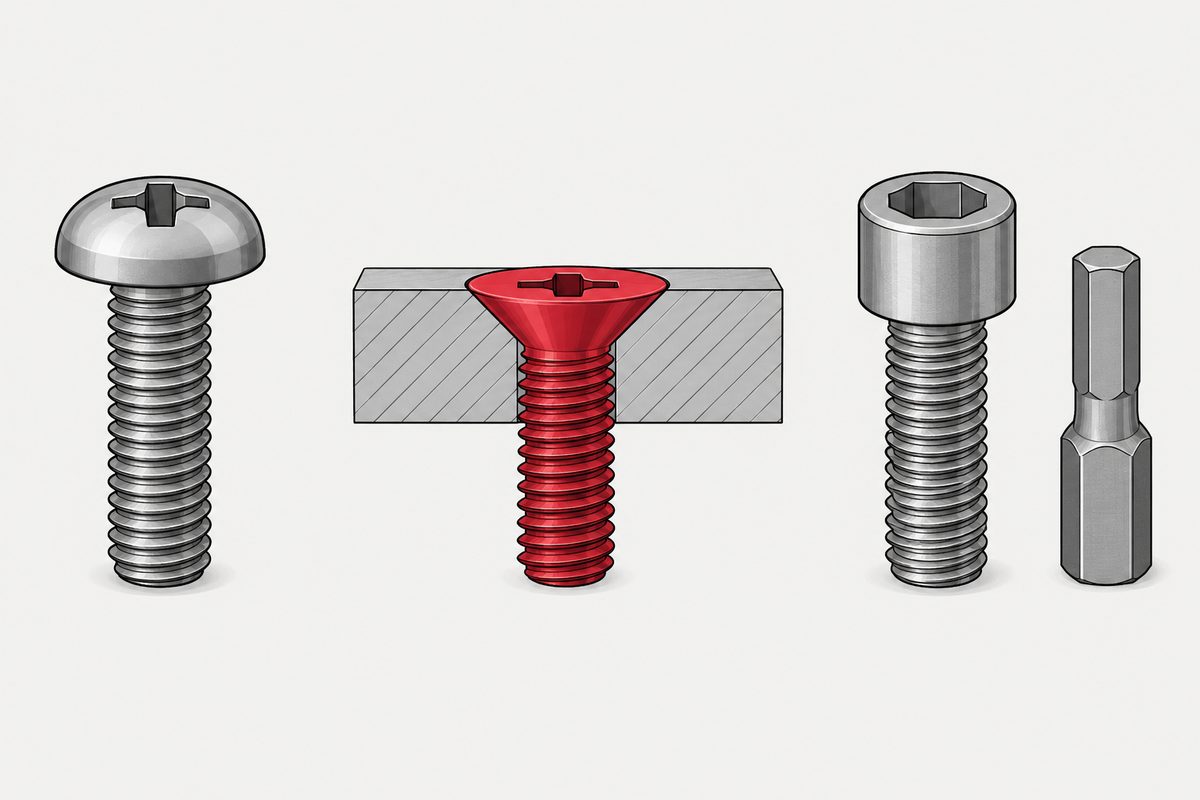
The three that cost time
| Term | What it looks like | What actually happens |
|---|---|---|
| 自攻螺絲 / self-tapping | A clean one-to-one match | English uses “self-tapping” loosely as an umbrella covering thread-cutting and thread-forming. The two behave differently in plastic and in sheet, so an enquiry saying only “self-tapping” can be quoted either way — correctly |
| 皿頭 / flat head | “Flat” sounds like a flat top | In US usage “flat head” means countersunk — a conical head that sits flush. It does not mean a flat-topped head, and it says nothing about the drive. Write “countersunk” and the angle, because 82° and 90° are different parts |
| 模具 / die, not mould | Both are “tooling” | A fastener is cold formed in a die. “Mould” suggests injection moulding, and an enquiry that uses it reads as a plastics enquiry — different lead time, different cost basis, different supplier |
Note what these three have in common: none of them is a translation error. Each word is correct. The failure is that one language draws the boundary in a different place, and nobody notices until the sample arrives.
Product types
| 中文 | English | Distinguishing feature |
|---|---|---|
| 機械牙螺絲 | Machine screw | Goes into an existing thread — makes none. Whether that makes it a screw or a bolt is about the joint |
| 鐵板牙螺絲 | Self-tapping screw | Cuts its thread; produces swarf |
| 三角牙螺絲 | Thread-forming screw | Displaces material; lobed cross-section, no swarf |
| 鑽尾螺絲 | Self-drilling screw | Drills its own hole first — the point must finish before the thread engages |
| 割尾螺絲 | Type-cutting screw | Slotted point acts as a cutting edge |
| 木螺絲 | Wood screw | Coarse pitch, partial thread |
| 乾牆螺絲 | Drywall screw | Bugle head, hardened, brittle by design |
| 組合螺絲 / 華司頭 | SEMS screw | Washer assembled at the factory and captive |
華司 is a loanword for washer; 螺帽 is nut; 螺栓 is bolt and 螺絲 covers screw generally.
Thread and dimensions
| 中文 | English | Watch for |
|---|---|---|
| 牙 | Thread | 攻牙 is tapping; 搓牙 / 輾牙 is thread rolling |
| 牙距 | Pitch | Imperial uses TPI — threads per inch — which is the inverse. “Pitch 20” is ambiguous and dangerous; state the unit |
| 外徑 | Major diameter | The nominal size; a measurement will read slightly under it |
| 有效徑 | Pitch diameter | The dimension that actually decides fit — and the one plating consumes |
| 牙底 / 牙峰 | Root / crest | The root is where fatigue cracks start |
| 引孔 | Pilot hole | A window, not a number |
| 沉孔 | Counterbore or countersink | Ambiguous in Chinese. A cylindrical recess is a counterbore; a conical one is a countersink. Say which, and give the angle if conical |
| 嚙合長度 | Thread engagement | Depth is not engagement |
| 公差 | Tolerance | Class such as 6g / 6H |
Heads, drives and failures
| 中文 | English | Note |
|---|---|---|
| 皿頭 | Countersunk head (US: flat head) | See the warning above |
| 圓頭 / 盤頭 | Pan head | ISO 7045 |
| 圓筒頭 | Cheese head | DIN 84 |
| 六角頭 | Hex head | External drive |
| 十字槽 | Cross recess (Phillips) | JIS looks identical and behaves differently |
| 梅花槽 | Hexalobular (Torx) | Near-parallel flanks — resists cam-out |
| 咬花 | Cam-out | The recess rounds out; the thread is fine |
| 滑牙 | Three different terms | Stripped screw thread, stripped hole, or cam-out — in English these are named separately, and saying which one saves a round trip |
| 斷頭 | Head separation / fracture | If it happens a day after assembly, ask about hydrogen embrittlement |
| 鬆脫 | Loosening | Rotational self-loosening and preload loss are different failures |
Finish, corrosion, process and paperwork
| 中文 | English |
|---|---|
| 電鍍 / 鍍鋅 / 鍍鎳 | Electroplating / zinc plating / nickel plating |
| 熱浸鍍鋅 | Hot-dip galvanizing — not applicable below M6 |
| 染黑 / 發黑 | Black oxide |
| 鈍化 / 酸洗 | Passivation / pickling — different treatments |
| 白鏽 / 紅鏽 | White rust / red rust — name which one on a salt spray requirement |
| 鹽霧試驗 | Salt spray test |
| 氫脆 / 烘烤除氫 | Hydrogen embrittlement / relief bake |
| 打頭 | Cold heading |
| 熱處理 | Heat treatment |
| 牙規 / 通止規 | Thread gauge / go & no-go gauge |
| 材質證明 | Mill test certificate (MTC) |
| 最低訂購量 | MOQ — minimum order quantity |
| 交期 | Lead time |
| 打樣 | Sample run |
The enquiry that does not need a second email
Terminology stops mattering as soon as the enquiry is specific. These six lines make translation almost irrelevant:
- Thread designation with pitch — M2 × 0.4 × 6, not “M2 short”
- Head standard, or the head diameter and height — a standard number beats any adjective
- Drive and, if cross recess, which standard
- Material and finish, with the thickness class — not “zinc plated”, which is a colour
- What it is screwed into — this decides thread type more reliably than the thread type field does
- Annual volume and target lead time
A drawing or a sample outranks all six. Photographs of a sample beside a caliper reading answer more questions than a paragraph of description in either language — and neither party has to be confident in the other’s vocabulary.
And the same head has four names in Chinese
The trap above runs English into Chinese. This one runs the other way, and it catches people sending drawings into Taiwan: a countersunk head has four common Chinese names, and the one the standards use is not the one the trade uses.
| Chinese | Who uses it |
|---|---|
| 埋頭 | Official. The BSMI standards list names cross-recessed countersunk (flat) head screws 「十字穴平頂埋頭螺釘」 |
| 沉頭 | Also standard. CNS 4560 is 「十字槽沉頭螺釘」 |
| 皿頭 | What the trade actually says — the common term in catalogues and on the shop floor |
| 平頭 | Ambiguous. Avoid it alone. It sometimes describes the flat top face of a countersunk head, but in catalogues 「扁平頭」 or 「I 頭」 is a broad head with no conical underside — a different part |
We hit this on our own product pages. Ours is titled 「皿頭(平頭)螺絲」 with a note that an I-head is not a countersunk head, because customers arrive using all four words and one of them means something else.
So write 皿頭(沉頭/埋頭) on a drawing or an enquiry, not 平頭 on its own. If a supplier replies with 平頭, that is worth one message to confirm which of the two they mean — before tooling is cut.
This is not one of the six steps. It shows up across them, or after assembly. Where the decisions that lead here were made is in specifying a screw, which sets out the order and why doing it out of order is rework.
Common questions
Does “self-tapping screw” mean the same thing as 自攻螺絲?
Not exactly, and the gap causes wrong quotations. English uses “self-tapping” loosely as an umbrella covering both thread-cutting and thread-forming screws, which behave differently in plastic and in sheet metal. An enquiry that says only “self-tapping” can be quoted either way, correctly. State whether the screw should cut its thread and produce swarf, or displace material and produce none.
What is 皿頭螺絲 in English?
Countersunk head screw. In US usage it is also called a flat head screw, which is a common source of confusion because it sounds like a flat-topped head — it is not, it is a conical head that sits flush with the surface. The head name says nothing about the drive, and the included angle matters: 82° and 90° are different parts, so state the angle.
What is 牙距 in English, and why is it risky?
Pitch — the distance from one thread crest to the next. The risk is that imperial practice uses TPI, threads per inch, which is the inverse quantity. A number written without a unit, such as “pitch 20”, can be read either way and the two interpretations are nowhere near each other. Always state the unit, or use the full metric designation such as M2 × 0.4.
How do you say 滑牙 in English?
There is no single term, and that is useful rather than awkward: English names the three cases separately. A stripped screw thread, a stripped hole thread, and a cammed-out recess are three different failures with different causes and different parties responsible. Saying which one you have saves a round trip and points the investigation in the right direction.
Should I say mould or die when asking about fastener tooling?
Die. A fastener is cold formed between dies; a mould implies injection moulding, so an enquiry using that word reads as a plastics enquiry with a different lead time, cost basis and supplier type. Heading dies and thread rolling dies are the two that come up most often in fastener quotations.
Enquiries
Sourcing from Taiwan and unsure a term will survive the round trip? Send the drawing or a photograph of a sample next to a caliper reading. We will reply with the designation in full — thread, head standard, drive, material and finish class — so what you approve is a specification rather than a description.
Request a quotation
Tell us the part and the quantity. We will come back on feasibility, lead time and price.
Or email us directly sales@tigerfasteners.com