 TIGERFASTENERS
Machine screw or bolt: the difference is the joint, not the part
The short version: the distinction is not a property of the part. ASME B18.2.1 separates them by how the fastener is intended to be tightened — a bolt is assembled through clearance holes and torqued by a nut; a screw is torqued by its own head into a thread that is already there or that it forms itself. The standard then acknowledges that the same physical part can be used either way. So arguing about the name is unproductive. What is worth arguing about is which side of the joint holds the thread, because that decides where it fails.
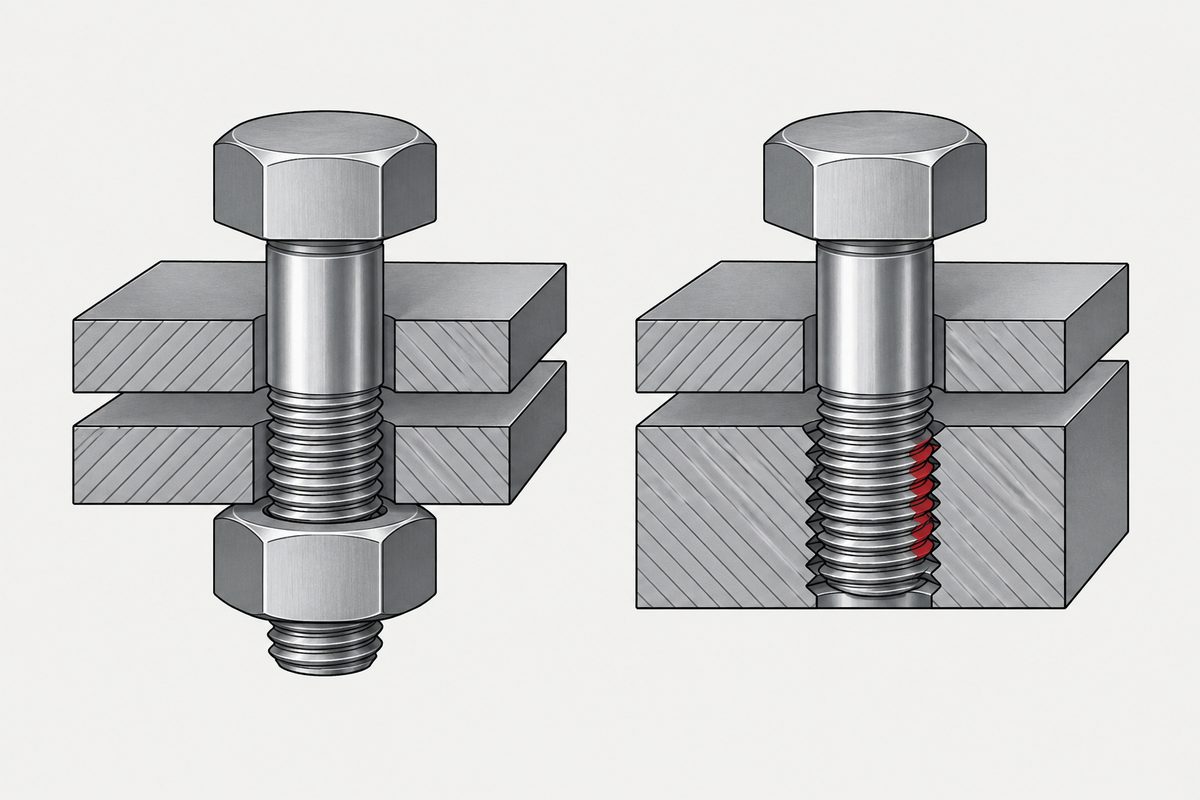
Everyone sorts them by what they look like
Hex head with a nut on the end: bolt. Small, slotted, goes into a threaded hole: screw. That rule is quick, it matches most of what anyone handles, and nobody has ever been misunderstood at a counter for using it.
It also survives because it is usually right. The geometry and the intended use line up in the common cases. They come apart on exactly the parts where the paperwork matters.
So it has a nut, so it is a bolt — and that is not what decides it
| Bolt | Screw | |
|---|---|---|
| Passes through | Clearance holes in the assembled parts | A hole that is threaded, or that it threads itself |
| Tightened by | Torquing the nut | Torquing the head |
| The female thread is | A separate component of known and certified strength | Part of your product, in whatever material that is |
The third row is the whole article. With a nut, the female thread is a purchased item with a property class printed on it. With a screw, the female thread is a hole in your casting, your sheet metal or your plastic boss — and nobody certified that.
Why the naming argument never resolves
- A hex head cap screw looks exactly like a hex bolt, and the difference between the two designations is tolerance and bearing surface, not function
- A part sold as a bolt can be run into a tapped hole, and it will work
- A part sold as a screw can be run through a clearance hole into a nut, and that works too
- Both usages are recognised in practice, which is why no naming rule survives contact with a real bill of materials
So do not specify by name. Specify by designation — thread, length, head standard, drive, material and finish — and the argument disappears, because the designation describes a part while “bolt” describes an intention.
What genuinely changes: where it fails
Swapping between the two arrangements is not a naming change. It moves the weakest link:
- With a nut, the female thread comes with a strength class, and the engagement length is fixed by the nut height. Overload breaks the fastener, which is the failure you want
- With a tapped hole, engagement depends on your part — its material, its depth, its chamfer. Whether the screw or the hole fails is now a design decision you have to make deliberately
- In a soft parent material the ratio can invert entirely, so the housing strips before the screw yields — which costs the housing rather than the screw
- Access changes too. A nut needs a tool on both sides; a tapped hole needs access from one. That single practical fact decides the arrangement more often than any strength calculation
In public recall data the two words do carry different failure profiles. Taking the full openFDA device-recall population (1,973 records), keeping those where a fastener is given as the cause, and splitting on which word the notice used:
Notices saying bolt (108) are 63.9 % breakage;
notices saying screw (346) are 47.1 % (p = 0.003).
The other way round, detached plus missing: screw 29.8 %,
bolt 12.0 % (p = 0.0001).
⚠️ That measures which word the notice used, not an independent classification of the part. Whoever wrote it sorted the part by the same habits described above. So this does not show that bolts break more — but if the two words tracked nothing, a gap that size should not appear.
Below M6 the choice mostly makes itself
- Holding a small nut while driving a small screw is a real assembly problem, and it is why small fasteners overwhelmingly go into tapped holes, formed threads or inserts
- The trade is that the female thread is now your material. That is the same trade discussed for plastics, where the boss is what fails rather than the screw
- “Machine screw” at these sizes means a thread that already exists. If the hole is not tapped, the question is which kind of thread the screw makes on the way in — a different decision entirely
This is why the catalogue splits machine screws from tapping screws and not “screws” from “bolts”. The useful division at this size is where the female thread comes from, and that is a manufacturing question rather than a naming one.
The same argument has a second axis, which this page leaves alone: whether the fastener has an integral head at all. That is what separates a stud from a bolt, and most of the advantages people credit to studs turn out to belong to the tapped hole instead. Most reasons for studs are reasons for tapped holes works through what ASME PCC-1 actually says.
Three lines that settle it on an enquiry
- The full designation — thread, pitch, length, head standard, drive. Not “M4 bolt”
- What the female thread is — a nut of stated class, a tapped hole in a stated material, or no thread at all yet
- Which side has tool access — because that decides the arrangement whatever the name says
The middle line is the one that gets left out, and it is the one that determines whether a quotation is even for the right kind of part. In Chinese the split runs differently again — another reason to send a designation rather than a noun.
There is an ISO vocabulary standard that sets out what these things are called, in six languages. It says three of the six are not ISO terms, and in one place its own official languages do not agree with each other.
This page covers step 1, the substrate. The whole order is substrate, thread, head, drive, finish, documentation, and why doing it out of order is rework rather than a tweak is in specifying a screw.
Common questions
What is the difference between a machine screw and a bolt?
ASME B18.2.1 separates them by how the fastener is intended to be tightened. A bolt is inserted through clearance holes in the assembled parts and is normally tightened by torquing a nut. A screw is inserted into a hole that is already threaded or that it threads itself, and is tightened by torquing its own head. The distinction is about intended use rather than the shape of the part.
Can the same part be both a bolt and a screw?
Yes, and the standards acknowledge it. A part sold as a bolt can be run into a tapped hole, and a part sold as a screw can be run through a clearance hole into a nut. Both usages occur in practice, which is why no naming rule survives contact with a real bill of materials. Specify by designation — thread, length, head standard, drive, material and finish — rather than by the noun.
Does it matter whether I use a nut or a tapped hole?
Yes, because it moves the weakest link. With a nut, the female thread is a purchased component with a stated strength class and an engagement length fixed by the nut height, so overload breaks the fastener — the failure you want. With a tapped hole, the female thread is part of your product, and whether the screw or the hole fails becomes a design decision. In a soft parent material the housing can strip before the screw yields, which costs far more than a screw.
Why are small fasteners rarely used with nuts?
Because holding a small nut while driving a small screw is a genuine assembly problem. Below about M6, fasteners overwhelmingly go into tapped holes, self-formed threads or inserts. The trade is that the female thread is now your material rather than a certified component, which is the same trade that makes plastic bosses rather than screws the usual point of failure.
References
Enquiries
Not sure whether your part should be quoted as a screw into a tapped hole or a bolt with a nut? Send the designation, the material the thread goes into, and which side has tool access. Those three settle it — and the second one is the one enquiries usually leave out.
Request a quotation
Tell us the part and the quantity. We will come back on feasibility, lead time and price.
Or email us directly sales@tigerfasteners.com