 TIGERFASTENERS
Self-tapping, thread-forming or self-drilling: start with the material
The short version: what separates these types is not the head or the material. It is where the female thread comes from — already there, cut, formed, or drilled on the way in. That single question decides whether you get swarf, how wide the torque window is, and whether the joint survives being taken apart — three separate failure modes. Settle the parent material and the state of the hole, and the selection is nearly made.
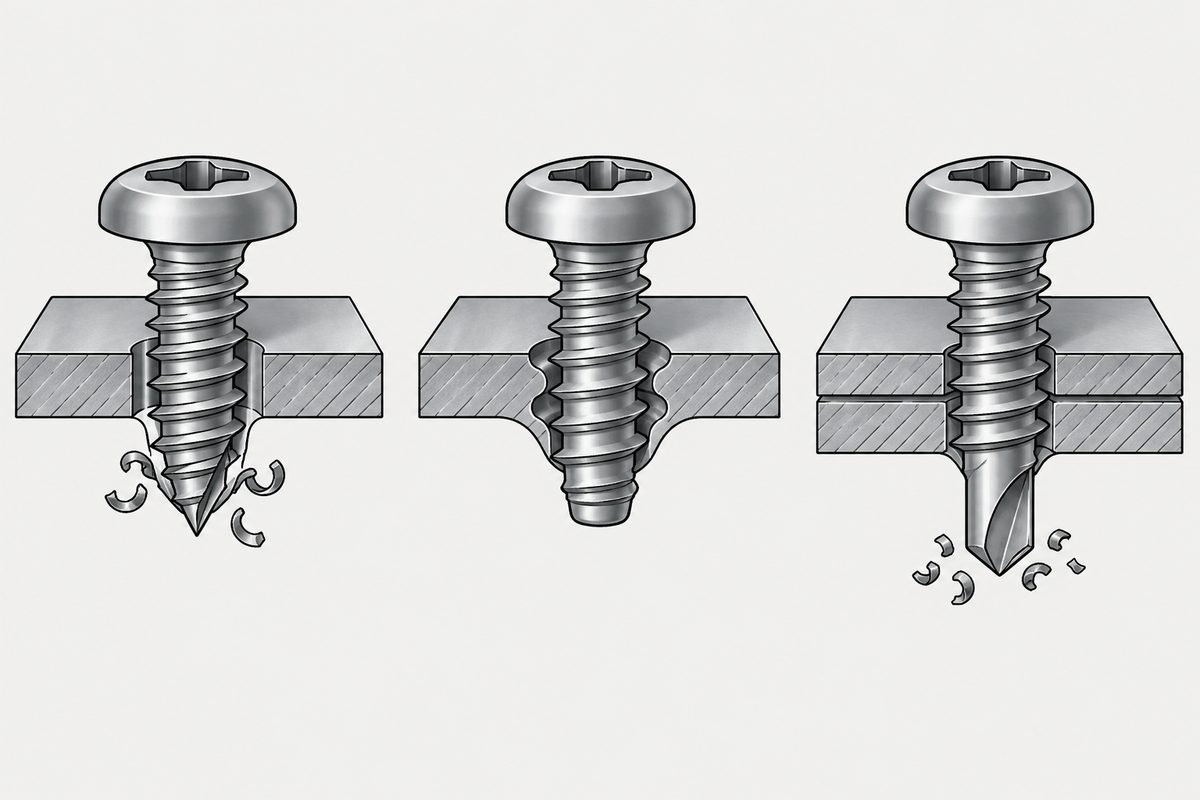
Swarf reads as a cleanliness issue, and it usually is one
Cutting a thread makes chips. They land on the bench, they get blown off, and nobody thinks about them again. Treating that as housekeeping is reasonable because for most of the parts anyone handles, that is all it is.
The line even has a procedure for it, which reinforces the reading: swarf is something you clean up after. In a sealed assembly the chips do not go on the bench.
Four ways in, one distinguishing question
Set the catalogue names aside and ask one thing: when it goes in, where does the female thread come from?
That question is second, not first. What the screw is going into decides which answers are even available, which is why the decisions have a usual order — substrate, thread, head, drive, finish, documentation. If you are choosing a type before you have settled the material it goes into, you are picking from a list that has not been narrowed yet.
| Type | Female thread | Swarf | Precondition |
|---|---|---|---|
| Machine screw | Already exists (nut or tapped hole) | None | Tapping or a nut has to happen first |
| Self-tapping | Cut | Yes | Needs a pilot hole |
| Thread-forming | Formed (plastic flow) | None | Needs a pilot hole, with a narrower window |
| Self-drilling | Cut — and it makes the hole too | Yes | Sheet thickness must suit the drill point |
| Type-cutting | Cut (a slotted end forms the edge) | Yes | Needs a pilot hole; for harder or thicker material |
“Cut” versus “formed” is the column that matters. It sets swarf, driving torque and how the female thread eventually fails — the next three sections all follow from it.
For the forming route into metal specifically, the standards situation and the hole tolerance are covered in thread-forming screws into metal.
The type letters that appear on these screws encode the same two choices — thread series and how the thread is made. See the letters on a tapping screw.
So blow the swarf out afterwards — and by then it is already inside
Cutting types shed metal chips as they go in. On a structural joint that is a cleaning operation. In electronics, optics and precision mechanisms those chips stay inside the assembly — on a lens, in a slide, or providing a path across something energised.
Forming types remove nothing, so there is no swarf. The cost is higher driving torque, and because the thread is made by displacing the parent material, they are far more sensitive to pilot hole size than cutting types — slightly large and there is not enough thread, slightly small and the torque climbs. Sizing that hole has its own page.
Self-drilling assumes the point finishes first
A self-drilling screw folds drilling and tapping into one motion and removes an operation. It carries one precondition that gets skipped: the point has to break through before the thread engages.
- Sheet too thin: the thread bites before the point is through, pushing the sheet away or pulling the hole out of shape
- Too thick or too hard: the point can wear, soften or snap before it gets there
So check the sheet thickness against the range that drill point is designed for. That range moves with point length and style — “self-drillers go through steel sheet” is not a specification.
That range is what a catalogue calls drill capacity, and it is not the same number as the grip range printed beside it.
If it comes apart often, do not rely on a thread made on the way in
With self-tapping and forming screws the female thread is created during the first assembly. Undo it and drive it again and the screw may not follow the original helix; each cycle removes a little more — and eventually it no longer holds.
Where a joint is opened repeatedly, the safer construction is a machine screw into a nut or a tapped hole: that thread is made separately, controlled separately, and can be replaced separately. If a forming or tapping screw has to be used, establish the cycle limit on real samples — it cannot be inferred. Some plastics design guidance actually prefers forming types for limited reinstallation, because the already-formed path is easier to find again — one of several widely repeated claims about these types that turn out not to be what the standard says.
Five questions that make the choice
- What is the parent material? Steel sheet, aluminium, casting, plastic, timber — this halves the options on its own
- Does the hole already exist? Tapped, pilot only, or nothing at all
- Is swarf acceptable? If not, the cutting types are out
- How many times does it come apart? More than a handful and machine screws deserve a look
- How thick is the sheet? Self-drilling depends on this more than the others
Those five answers are more useful to us than a part number — part numbers tend to be carried over from the last project, and the last project may not have had this parent material.
Enquiries
Not sure which type applies? Send the parent material, the thickness and the state of the hole, or a sample of what is fitted now. We will come back with the trade-offs for each type under your conditions, including the ones we would advise against.
Request a quotation
Tell us the part and the quantity. We will come back on feasibility, lead time and price.
Or email us directly sales@tigerfasteners.com