 TIGERFASTENERS
Screws into plastic: the boss fails before the screw does
The short version: in plastic, the screw is almost never what fails. The boss splits, or the joint quietly goes slack. Both come from the same place — a thread is a wedge, and driving one into a plastic boss puts the boss wall into hoop tension. That is why screws designed for plastics use a smaller thread angle than the 60° of a standard metric thread. And the second failure has no visible cause at all: the plastic relaxes around the thread, so a joint that was correct on day one is loose six months later with nothing broken.
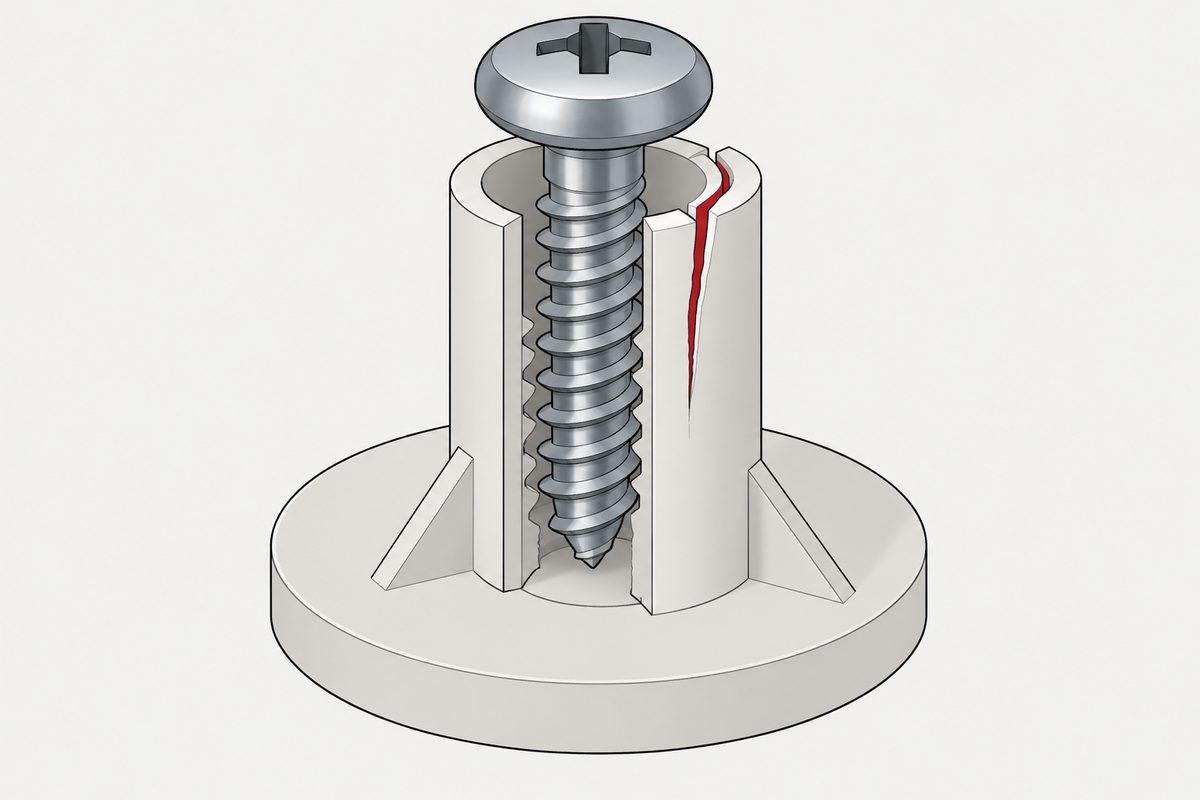
The thread angle is a wedge angle
Driving a thread into a boss forces material outward. The boss wall resists that as hoop tension — a stress that runs around the circumference, and one that plastic is comparatively poor at carrying.
- A standard metric thread has a 60° included angle. That is a relatively blunt wedge, and in a plastic boss it generates more radial force than it needs to
- Screws designed for plastics use a narrower included angle — commonly around 30° — specifically to reduce that radial component
- A coarser pitch is also deliberate. Fewer, deeper threads give more material between them, which matters when the material has low shear strength
- Asymmetric and lobed thread forms exist for the same reason: they displace material with less outward pressure than a symmetric thread of the same depth
So “we used an M3 machine screw thread because that is what we had” is a real design decision, not a neutral one. It puts a blunter wedge into a material chosen for reasons that had nothing to do with hoop strength.
The failure with no visible cause
The second failure mode does not split anything. It is stress relaxation, and it is structural to the material rather than a defect:
- Plastic under sustained load flows. The boss material squeezed by the thread slowly redistributes, and the clamp force falls with it
- Nothing rotates and nothing cracks, so an inspection finds a joint that is simply looser than it was
- Higher clamp force makes it worse, not better. More stress means faster relaxation, which is the opposite of the instinct that a loose joint should be tightened harder
- Temperature accelerates it, so an enclosure that gets warm in service loses preload faster than the bench test suggested
This is the same shape of problem as embedding in metal joints — preload lost without the screw ever rotating — and it has the same consequence: no locking device helps, because nothing is turning. Mark a line across the head and you will see it has not moved.
The boss is the part that needs designing
Most plastic fastening problems are boss problems. The dimensions below are commonly cited starting points, not specifications — they vary substantially between resins, and the resin supplier’s own data sheet outranks any general rule:
- Boss outside diameter is commonly quoted as roughly twice the screw diameter. Too thin and it splits; too thick and it sinks on the moulded face
- Hole diameter for a thread-forming screw is smaller than the screw’s major diameter but larger than its root — and the right way to settle it is by measuring drive and strip torque, not by picking a diameter
- A generous lead-in chamfer at the hole mouth reduces the peak force at the moment the thread starts forming, which is when bosses usually split
- Keep the boss away from a wall or an edge. A boss joined directly to a side wall cannot expand evenly, so the hoop stress concentrates where it is restrained
- Watch where the weld line lands. A knit line running down the boss is exactly where a split will start, and it is a mould gating decision rather than a fastener one
Thread-forming or thread-cutting depends on the resin
| Material | Preferred | Why |
|---|---|---|
| Soft, ductile thermoplastics | Thread-forming | Material displaces cleanly; no swarf, and the displaced material is still carrying load |
| Hard, filled or brittle resins | Thread-cutting | Forming would crack it. Cutting relieves the hoop stress by removing material instead of pushing it |
| Anything opened repeatedly | A metal insert | Every reassembly re-forms the plastic thread, and the material removed does not come back |
Swarf is not a housekeeping issue here. In a sealed electronic enclosure, a curl of cut plastic that falls inside is a contamination problem with no route out — which is a reason to prefer forming even where cutting would work mechanically. It is a risk to control rather than a ban, though, and the type ASME formally lists for plastics is a cutting type — Type BT, the one catalogues call 25.
The torque window is the specification
In metal you can often tighten to a torque and stop thinking. In plastic there are two torques and the useful number is the gap between them:
- Drive torque — what it takes to form the thread and pull the head down
- Strip torque — what it takes to destroy the thread you just formed
- The ratio between them is the process window, and in plastic it can be narrow enough that a hand-set clutch cannot reliably land inside it
Ask for both numbers, measured on your boss in your resin. A supplier quoting a torque value without a strip torque has given you half a specification — and the relationship between torque and clamp force is not fixed anyway.
Plastic expands five to ten times faster than steel, which moves the preload every time the part warms up: temperature moves preload.
Five questions before the mould is cut
- What resin, filled or unfilled? Glass fill changes the answer to every other question here
- How many times will it be opened? More than a handful, and an insert was always the answer — though it moves the failure to the boss rather than removing it
- Does it get warm? Relaxation accelerates with temperature
- Is the boss free-standing or tied to a wall? Restrained bosses concentrate hoop stress
- Has anyone measured drive and strip torque on an actual moulded part? Not a calculation — a measurement
All five are cheap before the mould is cut and expensive afterwards. A boss diameter is a tool change; a screw is a purchase order — which is why the screw usually gets changed to solve a problem that lives in the boss.
This page covers step 1, the substrate. The whole order is substrate, thread, head, drive, finish, documentation, and why doing it out of order is rework rather than a tweak is in specifying a screw.
Common questions
Why do plastic bosses crack when a screw is driven in?
Because a thread is a wedge. Driving it forces material outward and the boss wall carries that as hoop tension, which plastic is comparatively poor at resisting. A standard metric thread has a 60° included angle, a relatively blunt wedge; screws designed for plastics use a narrower angle, commonly around 30°, specifically to reduce the radial component. Coarser pitch and asymmetric or lobed thread forms exist for the same reason.
Why does a screw in plastic feel loose after a few months?
Stress relaxation. Plastic under sustained load flows, so the boss material squeezed by the thread slowly redistributes and the clamp force falls with it. Nothing rotates and nothing cracks, so an inspection finds only a looser joint. Tightening harder makes it worse rather than better, because more stress means faster relaxation, and warmth accelerates it further. No locking device helps, because nothing is turning.
Should you use thread-forming or thread-cutting screws in plastic?
Thread-forming for soft ductile thermoplastics: the material displaces cleanly, there is no swarf, and the displaced material still carries load. Thread-cutting for hard, filled or brittle resins, where forming would crack the boss and cutting relieves hoop stress by removing material instead of pushing it. For a joint opened repeatedly, neither is right — every reassembly re-forms the thread and the material removed does not come back, so a metal insert was always the answer.
What size should the hole in a plastic boss be?
Smaller than the screw major diameter and larger than its root, but the specific figure varies substantially between resins and the resin supplier’s data outranks any general rule. The reliable way to settle it is not to pick a diameter but to measure drive torque and strip torque on an actual moulded part, because the ratio between those two is the real process window.
How thick should a plastic boss wall be?
A commonly cited starting point is an outside diameter of roughly twice the screw diameter, but this is a starting point rather than a specification and varies with resin. Too thin and the boss splits; too thick and it sinks on the moulded surface. Equally important is that the boss should be free-standing rather than tied directly to a side wall, since a restrained boss cannot expand evenly and concentrates hoop stress where it is held.
References
- Technical bulletin — Thread forming screws for plastics (thread angle, boss proportions, drive and strip torque)
- Creep (deformation) — Wikipedia
- ISO 965-1 — ISO general purpose metric screw threads — Tolerances — Part 1 (60° metric thread form, for comparison)
Enquiries
Bosses splitting, or joints going slack in service? Send the resin, the boss dimensions, and the screw currently specified. We will say whether a different thread form solves it — and say plainly when it does not, because the problem is in the boss and no screw will fix it.
Request a quotation
Tell us the part and the quantity. We will come back on feasibility, lead time and price.
Or email us directly sales@tigerfasteners.com