 TIGERFASTENERS
Why screws loosen: two different failures share the word
The short version: “it came loose” covers two failures that share no mechanism. In one, the screw rotated backwards. In the other, the screw never moved and the clamp force disappeared anyway. Thread locker, prevailing-torque nuts and lock washers only address the first one — and split lock washers barely address even that. Before choosing a countermeasure, find out which failure you have. It takes a marker pen and costs nothing.
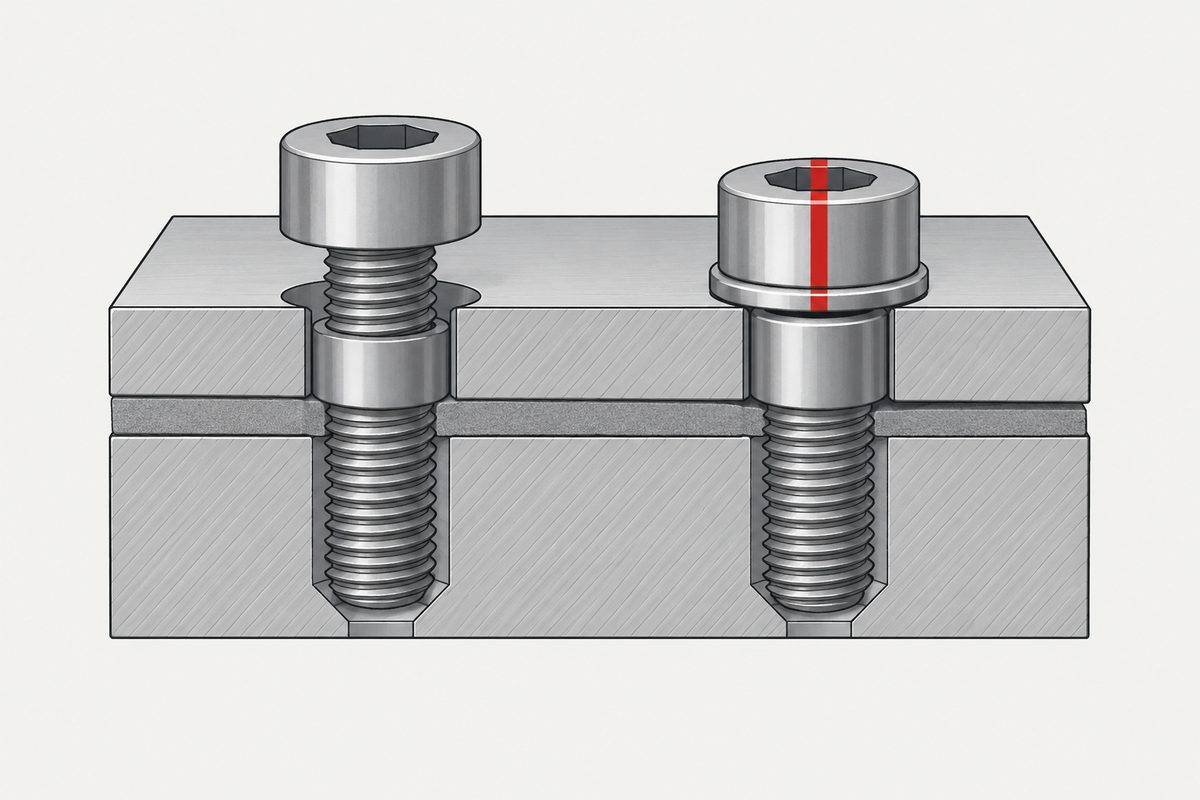
Two failures, one word
| Failure | Did the screw turn? | Driven by |
|---|---|---|
| Rotational self-loosening | Yes — it unwound | Transverse (sideways) movement at the joint faces, not axial pull |
| Preload loss without rotation | No — it is exactly where you left it | Embedding, relaxation, creep, thermal cycling — the joint got shorter |
The second one is invisible to every anti-rotation device ever made. A screw that never turns cannot be stopped from turning. Fitting thread locker to a joint that is losing preload by embedding adds cost, adds a rework problem, and changes nothing — and it is one of the most common wrong fixes in small-fastener assembly.
This shows up in the public recall record. Reading every fastener-caused recall in two US registers, the two disagree about which failure leads: loosening in consumer products (45.8 %), breakage in medical devices (49.3 %).
The free check that tells them apart
Draw a single line across the screw head and onto the part next to it, with a marker, after tightening. Then run the product.
- The two halves of the line no longer align → the screw rotated. You have self-loosening
- The line is still perfectly aligned but the joint is slack → the screw never moved. You have preload loss
- The line is aligned and the joint is still tight, but torque-to-turn has dropped → preload loss in progress, caught early
This check is decisive, costs nothing, and almost nobody does it. Re-torquing before marking destroys the evidence, in exactly the same way that running a bigger screw into a stripped hole destroys the evidence there.
So it unwound — except it almost never unwinds that way
The counterintuitive part of self-loosening is the direction. It is not the pulling that unwinds a screw — it is relative sliding across the joint faces. Junker demonstrated this in the late 1960s with a transverse-vibration rig, and it is still the basis of how locking devices are tested today.
- While the clamped faces cannot slip relative to each other, the screw does not rotate, however much axial vibration is present
- Once transverse slip begins, the head and thread contacts slip in turn, and each cycle gives back a small amount of rotation
- So the real defence is preload — enough clamp force that slip never starts
This reframes the whole problem. A joint that self-loosens is usually a joint that never had enough preload, or lost it — which means the two failures in the table above are not independent. Preload loss is very often the thing that lets self-loosening start.
Why small screws lose a larger share of their preload
Embedding is the flattening of surface roughness under the bearing faces and in the threads. Here is the part that does not appear in general fastener guides:
- Embedding is an absolute distance, not a percentage. A few microns of asperity flattening is a few microns whether the screw is M2 or M12
- But the elastic stretch that stores the clamp force scales with the screw. A short, thin screw holds its preload in a very small amount of stretch
- So the same few microns removes a far larger fraction of the preload on a small screw. This is a geometric consequence, not a quality problem
The practical consequence: grip length is a design variable, not a leftover. A longer screw through a spacer stores more stretch for the same clamp force and is far less sensitive to embedding — and the clamp force you actually get from a given torque is a separate problem again.
Countermeasures, ranked by whether they address the cause
One caution before the table: an experiment that bonded the nuts so they could not turn still lost up to 40% of clamp force in 200 cycles. Anti-rotation measures address the first failure only.
One that is missing from this table on purpose is the double nut. It only ever addresses rotation, and where locking has to be verified it repeatedly fails to qualify — the order was in the standard, and then it was taken out.
| Measure | Which failure it addresses | Verdict |
|---|---|---|
| Remove the transverse slip — dowels, shoulders, higher interface friction | Self-loosening, at the cause | Best. Removes the mechanism instead of resisting it. Interface friction also sets whether an angled screw slides the joint as it is driven |
| More preload, more grip length | Both | Best. Prevents slip and dilutes embedding at the same time |
| Prevailing torque (nylon patch, deformed thread) | Self-loosening only | Works, but it is friction in the thread — it does not restore lost clamp force. The figure on the data sheet is a limit rather than a value to add |
| Chemical thread locker | Self-loosening only | Works when correctly applied and cured. Creates a rework and cleaning problem |
| Wedge-lock (ramped pair) washers | Self-loosening only | Effective under transverse vibration testing — what that sentence leaves out |
| Split (helical spring) lock washer | Neither, in practice | NASA’s fastener design manual calls the split type useless for locking once flattened by preload (the other washer types, and what each actually does), and the washer flattens at a small fraction of typical clamp force |
| Positive locking — castellated nut and split pin, safety wire, tab washer | Self-loosening only, and absolutely | It does not resist rotation, it forbids it beyond a discrete step. The cost is that the preload you finish with is whichever one the hole allowed, not the one you set (a castellated nut stops where the hole lets it) |
| Re-torquing on a schedule | Neither — it treats the symptom | Legitimate only as a stopgap, and it hides the trend that would have told you the cause |
Note the shape of the table: the two measures that work on both failures are the two that change the joint rather than adding a part. Every device in the lower half is a way of resisting a mechanism instead of removing it, which is why they are rated by test rather than by principle.
Four questions before adding a locking device
- Did the marker line move? If not, no locking device is the answer
- Is there transverse load at this joint? If the parts can slide across each other at all, that is the mechanism
- How much stretch is in the screw? Short grip plus soft or coated faces is the embedding-sensitive combination
- Has anything changed the friction recently? A new coating changes both the torque-to-preload relationship and the interface friction — a finish change is a joint change, and it needs re-verification
How much of that loss is tolerable is a question this page cannot answer, because the sources do not set a threshold. One document does, for one kind of bolt: a regulation that names seventy percent of a specified minimum, and fifty where the plate bears against wood.
This is not one of the six steps. It shows up across them, or after assembly. Where the decisions that lead here were made is in specifying a screw, which sets out the order and why doing it out of order is rework.
Common questions
What actually causes screws to vibrate loose?
Relative sliding across the clamped faces — transverse movement — not axial pull. Junker demonstrated this with a transverse-vibration rig in the late 1960s, and it remains the basis of locking-device testing. While the faces cannot slip relative to each other the screw does not rotate, however much axial vibration is present. Once slip begins, the head and thread contacts slip in turn and each cycle returns a small amount of rotation.
How can a screw be loose if it has not turned?
That is preload loss without rotation, caused by embedding, relaxation, creep or thermal cycling. Surface roughness under the bearing faces and in the threads flattens, the joint becomes microscopically shorter, and the elastic stretch that stored the clamp force is released. No anti-rotation device can help, because nothing is rotating. Mark a line across the head and onto the part: if the line still aligns and the joint is slack, this is what happened.
Do split lock washers work?
NASA’s fastener design manual assesses the split type as useless for locking once the washer has been flattened by preload, and it flattens at a small fraction of typical clamp force. Under transverse-vibration testing, split and star washers provide very little locking benefit. Measures that remove the transverse slip, or that increase preload and grip length, address the cause instead of resisting it.
Why do small screws lose clamp force more easily?
Because embedding is an absolute distance while stored elastic stretch scales with the screw. A few microns of asperity flattening is a few microns whether the screw is M2 or M12, but a short thin screw holds its clamp force in a very small amount of stretch, so the same few microns removes a far larger fraction of the preload. This is geometry, not a quality problem, and it is why grip length should be treated as a design variable rather than whatever is left over.
References
- Junker test — Wikipedia (transverse vibration test, Gerhard Junker, late 1960s)
- Bolt Science — Self-loosening of threaded fasteners
- NASA RP-1228 — Fastener Design Manual (assessment of split-type lockwashers)
- ISO 16130 — Aerospace series — Dynamic testing of the locking behaviour of bolted connections under transverse loading conditions
Enquiries
Joints going slack in service and not sure which failure it is? Mark a line across the head and the part, run the product, then send a photograph of the line along with the grip length and the mating materials. That one photograph decides whether a locking device would help at all — and quite often the answer is that it would not.
Request a quotation
Tell us the part and the quantity. We will come back on feasibility, lead time and price.
Or email us directly sales@tigerfasteners.com