 TIGERFASTENERS
One Regulation Says How Much Preload a Bolt May Lose, and It Is Not the Number You Would Guess
Ask how much clamp force a joint is allowed to lose before somebody has to do something about it, and almost every document goes quiet. Our own page on why screws loosen describes the mechanism in detail and never reaches a threshold, because the sources did not have one. There is a place where the threshold is written down in law, and it is the least comfortable setting imaginable: bolts holding a rock ceiling over people working underneath it.
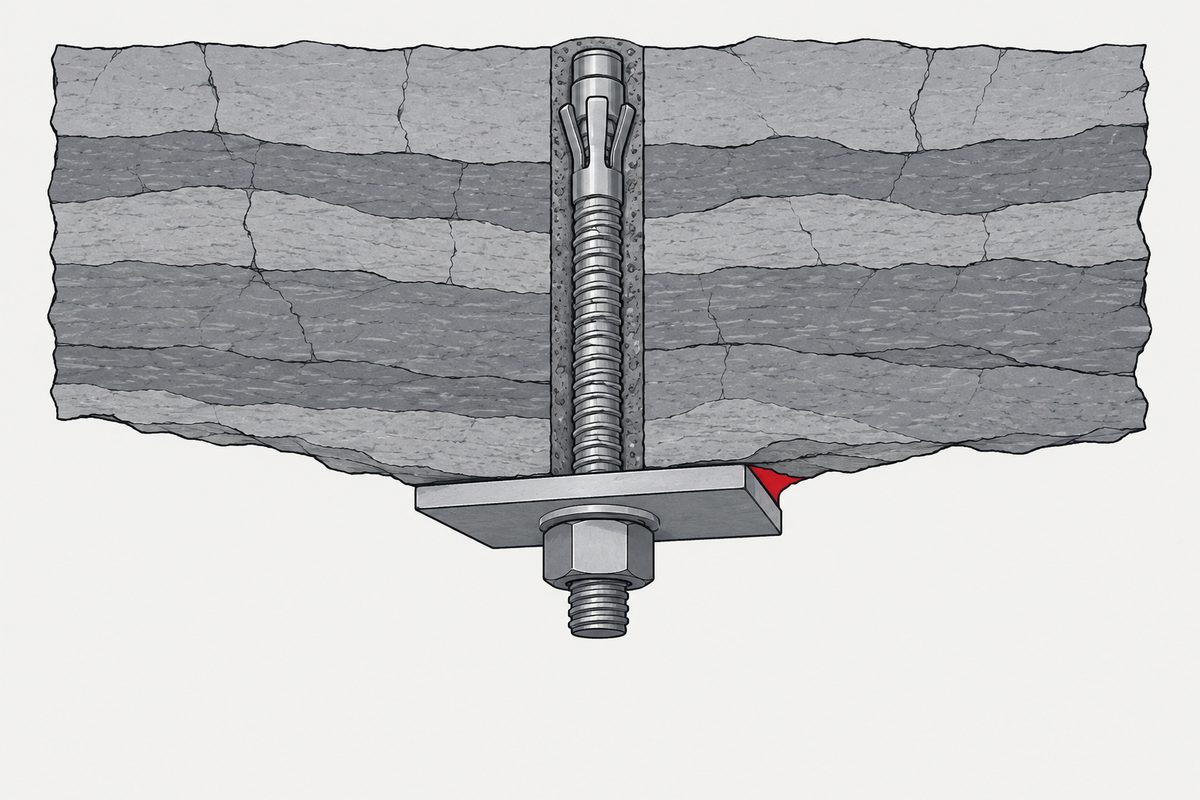
From the rule on roof bolting, on bolts already installed: corrective action is required if the majority of the bolts measured “do not maintain at least 70 percent of the minimum torque or tension specified in the roof control plan, 50 percent if the roof bolt plates bear against wood”, or “have exceeded the maximum specified torque or tension by 50 percent.”
Do not carry that seventy percent to any other joint. It is a United States federal regulation for underground coal mines, the percentage is measured against a minimum written in that particular mine's own approved plan, and nothing about it transfers to a flange, a wheel or a machine frame. This page reports what one rule says. It gives no mining, roof support, inspection or tightening advice, and we are not a supplier to that industry.
This article did not come from a forum question. Three searches for a question about acceptable preload loss returned nothing, so this one starts from a gap in our own coverage instead, following what we have done twice before when the usual sources were unavailable. The browser tooling this site normally uses remains disconnected.
The document, and why it is unusual
Title 30 of the Code of Federal Regulations, Part 75, Subpart C, is titled Roof Support. By our count it runs to twenty numbered sections, and the one used here is § 75.204, Roof bolting. Its history note records that it was published in 1988 and amended in 1990 and 1998.
This is the third time this site has read a federal regulation through the eCFR interface, after two parts of the occupational safety rules, and the first time in this title. The earlier two were about steel erection and about electrical connections; one of them turned on a rule about how many bolts must be in before the crane lets go. Nothing from those pages is repeated here.
What makes this rule worth a page is the density of numbers in it. Most fastener documents specify how tight to make something and then fall silent about what happens afterwards. This one specifies the installation, the sampling, the retention, the record, and the drill bit.
Checked as you go, at one in four
Before the retention rule there is an installation rule, and it is a sampling rate most industries would find heavy. In each roof bolting cycle, the actual torque or tension of the first tensioned bolt installed with each drill head is measured immediately after it is installed. After that, for each drill head in use, at least one bolt out of every four is measured.
By our arithmetic that is a twenty five percent in process check, and the count restarts for every drill head, so a machine with more heads does not get to spread the same sample thinner. If any measured bolt falls outside the range in the plan, corrective action follows.
The range itself is not in the regulation. It is in the mine's roof control plan, and the rule constrains it from two directions: the installed torque or tension range “shall not exceed the yield point of the roof bolt nor anchorage capacity of the strata.” Two ceilings, one inside the fastener and one inside the rock, and whichever is lower governs.
Checked again later, at one in ten
Then comes the part that has no equivalent in most fastener practice. In working places that produced coal during any part of a twenty four hour period, at least one out of every ten previously installed mechanically anchored tensioned bolts is measured, along a defined stretch: from the outby corner of the last open crosscut to the face, in each advancing section.
The pass criteria are the passage quoted at the top. Read closely, three things stand out.
- There is a floor, and it is a percentage of a specified minimum. Seventy percent, and fifty percent where the plates bear against wood, because wood keeps compressing
- There is a ceiling as well. Exceeding the specified maximum by fifty percent is also a failure. Too tight is a defect, not a bonus
- The trigger is the majority of those measured, not a single bolt. One low reading does not start the process; more than half of the sample does
By our arithmetic the acceptable band on a bolt already in the roof runs from seventy percent of the minimum to one hundred and fifty percent of the maximum, and drops to fifty percent at the bottom when the plate is against wood. That is a wide band, and it is a written one, which is the rare part.
The measurements are not informal. The operator or a designated person certifies them by signature and date, the certification is kept for at least a year, and it is made available to the Secretary's authorized representative and to representatives of the miners.
A torque that is a proof, not a target
Grouted bolts that are not tensioned get a different rule, and it is a small masterpiece of economy. The first non-tensioned grouted bolt installed in each cycle is tested during or immediately after the first row goes in. If it “does not withstand at least 150 foot-pounds of torque without rotating in the hole”, corrective action is taken.
That 150 is not a tightening figure. Nobody is trying to reach it. The wrench is there to find out whether the grout has taken hold, and the bolt passes by refusing to move. A number that looks like a torque specification is functioning as a proof load on the anchorage.
It is worth noticing what the regulation does not contain. By our count the word resin does not appear anywhere in the subpart. The category is named by what it does, non-tensioned and grouted, rather than by the chemistry that does it. That is the same instinct we have found elsewhere, where a maintenance document decides a locknut by a measurement rather than by a count of previous uses.
The plate, the washer, the bit and the angle
The rest of the section is a reminder that the fastener is never the whole system.
- A bearing plate is firmly installed with every roof bolt. Against the roof it is at least six inches square or the equivalent, five inches where the roof is firm and not susceptible to sloughing, and at least four inches square where it works with wood or metal materials. Wood between plate and roof in areas that will exist for three years or more has to be treated against deterioration
- Washers are specified by shape, not by grade. When they are used, they “shall conform to the shape of the roof bolt head and bearing plate.” No hardness, no thickness, no class
- The drill bit gets a tolerance. Finishing bits must be within plus or minus 0,030 inch of the manufacturer's recommended hole diameter for the anchor used, and where separate finishing bits are used they must be distinguishable from other bits
- Angle compensating devices are required beyond five degrees from the perpendicular to the bearing plate
That last one has a familiar shape. An angled fastener does not simply lose a little capacity; it changes what the joint is doing, which is why a screw driven at an angle moves the joint rather than clamping it. Here the regulation sets the boundary at five degrees and requires hardware to fix it rather than a judgement call.
And one prohibition worth quoting for its precision. Tensioned bolts in the support pattern “shall not be used to anchor trailing cables or used for any other purpose that could affect the tension of the bolt”, yet hanging cables, line brattice or telephone lines “which do not place sudden loads on the bolts are permitted.” The line is not between hanging and not hanging. It is between a steady load and a sudden one.
What we could not read
Three gaps, stated rather than filled.
The roof control plan is not a public document and we do not have one. Every torque and tension figure in this rule is relative to a number that lives in a mine-specific plan approved by a District Manager. We can report the percentages and not the values they apply to.
ASTM F432-95 was not read. The rule requires a manufacturer's certification that roof bolts and accessories covered by that specification were manufactured and tested to it, and requires that certification to be available to the Secretary's representative and to the miners' representative. What the specification itself requires is behind a paywall that has refused this site before, so nothing here summarises its contents. Materials it does not cover can still be used, with District Manager approval based on demonstrations or tests, and during such a test “access to the test area shall be limited to persons necessary to conduct the test.”
We read one section of one subpart. The neighbouring sections on temporary support, pillar recovery, longwall systems and the approval criteria for the plan were not read, beyond noting a few spacing rules in the following section for contrast.
What this settles and what it does not
- A written threshold for preload loss exists, in one regulation, for one kind of bolt: seventy percent of a specified minimum, fifty percent where the plate bears against wood
- The same rule sets an upper bound, at fifty percent above the specified maximum, so over tension is a defect too
- It takes the majority of a sample to trigger action, not one reading
- Installation is checked at one in four per drill head, with the first bolt on each head measured immediately, and retention at one in ten later
- The measurements are certified by signature and date and kept for at least a year
- A grouted bolt is proved by 150 foot-pounds it must not rotate under, which is a test rather than a tightening figure
- None of these numbers transfer. They belong to a specific rule, a specific kind of bolt, a specific ceiling made of rock, and percentages of values written in a plan we have not seen
What the page is really for is the shape of the answer rather than the number. Asking how much loss is acceptable turns out to be answerable, but only where somebody had to decide: a specified range, a floor and a ceiling expressed as percentages of it, a sampling rate, a majority rule, and a signature. Documents that decline the question usually decline all six at once.
The same drafting tradition produces the opposite requirement where a joint is meant to move: rail joint bolts are tightened to allow the rail to slide, and that regulation never uses the word torque.
This is not one of the six steps. It shows up across them, or after assembly. Where the decisions that lead here were made is in specifying a screw, which sets out the order and why doing it out of order is rework.
Common questions
How much preload is a bolt allowed to lose?
In general, published fastener documents do not say. The exception found here is a federal regulation for underground coal mine roof bolts, which requires corrective action if the majority of bolts sampled do not maintain at least 70 percent of the minimum torque or tension specified in the mine roof control plan, or 50 percent where the plates bear against wood. That figure belongs to that rule and does not transfer to other joints.
Can I use the seventy percent figure on my own joints?
No. It is a United States regulation for a specific kind of bolt holding a rock roof, the percentage is measured against a minimum written in a mine-specific plan approved by a regulator, and the rule also depends on a sampling scheme and a majority test that go with it. This page gives no tightening or inspection advice for any application.
Does the same rule limit over tightening?
Yes. Corrective action is also required if the majority of the bolts measured have exceeded the maximum specified torque or tension by 50 percent. Separately, the installed range itself must not exceed the yield point of the roof bolt nor the anchorage capacity of the strata.
How many bolts get checked?
Two different rates. During installation, the first tensioned bolt installed with each drill head is measured immediately, and thereafter at least one out of every four, per drill head. For bolts already in place, at least one out of every ten previously installed mechanically anchored tensioned bolts is measured along a defined stretch in each advancing section, in working places that produced coal during any part of a 24 hour period.
Does one loose bolt trigger action?
Not under the retention rule. It is written so that corrective action follows if the majority of the bolts measured fail the criteria. During installation the wording is different: if the torque or tension of any of the bolts measured is outside the specified range, corrective action shall be taken.
What is the 150 foot-pounds for?
It is a proof, not a target. The first non-tensioned grouted bolt in each cycle is tested during or immediately after the first row, and must withstand at least 150 foot-pounds of torque without rotating in the hole. Nobody is tightening to that figure; the bolt passes by not moving.
What does the rule say about washers?
Only that when washers are used with roof bolts, they shall conform to the shape of the roof bolt head and bearing plate. No hardness, thickness or class appears.
Does the bearing plate have a size?
Yes, and it varies with what it bears against. Directly against the mine roof, at least six inches square or the equivalent, or five inches square where the roof is firm and not susceptible to sloughing. Used with wood or metal materials, at least four inches square. Wood between plate and roof in areas that will exist for three years or more must be treated to minimise deterioration.
Is there a rule about installing bolts at an angle?
Angle compensating devices must be used when tensioned roof bolts are installed at angles greater than five degrees from the perpendicular to the bearing plate.
Where do the actual torque values come from?
From the mine roof control plan, which is a mine-specific document approved by a District Manager. The regulation sets percentages relative to that plan and constrains the range, but does not contain the values. We do not have such a plan and report no torque values from one.
References
Section 75.204 was read in full from the public regulation interface, at the most recent issue date for that title, and section 75.205 was read for contrast. This is the third time this site has used that interface and the first time in this title. This article did not come from a forum question; three searches for a question about acceptable preload loss returned nothing, so it starts from a gap in this site’s own coverage, as two earlier pages have done when the usual sources were unavailable. The browser tooling this site normally uses remains unavailable. The following are our own counts and arithmetic, not statements by the regulation: that Subpart C runs to twenty numbered sections; that one in four is twenty five percent and restarts per drill head; that the retained band runs from seventy percent of the minimum to one hundred and fifty percent of the maximum; and that the word resin appears nowhere in the subpart. ASTM F432-95 was not read, being behind a paywall that has refused this site before, and nothing about its contents appears here beyond the fact that the rule cites it and requires a manufacturer’s certification against it. No roof control plan was seen, and no torque or tension value from one appears here, only the percentages the rule applies to such values. The other sections of the subpart were not read. This page gives no mining, roof support, inspection or tightening advice, names no equipment or fastener brand, and the seventy percent figure must not be carried to any other kind of joint.
Enquiries
If a specification you work to sets an acceptance band rather than a single figure, that is a different thing to evidence than a target, and it is worth separating before anyone quotes. Send the clause as written and we will tell you what we can certify about the parts themselves and what would have to be measured in place by someone else.
Request a quotation
Tell us the part and the quantity. We will come back on feasibility, lead time and price.
Or email us directly sales@tigerfasteners.com