 TIGERFASTENERS
One Rule Requires Bolts To Be Tightened So That the Joint Can Still Move
Almost everything written here about bolted joints assumes the same purpose: the bolt is stretched, the parts are squeezed together, and the joint holds because it does not move. There is a body of federal regulation covering a bolted joint built on the opposite premise. The bolts have to be tight enough to support the ends of two rails and loose enough to let those rails slide as the day warms up, and across the whole of it the word torque never appears once.
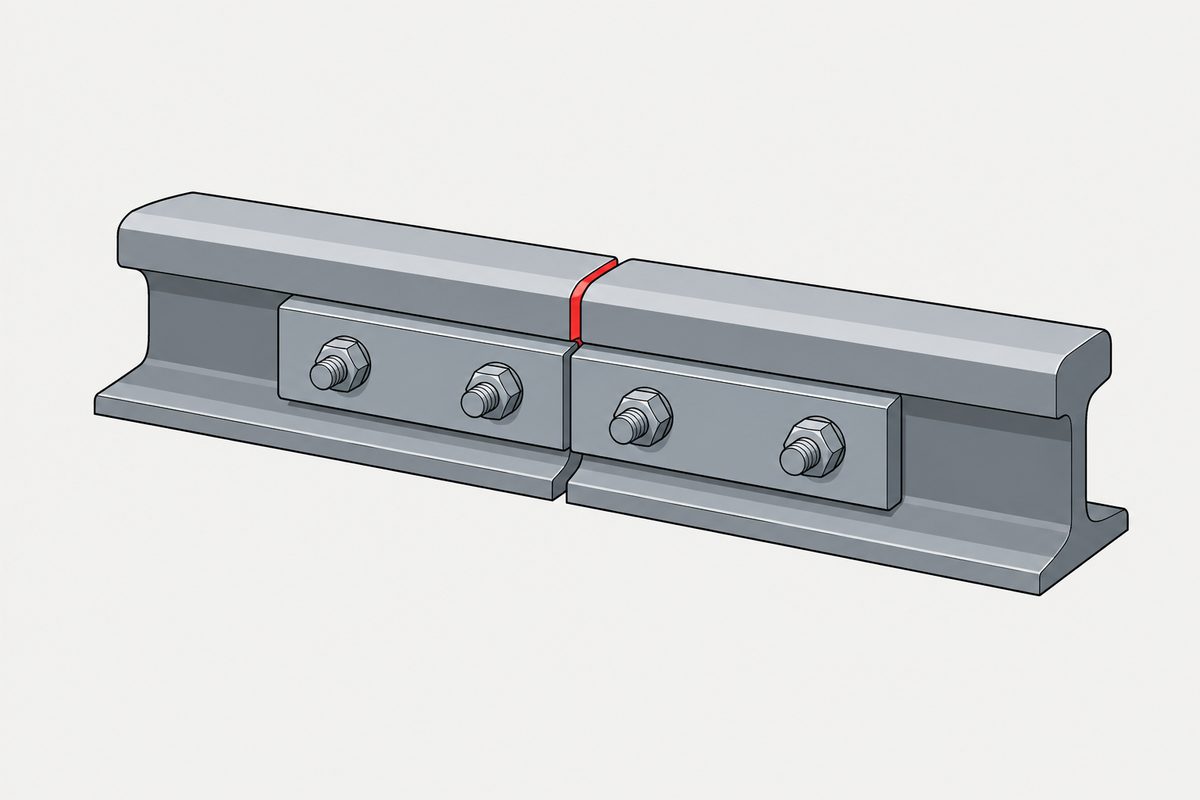
From the rule on rail joints: “Each joint bar shall be held in position by track bolts tightened to allow the joint bar to firmly support the abutting rail ends and to allow longitudinal movement of the rail in the joint to accommodate expansion and contraction due to temperature variations.”
None of this transfers. It is a United States federal regulation for railroad track, the requirement exists because a rail is a very long steel bar that changes length with the weather, and nothing in it is a guide to any other joint. This page reports what one part of one regulation says. It gives no track, maintenance, inspection or tightening advice, and we are not a supplier to that industry.
This article did not come from a forum question either. That is two in a row, which is the limit we want to run; three searches for a question in this area returned one unrelated result. The browser tooling this site normally uses remains disconnected.
What the word count says before the reading starts
Title 49 of the Code of Federal Regulations, Part 213, Subpart D, is titled Track Structure. By our count it runs to eighteen numbered sections and about fifty two and a half thousand characters of visible text. Before reading any of it closely, the search results are already an argument.
- torque: zero
- preload: zero
- lubricant: zero
- tighten: twice, and both occurrences are about not clamping
- clamp: once, in a definition describing what some fasteners do to the rail base, not as a requirement on a bolt
- tension: once, in the definition of the temperature at which the rail is neither in compression nor tension, so about the rail rather than the fastener
- friction: twice, both inside a gage measurement formula, between rail and tie, never about a thread
That last group matters. A document can be about bolted joints and still contain no fastener mechanics at all, because the quantities it cares about live somewhere else. Here they live in the geometry of the track and in the temperature of the steel.
Two bolts, and one on the slowest track
The joint rule counts fasteners rather than measuring them. For conventional jointed track, each rail is bolted with at least two bolts at each joint in Classes 2 through 5, and with at least one bolt in Class 1 track. For continuous welded rail, at least two bolts at each joint.
One bolt is permitted to hold the end of a rail to a joint bar, on the class of track where the least is asked of it. We are deliberately not stating what speeds those classes correspond to, because the sections that define them were not read.
The bar itself is condemned by geometry rather than by measurement. It is replaced if it is cracked or broken, or if wear “allows excessive vertical movement of either rail when all bolts are tight”, and separately “if a joint bar is cracked or broken between the middle two bolt holes it shall be replaced.” A defect is located by which holes it lies between. That phrasing also implies, by our reading rather than by any statement in the rule, that a bar carries more holes than the minimum number of bolts required to be in it.
This is a familiar shape from the other direction. Steel erection has its own rule about how few bolts may be in a connection at a given moment, and there the count is a threshold for when the crane may let go. Here the count is a permanent minimum, not a stage in an operation.
The sentence that inverts everything
Paragraph (f) is the reason this page exists. The bolts hold the joint bar in position, and they are tightened to do two things at once: to let the bar firmly support the abutting rail ends, and to allow longitudinal movement of the rail in the joint so that the steel can expand and contract with temperature.
Read that as a fastener requirement and it is close to a contradiction. Support requires contact; movement requires slip. The rule resolves it by asking for both and specifying neither numerically, which is why torque cannot appear. A torque figure would fix a friction condition, and a fixed friction condition is exactly what this joint must not have.
The escape clause confirms the reading. “When no-slip, joint-to-rail contact exists by design, the requirements of this paragraph do not apply”, and such locations, when over four hundred feet in length, are treated as continuous welded rail and fall under a different set of requirements entirely. So the regulation recognises two regimes: a joint that slides, and a rail that is not allowed to. Choosing the second is not a tightening decision. It changes which rules apply.
Behind it sits a definition worth quoting on its own: “Rail neutral temperature is the temperature at which the rail is neither in compression nor tension.” The joint bolts exist so that the rail can reach that state on its own.
Tighten appears twice, and once it is a warning
The second of the two occurrences is in the section on switches, and it is a rare thing to find in a regulation. “Each stock rail must be securely seated in switch plates, but care shall be used to avoid canting the rail by overtightening the rail braces.”
Secure, but not so secure that the rail tips. The failure being guarded against is not the fastener letting go; it is the fastener succeeding so thoroughly that it moves the thing it was holding. Two paragraphs later the same section says “the bolts in each heel shall be kept tight”, with no qualification at all, so the document is perfectly capable of demanding tightness where tightness is what it wants.
By our count those two sentences are the entire appearance of the word in the subpart. One asks for tightening that permits movement, the other warns against tightening that causes it. Neither is a number.
The fastening system is judged by an outcome
The section on rail fastening systems does not list fasteners. It says track “shall be fastened by a system of components that effectively maintains gage”, and then that “each component of each such system shall be evaluated to determine whether gage is effectively being maintained.”
The requirement is on the result, and the components are assessed against it rather than against a specification of their own. There is even permission to remove one: where a fastener's placement stops an insulated joint from performing as intended, the fastener may be modified or removed, provided the crosstie supports the rail.
Counting reappears where the outcome is harder to judge. A crosstie does not count toward the required support if it is configured with less than two fasteners on the same rail, and where timber crossties are used on the higher classes there must be tie plates under the running rails on at least eight of any ten consecutive ties. Eight in ten, two per rail, two per joint, one on the lowest class. This is a regulation that has decided a count is more inspectable than a measurement.
One more count worth reporting, because it puts the rest in proportion. Where continuous welded rail joints must be inspected on a schedule, the required frequency runs from four times a calendar year down to none at all, depending on class and annual tonnage, with minimum separations of sixty, ninety, one hundred and twenty or one hundred and eighty days between consecutive inspections, and an allowance of up to thirty extra days when extreme weather prevents one. The first condition the inspection plan must cover is loose, bent, or missing joint bolts.
Why a fastener page cares
Not because anyone reading this is buying track bolts. Because this is the clearest example we have found of a bolted joint whose specification refuses every quantity that fastener work normally runs on, and does so for a reason you can state in one sentence: the parts have to be able to move relative to each other.
The moment a joint is allowed to move, most of the usual apparatus stops applying. A joint that is not clamped is a different structure from one that is, and a specification written for the second will not describe the first. What this regulation does instead is specify presence, condition and frequency: how many bolts, in what state, checked how often, and what a cracked bar looks like.
It is also a useful contrast with the one regulation we have found that does put a number on fastener condition. In underground coal mines, roof bolts have a written threshold for how much tension may be lost, because there the whole point is that they hold. Same drafting tradition, opposite requirement, and the difference is entirely in what the joint is for.
What this settles and what it does not
- A federal rule requires joint bolts to be tightened so that the rail can still move longitudinally, while the bar firmly supports the abutting rail ends
- Where no-slip contact exists by design, that paragraph does not apply, and such locations over four hundred feet long are treated as continuous welded rail instead
- The minimum is two bolts per rail at each joint, and one on Class 1 track
- By our count the word torque does not appear in the subpart at all, nor preload, nor lubricant, and tighten appears exactly twice, both times about not clamping
- The fastening system is judged by whether gage is maintained, with each component evaluated against that outcome rather than a specification of its own
- We did not read the sections that define the track classes, so no speed appears on this page, and we did not read the remedial action table for defective rails
- None of these numbers or requirements transfer to any other kind of joint
The useful residue is a question to ask of any joint before reaching for a torque figure: is this thing supposed to move? Almost always the answer is no, and the usual apparatus applies. When the answer is yes, a document written by people who had to make it work stops talking about tightness and starts counting bolts.
A later page counted words the same way in a construction regulation that says how many fasteners and how far apart, and never how tight.
This is not one of the six steps. It shows up across them, or after assembly. Where the decisions that lead here were made is in specifying a screw, which sets out the order and why doing it out of order is rework.
Common questions
Are rail joint bolts torqued?
The track structure rules read for this page do not say. By our count the word torque does not appear anywhere in that subpart. What the rule requires is that track bolts hold the joint bar in position, tightened to let the bar firmly support the abutting rail ends and to allow longitudinal movement of the rail in the joint for thermal expansion and contraction.
How can a bolt be tight and still allow movement?
That is what the rule asks for, and it does so without giving a number. Support needs contact and movement needs slip, so a fixed torque figure would settle a friction condition the joint is not supposed to have. Where no-slip contact between joint and rail exists by design, the rule says that paragraph does not apply at all.
How many bolts does a rail joint need?
For conventional jointed track, each rail is bolted with at least two bolts at each joint in Classes 2 through 5, and with at least one bolt in Class 1 track. For continuous welded rail, at least two bolts at each joint.
When is a joint bar replaced?
If it is cracked or broken, if wear allows excessive vertical movement of either rail when all bolts are tight, and specifically if it is cracked or broken between the middle two bolt holes.
Does the regulation warn against overtightening?
Once, in the section on switches: each stock rail must be securely seated in switch plates, but care shall be used to avoid canting the rail by overtightening the rail braces. By our count that is one of only two appearances of the word in the subpart.
What is rail neutral temperature?
The regulation defines it as the temperature at which the rail is neither in compression nor tension. It is a property of the rail, not of the fastener.
How is a rail fastening system specified?
By outcome. Track shall be fastened by a system of components that effectively maintains gage, and each component of each system shall be evaluated to determine whether gage is effectively being maintained. Where a fastener placement stops an insulated joint performing as intended, the fastener may be modified or removed provided the crosstie supports the rail.
Do these rules apply to my bolted joints?
No. This is a United States regulation for railroad track, written around a joint that must accommodate thermal movement of a very long steel bar. Nothing here is a guide to any other joint, and this page gives no tightening or inspection advice.
How often are welded rail joints inspected?
Between four times a calendar year and not at all, depending on the class of track and the annual tonnage, with required minimum separations between consecutive inspections and an allowance of up to thirty extra days when extreme weather prevents one. The first item an inspection plan must cover is loose, bent, or missing joint bolts.
What speeds do the track classes correspond to?
This page does not say. The sections that define the classes were not read, so no speed figure appears here.
References
- 49 CFR 213.121, Rail joints, in Part 213 Subpart D, Track Structure. Read in full through the public regulation interface at the 19 August 2026 issue date
- 49 CFR Part 213 Subpart D, Track Structure, the subpart the word counts on this page were taken from
Subpart D was retrieved in full through the public regulation interface at the most recent issue date for that title, and section 213.121 was read in full, along with 213.123, 213.127, 213.133, 213.135, the crosstie fastener condition in 213.109 and the joint inspection provisions in 213.119. This is the fourth time this site has used that interface and the first time in this title. This article did not come from a forum question; three searches in this area returned one unrelated result, so it starts from a gap in this site’s own coverage. That is the second such article in a row and we do not intend a third. The browser tooling this site normally uses remains unavailable. The following are our own counts, not statements by the regulation: that Subpart D runs to eighteen numbered sections and about fifty two and a half thousand characters of visible text; that torque, preload and lubricant appear zero times; that tighten appears exactly twice; that clamp and tension appear once each and not as requirements on a fastener; and that friction appears twice, both inside the gage restraint measurement provisions. The inference that a joint bar carries more bolt holes than the minimum number of bolts required is ours, drawn from the phrase about the middle two bolt holes, and the rule does not state it. Subparts A and B were not read, so no speed is stated for any class of track, and the remedial action table for defective rails was not read or summarised. This page gives no track, maintenance, inspection or tightening advice, names no brand, and none of these requirements transfer to any other kind of joint.
Enquiries
If a joint you are specifying has to accommodate movement rather than prevent it, the fastener question changes shape and so does the evidence anyone can give you about it. Tell us what the joint has to do and we will say what we can hold ourselves to on the parts, and what belongs to the design instead.
Request a quotation
Tell us the part and the quantity. We will come back on feasibility, lead time and price.
Or email us directly sales@tigerfasteners.com