 TIGERFASTENERS
A Federal Table Counts the Clips by What the Clip Is Made Of
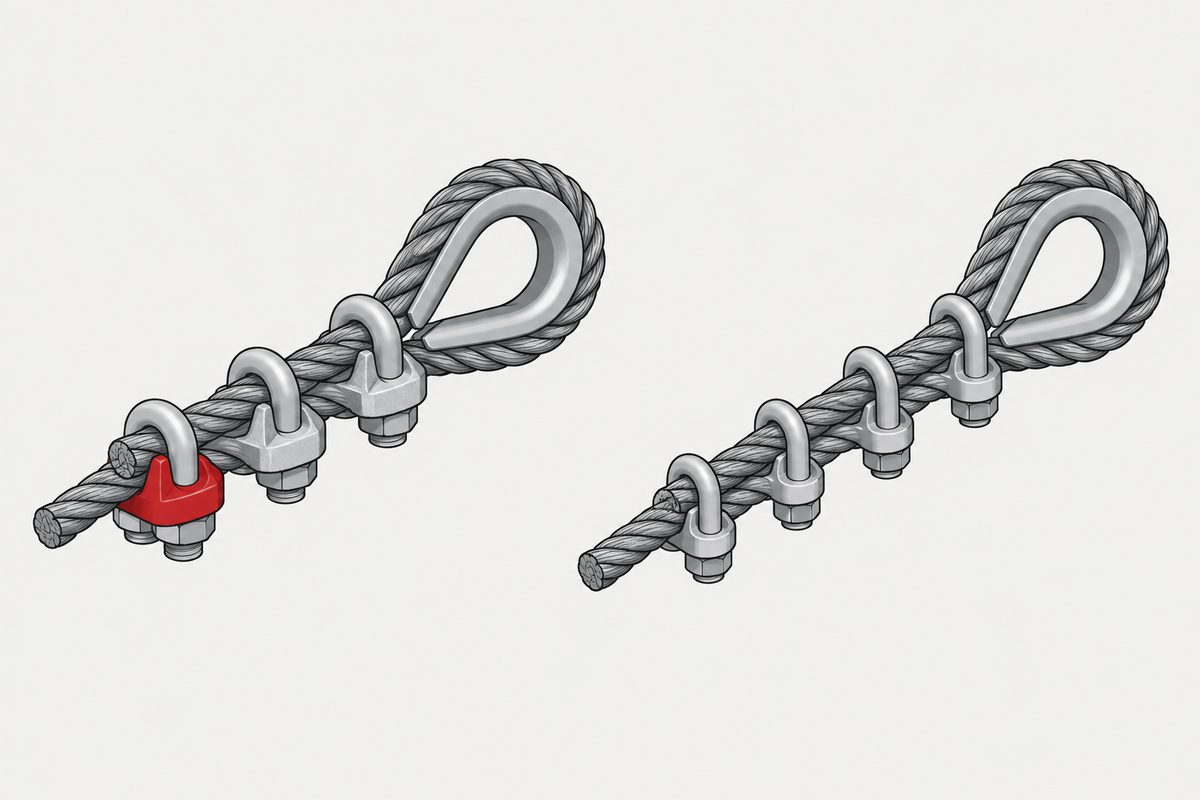
Most tables that tell you how many fasteners to use are indexed on the thing being fastened. This one has a second index. It gives the number of U-bolt wire rope clips needed to form an eye, and it prints two counts for every rope diameter: one if the clip was drop forged, and a different one if it was made of other material. The rope has not changed. The fastener has.
The four columns of the table are “Improved plow steel, rope diameter (inches)”, then “Number of clips” split into “Drop forged” and “Other material”, then “Minimum spacing (inches)”. For a half inch rope it is three clips drop forged and four of other material.
This page is not rigging guidance and this site is not a rigging supplier. Anyone who has to form an eye in wire rope has to read the regulation itself, in the version in force where the work is done. What is written here is a reading of one table and of what the surrounding section does and does not contain. It did not come from a forum question; it comes from scanning fastener families for zero coverage, which is how the site found that it had never written the words clip, U-bolt or saddle. The browser tooling we normally use remains unavailable.
Which document, and which version
The section is 29 CFR 1926.251, Rigging equipment for material handling, in the construction standards. We read the annual edition published by the Government Publishing Office, whose own date field reads 1 July 2025, as machine readable XML rather than as a scan, so there is no character recognition in the path.
We could not cross check it against the current electronic edition. That service returned 503 for every form of the request we tried, while its catalogue endpoint answered normally, so the failure was on their side and not a wrong query. Everything below is therefore the annual edition as of that date, and we are not saying it matches what is in force today.
The section carries an amendment line running from 1979 through 2012, so the text has been revisited more than once since it was first published.
Forbidden in one paragraph, sized four paragraphs later
Paragraph (c)(4)(iii) says: “Eyes in wire rope bridles, slings, or bull wires shall not be formed by wire rope clips or knots.”
Paragraph (c)(5) says: “When U-bolt wire rope clips are used to form eyes, Table H-2 shall be used to determine the number and spacing of clips.”
Both sentences are about forming eyes with clips, and they sit four paragraphs apart in the same subsection. The prohibition carries three named objects, bridles, slings and bull wires. The table carries none. So the reading that makes both sentences do work is that the prohibition is scoped to those three, and the table governs the eyes that are not any of them. That is our reading of the structure, and the section does not spell it out.
The next paragraph, (c)(5)(i), is the one people remember without the number: “When used for eye splices, the U-bolt shall be applied so that the ‘U’ section is in contact with the dead end of the rope.” The paragraph after that is marked reserved, and in the annual edition XML its designator is printed as (i1) rather than (ii). We are reporting what the file contains, not claiming the current edition prints it the same way.
The second index is the clip
Table H-2, in full. Rope diameter in inches, then clips drop forged, then clips of other material, then minimum spacing in inches.
- ½ → 3, 4, spacing 3
- ⅝ → 3, 4, spacing 3¾
- ¾ → 4, 5, spacing 4½
- ⅞ → 4, 5, spacing 5¼
- 1 → 5, 6, spacing 6
- 1⅛ → 6, 6, spacing 6¾
- 1¼ → 6, 7, spacing 7½
- 1⅜ → 7, 7, spacing 8¼
- 1½ → 7, 8, spacing 9
In seven of the nine rows, a clip that was not drop forged needs one more of itself. The two rows where the counts are equal are one and one eighth inch and one and three eighths inch. That count is ours, from the rows above.
The regulation does not say why forging changes the number, and we are not going to guess. What is worth carrying away is the shape of the rule. The quantity of fasteners is not a function of the rope alone. Two clips that fit the same rope and do the same job are not interchangeable at the same count, and the difference is in how the clip was made.
Nine numbers for one rule
The last column looks like nine independent values. Divide each one by the rope diameter on its own row and the result is the same every time.
Three over one half is six. Three and three quarters over five eighths is six. Four and a half over three quarters is six. Five and a quarter over seven eighths is six. Six over one is six. Six and three quarters over one and an eighth is six. Seven and a half over one and a quarter is six. Eight and a quarter over one and three eighths is six. Nine over one and a half is six.
The minimum spacing is six rope diameters in every row of the table. That arithmetic is ours; the table prints the products and not the rule. It is a small thing, but it changes how you read the column. Nine numbers that vary independently would be nine facts to look up. Nine numbers that are all six diameters are one fact, printed nine times so that nobody has to multiply on a job site.
How many, how far apart, and never how tight
We counted words across the whole section. The word torque does not appear once. Neither does retighten, nor any form of lubricate, nor seat.
The word tighten appears exactly once, in paragraph (c)(10), and it is not an instruction to tighten anything: “Hands or fingers shall not be placed between the sling and its load while the sling is being tightened around the load.” The one appearance of the word is a warning to get your hands out of the way.
So the regulation fixes how many clips and how far apart they sit, and says nothing at all about how hard they are done up. This site has made an absence count of this kind before, on a different regulation covering a joint that is deliberately not clamped; that page is linked rather than repeated, and the two documents are not being compared here beyond the shape of the finding.
One more absence, in a different document. We also read 29 CFR 1910.184, the general industry standard on slings, which is longer than the construction section at about twenty two thousand characters against about fifteen thousand seven hundred. It contains the word clip zero times, and U-bolt zero times, and torque zero times. The clip table lives in the construction standard and not in that one.
What this settles and what it does not
- The number of clips depends on the clip, not only on the rope: two counts are printed for every rope diameter, drop forged and other material
- Other material needs one more clip in seven of the nine rows, and the same number in the other two, by our count
- The minimum spacing is six rope diameters in all nine rows, by our arithmetic; the table prints the products, not the rule
- Eyes in bridles, slings and bull wires shall not be formed by clips or knots, and four paragraphs later a table sizes the clips used to form eyes
- The U section shall contact the dead end of the rope when used for eye splices
- The word torque does not appear in the section, and the single appearance of tighten is a warning about hands
- The general industry standard on slings contains the word clip zero times
- A reserved paragraph is designated (i1) in the annual edition XML, which we report without claiming the current edition matches
- We read the annual edition dated 1 July 2025 and could not reach the current electronic edition, which returned 503 throughout
- The regulation does not say why forging changes the count, and neither do we
- This is not rigging guidance
The habit worth taking from this is checking what a quantity is indexed on. A table that says how many fasteners you need is answering a question about a joint, and the joint has more than one part in it. When the count moves and the thing you were looking at did not, the answer is somewhere else in the assembly.
A later page found the same question answered twice in opposite directions inside one regulation, where a bead on the pipe end excuses a clamp in one section and is required alongside two in another.
A later page put this next to a table where twenty printed numbers did not resolve to a single rule, which is what makes checking worth the minute it takes.
A later page did the same division on a shorter column and found one rule with a rounded last value, which is the third outcome this test can have.
A later page could finally do what this one could not, and read the same federal text from two independent editions that agreed word for word.
This is not one of the six steps. It shows up across them, or after assembly. Where the decisions that lead here were made is in specifying a screw, which sets out the order and why doing it out of order is rework.
Common questions
Does the number of wire rope clips depend on the rope only?
Not in this table. It prints two counts for each rope diameter, one for drop forged clips and one for clips of other material. For a half inch rope the counts are three and four.
How much difference does the clip material make?
By our count of the nine rows, a clip that was not drop forged needs one more of itself in seven rows, and the same number in the two rows at one and one eighth inch and one and three eighths inch.
Why does forging change the count?
The regulation does not say, and this page does not guess.
What is the minimum spacing?
The table prints a value for each rope diameter. Dividing each one by the diameter on its own row gives six every time, so the spacing is six rope diameters throughout. That arithmetic is ours, not a statement in the table.
Can eyes be formed with clips at all?
The section says eyes in wire rope bridles, slings or bull wires shall not be formed by wire rope clips or knots, and four paragraphs later it says that when U-bolt wire rope clips are used to form eyes, the table shall be used for the number and spacing. Reading the prohibition as scoped to those three named applications is our reading of the structure, not something the section spells out.
Which way round does the U-bolt go?
The section says that when used for eye splices, the U-bolt shall be applied so that the U section is in contact with the dead end of the rope.
Does the regulation say how tight the clips should be?
The word torque does not appear anywhere in the section. The word tighten appears once, and that once is a warning not to put hands or fingers between the sling and its load while the sling is being tightened around the load.
Is this the current text?
It is the annual edition published by the Government Publishing Office, whose date field reads 1 July 2025. We could not cross check it against the current electronic edition, which returned 503 for every request, so this page does not claim the two agree.
Is this rigging guidance?
No. Anyone forming an eye in wire rope has to read the regulation itself, in the version in force where the work is done.
References
- 29 CFR 1926.251, Rigging equipment for material handling, annual edition XML dated 1 July 2025, including Table H-2
- 29 CFR 1910.184, Slings, annual edition XML dated 1 July 2025, read only to count words
Both documents are machine readable XML published by the Government Publishing Office, not scans, so no character recognition sits in the path. The table was read from the row and cell markup of the source file rather than from flattened text, because flattening a government table mixes the column order. We could not cross check against the current electronic edition of the regulation: it returned 503 for every form of the request while its catalogue endpoint answered normally, so this page is the annual edition dated 1 July 2025 and does not claim to match what is in force today. The reserved paragraph designated (i1) is what the annual edition file contains, reported without any claim about the current edition. The following are our own counts and arithmetic, not statements in the regulation: that the minimum spacing is six rope diameters in all nine rows; that a clip of other material needs one more in seven of the nine rows; that the word torque does not appear in the section; and that the general industry standard on slings contains the word clip zero times. Reading the prohibition as scoped to the three named applications is also our reading, and the section does not spell it out. The regulation does not say why forging changes the count, and this page does not guess. This article did not come from a forum question; it comes from scanning fastener families for zero coverage. This is not rigging guidance, this site is not a rigging supplier, and no brand is named. The browser tooling this site normally uses remains unavailable.
Enquiries
If a quantity on your drawing changes with something other than the part you were looking at, that is worth writing down before it becomes a purchasing question. Tell us what the count is indexed on and we will tell you which of those properties we can evidence.
Request a quotation
Tell us the part and the quantity. We will come back on feasibility, lead time and price.
Or email us directly sales@tigerfasteners.com