 TIGERFASTENERS
Micro screws: M1.0 to M5.0
M6 is a dividing line, not a ceiling. Below it, the wire, the tooling, the thread rolling and the inspection are all on our own floor in Shulin, and have been since 1994 — that is the range we are specialists in. Above it we still take the enquiry: standard fasteners up to M16, and items we do not form in house we source. What follows is the part most catalogues leave out — the constraints that only appear once the parts get this small.
What counts as a micro screw
There is no single industry definition, and the words move around — micro screw, miniature fastener, small screw, precision screw. On this site the line is M6, because that is where the equipment changes: below it the wire, the dies and the thread rolling are a different set from the one a general fastener plant runs.
| Size | Coarse pitch | Where these usually go |
|---|---|---|
| M1.0 | 0.25 | Hearing aids, micro-optics, sensor assemblies |
| M1.2 | 0.25 | Connectors, small instrument housings |
| M1.4 | 0.3 | Optics, measuring instruments |
| M1.6 | 0.35 | Consumer electronics, camera modules |
| M2.0 | 0.4 | Electronics assembly generally |
| M2.5 | 0.45 | Housings, brackets, drives |
| M3.0 | 0.5 | The most common size in small mechanisms |
| M4.0 – M5.0 | 0.7 – 0.8 | Cabinets, enclosures, general mechanical |
Applications listed above are typical uses of the size, not a customer list. Fine pitches are a separate series and have to be written out in full — how to read the rest of the designation.
Four things that only bite at these sizes
This is the part worth reading before you release a drawing. Each one has its own page, because each one has cost somebody a production lot.
- The standards run out. The reference method for torque and clamp force testing starts at M3; some material tests need a specimen a small screw cannot yield. Where the standards stop
- Plating has nowhere to go. A coating of thickness t adds about 4t to pitch diameter, and at M1–M1.4 the usual tolerance position sets nothing aside for it. Plating and thread tolerance
- Head forming gets harder, not easier. The achievable upset ratio falls as parts shrink, so a head that scales on paper may not form. Head forming limits
- The screw is often the last adjustable part. When a stack-up turns up at trial assembly, changing the screw is frequently the quickest route — and sometimes the wrong one. Tolerance stack-up
We publish these because they are the questions that decide whether a part works, and because a supplier who has not met them cannot warn you about them.
Types we form in this range
| Type | Use it when |
|---|---|
| Micro screws M1.0–M5.0 Machine screws | The thread already exists — nut or tapped hole; best where it comes apart repeatedly |
| Thread-forming | No swarf allowed; the thread is displaced rather than cut |
| Self-tapping | Cuts its own thread in a pilot hole |
| Type-cutting | Harder or thicker parent material |
| Self-drilling | No pilot hole, where sheet thickness suits the point |
| Wood screws | Timber and wood-based panels |
| Drywall screws | Plasterboard to framing |
Not sure which applies? The selection question is really about the parent material, and the answer usually follows from it.
Above M6, and everything else on the bill
Standard fasteners up to M16, and items we do not form in house we source. Nuts, washers, rivets, blind rivets, rivet nuts, springs, CNC machined parts and hardware components come through the same window.
To be precise about what that means: above M6 we are not claiming every part is cut on our own floor. We are saying one enquiry covers the bill instead of splitting it across two suppliers. The limits are written out on the capabilities page, including what we decline.
How this size range gets measured and sorted
The smaller the screw, the less a caliper and a ring gauge can settle, and measurement moves toward optical methods. These two machines do that work in-house.
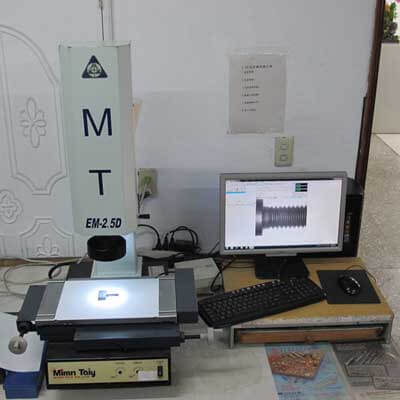
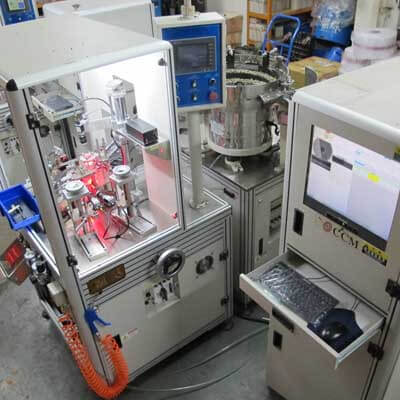
⚠️ This says what is on the floor. It does not say every lot is inspected the same way. Sampling or 100 %, which measurement, and where the acceptance criteria sit, is settled per job — what “passed inspection” means covers why that is worth settling before the order. Bring measurement requirements to the quotation stage.
Verifiable facts
- In-house below M6: wire inspection, forming, thread rolling, inspection, packing — since 1994
- Quality system ISO 9001:2015, certificate 020460
- Environmental system ISO 14001:2015, certificate 67E01741
- Both issued by GCL International Ltd
- Materials: low and medium carbon steel, alloy steel, stainless steel, brass, aluminium, titanium — not every material is routine at every size, so ask for the one you need
- Standards worked to: ASTM · ANSI · AISI · DIN · ISO · IFI · JIS
- Minimum order from 10,000 pcs, varying with the part
One thing to settle on the drawing at these sizes: ISO 898-1 starts at M1,6 for coarse pitch, so M1, M1.2 and M1.4 have no property class in it — not a lower class, no coverage. Specify the material, the condition and how hardness or tensile is to be verified. The three standards that all break at M1.6 are set out here.
We do not publish an on-time delivery rate, because we do not hold a figure anyone could verify. What we can explain is where a lead time actually goes.
Enquiries
Working below M6? Send the drawing, or a sample of what is fitted now. We will come back on feasibility and what it would take — including whether an existing standard part already solves it, which is often cheaper than anything we would make for you.
Request a quotation
Tell us the part and the quantity. We will come back on feasibility, lead time and price.
Or email us directly sales@tigerfasteners.com