 TIGERFASTENERS
Why fastener lead times slip, and what to ask before you order
The short version: a late small order is usually a scheduling structure, not carelessness. Three structural causes — big-order priority, setup batching, outsourced process steps — and every one of them can be asked about before you place the order. Not getting an answer is itself an answer. The second of those causes is the same thing as why the minimum order quantity is that number — one indivisible batch, which shows up as an MOQ on a quotation and as a delay on a schedule. This page does not quote our own on-time rate, because we do not have a figure anyone could verify. It covers where the delay actually happens, and how to surface it in advance.
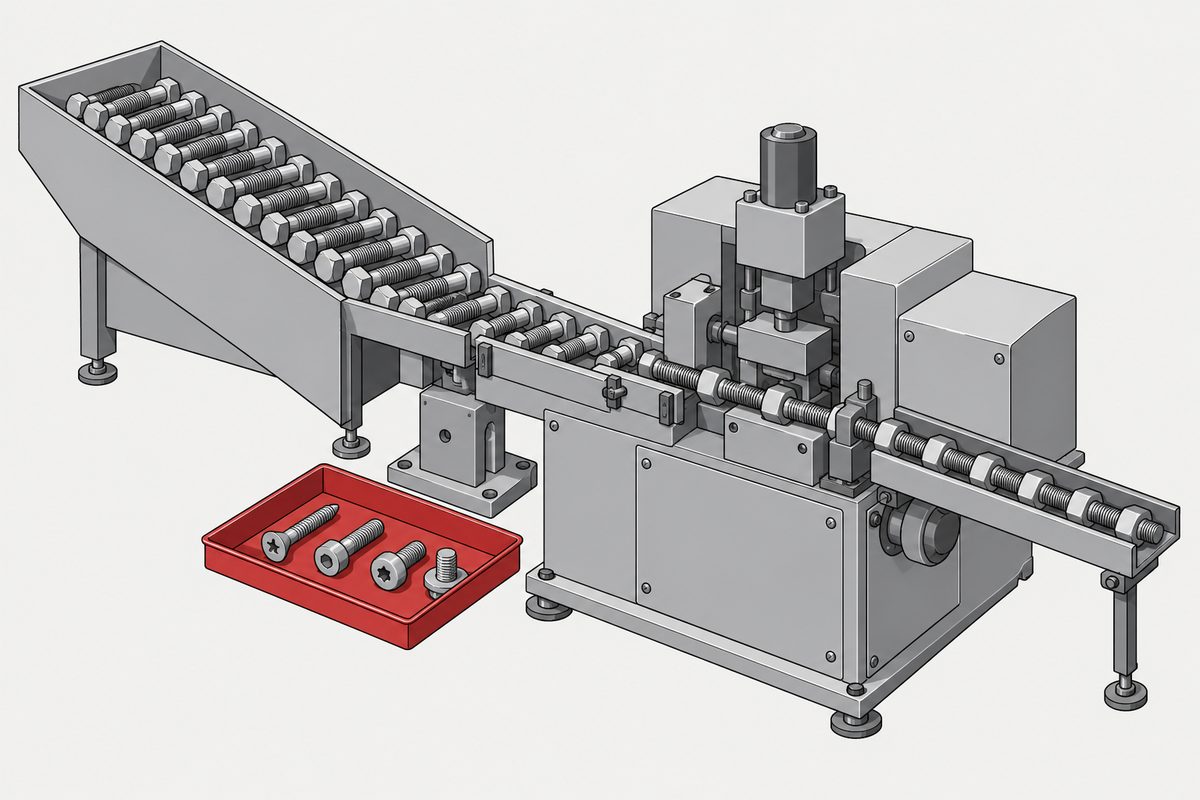
Delay rarely happens in the making
From wire to shipment a screw passes through wire inspection → heading → thread rolling → in-process inspection → heat treatment → surface finishing → final inspection, and then packing.
The time a machine actually spends on your order is usually the smaller part of the lead time. Most of it is queueing: waiting for the schedule, waiting for enough volume to justify a setup, waiting for an outside process to come back, waiting for inspection and first-article approval.
Which is why “how many days does this take to make” is the wrong question. The answer describes processing time; what you need is elapsed time. Ask where it queues, and who controls each queue.
One structural answer to replenishment timing, with the contract terms it needs: VMI and consignment.
Cause one: small orders sit behind large ones
Every changeover means re-setting the machine, running a first article and confirming dimensions. That setup cost is fixed, and it is spread over the batch. A long run occupies the machine for longer but absorbs the setup once; a short run carries the same setup over far fewer pieces.
So when the schedule is reshuffled, the small order is the one that moves. This is capacity economics rather than a judgement about your business — but it defines the conditions under which your order gets pushed, and those conditions can be asked about.
The question worth asking is not “do you ever bump orders” but “what are the rules when you do”. Every plant bumps orders. The difference is whether there are rules, and how quickly the bumped party finds out.
Cause two: long setups force batching
A plant that needs several hours to change tooling has to accumulate orders before it runs. That wait is invisible from the outside — your order was placed weeks ago, but the machine has not reached your item yet.
This is the problem SMED (single-minute exchange of die) addresses. Its point is not working faster: it is moving work that currently requires a stopped machine to while the machine is still running. Shorter setups mean less pressure to batch.
Size range changes the magnitude of this. Small-diameter tooling is physically small and changeovers are routine on a line built for it, so the batching pressure differs from a line built around long runs of larger parts. It is the same reason a modified feature here is usually a die adjustment rather than a new programme.
Cause three: once a step leaves the site, the schedule leaves with it
Heat treatment and surface finishing are commonly outsourced in this industry. Once a step leaves the site it enters another company's schedule — one your supplier can chase, but cannot plan.
So a supplier who cannot tell you which steps leave the site cannot genuinely commit to the lead time of those steps. The value of the question is not that outsourcing is bad — it is common, and not necessarily slower — it is whether the answer exists at all.
Ask us the same question. What we can confirm: below M6, the wire, tooling, thread rolling and inspection are in house, forming, inspection and packing run in one flow, and have since 1994. For anything else, ask — you will not get “everything is in house” as an answer.
Three causes, three questions
| Cause | What to ask | A real answer | A warning sign |
|---|---|---|---|
| Big orders first | Where does my order sit in the schedule? What moves it? | States the bumping rules and how you are told | “Don't worry, we are always on time” |
| Setup batching | How long is a changeover? How often does this item run? | Gives an order of magnitude and a run frequency | “Quickly”, with no number |
| Outside processes | Which steps leave the site? How is that queue estimated, and who chases it? | Names the steps and the reporting route | Vague, or claims everything is in house without naming equipment |
| All three | How do I get told about a delay? | States how early you will hear | You hear on the due date |
What a wide lead time range is telling you
The width of the range describes the state of the schedule. A narrow range means the supplier is working from a specific scheduling assumption. A wide one means the order has not been scheduled, or that the uncertainty of outside processes has been folded in.
If the range spans an order of magnitude, it is a possible range, not a commitment. That is not necessarily dishonest — putting the uncertainty on the table beats inventing a date nobody can hit — but you should know which of the two you are holding.
So the question is not “can you do better than that” but “what determines the range”. Once that is stated you can see what you are able to do about it: freeze the drawing earlier, accept partial shipments, have wire committed in advance, or put every verification requirement on the table at once. All of those are time the buyer can remove.
Some delays are not the supplier's
Worth saying plainly, because it cuts both ways. The following is time spent on information, not on manufacturing:
- The drawing is still moving. A dimension fixed after the order is placed re-starts the scheduling
- Material or coating not confirmed. Small sizes especially — at M1–M1.4 the thread tolerance sets nothing aside for plating, and confirming that late means finding out on the first production lot
- Customer-supplied material has not arrived. When the wire is free-issued, the clock does not start with the supplier
- Origin has not been settled. Origin is a legal test applied to the working done, not the address on the invoice. How much a correction after shipment costs depends on the destination and the mechanism — it can mean a hold, a duty adjustment or an audit — but settling it before the order is the version with no variance in it
- First-article approval round trips. Sample out, trial fit scheduled, response back — routinely left out of the plan
- Verification requirements raised after the order. what has to be re-verified depends on what changed, and asking for all of it once is faster than asking three times
Seven questions to ask before you order
- Where does this order sit in your schedule, and what would move it?
- How long is a changeover, and how often does this item run?
- Which process steps leave the site? (heat treatment and finishing most often)
- How is the outside queue estimated, and who chases it?
- Is the wire held in stock, or bought after the order?
- The lead time range on the quotation — what determines it?
- How do I get told about a delay, and how early?
The last one matters most. A late delivery can be worked around — change the sailing, ship part of it, reorder the line — provided you still have time. A delay announced on the due date removes every one of those options.
The same questions, asked of us
Running our own checklist against ourselves:
- Confirmed: below M6 the wire, tooling, thread rolling and inspection are in house; forming, inspection and packing run in one flow, and have since 1994
- Confirmed: tooling at these sizes is small and changeovers are routine, so a dimensional change here is usually a die adjustment rather than a new programme
- Not stated: an on-time rate. We do not hold a figure anyone could verify, so this page does not say we are reliable on lead time. A buyer who has just been let down reads that sentence as noise — their last supplier almost certainly printed it too. When there is a real number, it will go here.
References
- Single-minute exchange of die (SMED) — Wikipedia
- ISO 9001:2015 — Quality management systems (§8.1 Operational planning and control)
This page describes scheduling mechanisms and how to ask about them. It is not a performance commitment by any supplier, including us. Actual lead times depend on the item, the quantity and the confirmed specification.
Enquiries
Have an item whose lead time never holds? Send the item and the quantity. We will tell you where it would queue here, and which of those queues are not ours to control.
Request a quotation
Tell us the part and the quantity. We will come back on feasibility, lead time and price.
Or email us directly sales@tigerfasteners.com