 TIGERFASTENERS
Why the minimum order quantity is that number
You send out two similar drawings. One comes back with a minimum of thirty thousand, the other with three hundred thousand. Both are M4, both pan head cross recess, both zinc plated.
It reads as a sales position, and sometimes there is a commercial component — order admin cost, scheduling opportunity cost, inventory risk and target margin all get folded in. But in fasteners, what pulls two numbers an order of magnitude apart is usually the process: your two drawings are unusual at different points in it.
This page is about that arithmetic. Knowing it means you can do more than accept the number or argue with it: you can work out which specification to change to actually bring it down.
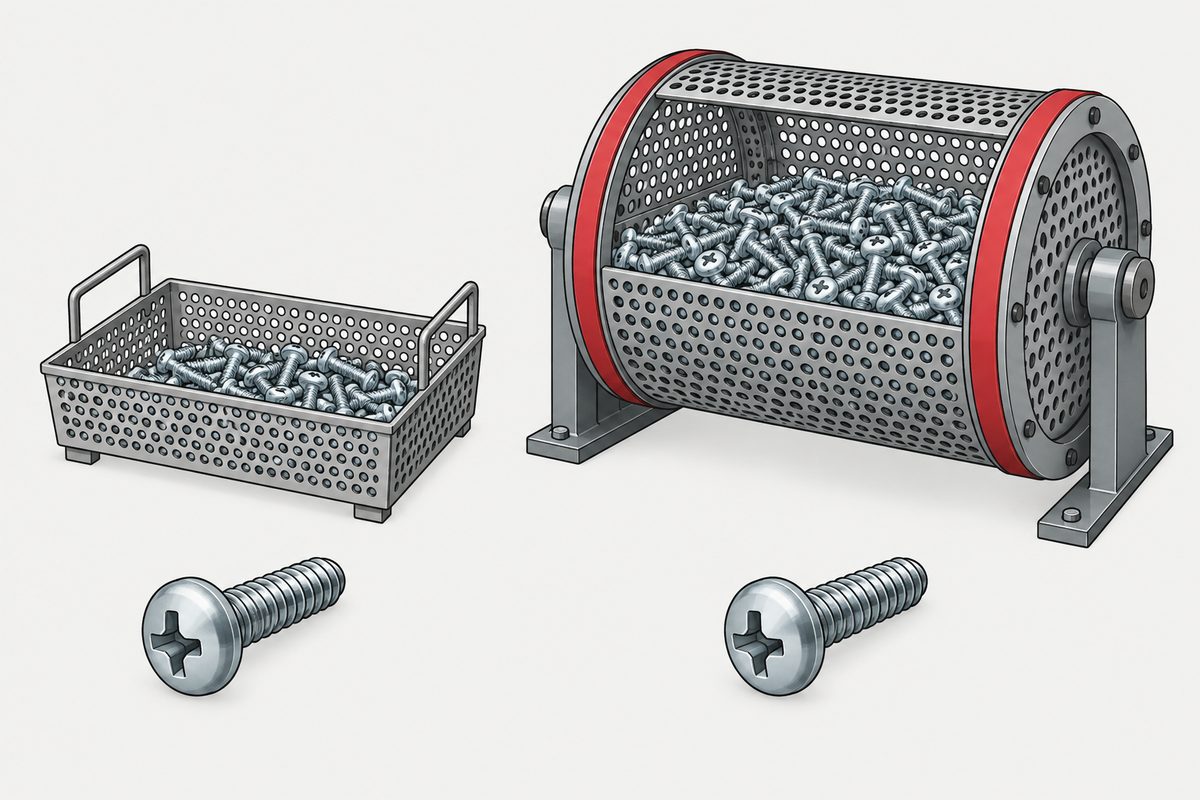
It arrives as one number, so it looks negotiable
A quotation says minimum order 50,000 pieces. One line, one figure, no working shown. Everything else on that page — unit price, tooling, lead time — has some give in it if you ask, so it is reasonable to assume this does too.
Buyers push back on it because pushing back on numbers is the job, and sometimes it moves. When it does not move at all, the usual conclusion is that the supplier does not want the order.
So ask them to lower it — and there is nothing there to lower
A screw passes through several stations between wire and packing. Each has its own view of how little it is sensible to run, and those views have unrelated causes:
| Station | Batch is set by | When it becomes your constraint |
|---|---|---|
| Wire | The weight of a coil | Your material or diameter is not stocked |
| Heading | Tool change and setup time | Almost any custom part |
| Thread rolling | Changing rolls and setting up | Non-standard thread or size |
| Heat treatment | Minimum sensible run on a continuous line, or a batch furnace load | Treatment needed and your quantity cannot justify a run or a changeover |
| Finishing | Barrel or rack load | Colour or system is not one that runs often |
| Inspection and documents | Certificates tied to a traceable inspection unit, sampling per lot | Small quantities, where fixed cost dominates |
Your MOQ is driven mainly by whichever station has to do something dedicated for your part. Not the sum, and not the average.
It is not a simple maximum, though. An economic batch size comes out of setup cost and inventory holding cost together, plus the supplier's own scheduling, credit and margin position. What this page explains is why the number lands in the order of magnitude it does — not a claim that it can be computed exactly.
So when two similar drawings differ tenfold, the answer is usually simple: one of them changed the material and the other only changed the length.
Why changing the material costs so much more than changing the length
This is the most common trap and the most avoidable, so it is worth the numbers.
Wire is bought and delivered by the coil. If your material and diameter are stocked, your order takes a length off an existing coil and other orders absorb the rest. Specify a material the factory does not run and a coil has to be opened for you — and a coil makes far more pieces than you asked for. Whether an existing coil can be shared is not guaranteed either: heat traceability, a customer-specified source, the length left on it and the cost of a changeover all bear on that, so ask rather than assume.
You can estimate that yourself. Steel is about 7.85 g/cm³. Treating a screw as a shank cylinder plus a head cylinder: M4×10 is roughly 1.8 g, M5×12 roughly 3.3 g, M6×16 roughly 6.0 g. So assuming a 1,000 kg coil, that is on the order of 560,000 pieces in M4×10 and 170,000 in M6×16. Published cold heading wire packs run from around a hundred kilos to over two tonnes, so treat 1,000 kg as a convenient round number rather than a typical stocked weight.
That is a rough estimate. It ignores the real head shape, the thread, and losses to trimming and setup, and stocked coil weights differ between factories. It is not a basis for a quotation. It exists to show one thing: between “a coil opened for you” and “the quantity you want” there are usually one to two orders of magnitude.
Changing the length is a different kind of change. The wire is the same; you are paying for a tool change and a setup. That is time, not material, and time can be spread by running more. Material cannot — the other 900,000 pieces of wire do not disappear because you ordered another hundred thousand.
So the first practical rule: ask whether the material is one they run, before you ask the price. That question moves the number further than haggling does.
The plating barrel is the other invisible floor
Finishing is normally done a batch at a time, in a barrel or on racks. A barrel has a sensible load, and underloading it is not merely wasteful — coating uniformity suffers too, because parts tumbling in a barrel rely on contact with each other to carry current.
So “I only need five thousand, and only zinc” is not a small request in process terms. If that finish is one the factory runs often, your parts may share a load with other orders — not necessarily, since substrate, part shape, thickness, passivation, traceability and de-embrittlement requirements can each prevent it. If it is not, the barrel runs for you alone.
This is also why a plain zinc finish is cheap and easy to negotiate while a particular colour or coating system suddenly comes with a minimum. Sharing is part of it; but a special finish can genuinely cost more too — different chemistry, pre- and post-treatment, baking, thickness control, effluent handling and inspection. Both can be true at once, which is why they are worth asking about separately. (Which finish to choose, and how long it lasts, are covered elsewhere; this page is only about what it does to batch size.)
Tooling charges and MOQ are different things
Conflating them puts the emphasis in the wrong place during a negotiation.
- A tooling charge is closer to one-off. The tool exists afterwards and the next batch reuses it. But it is a consumable rather than a permanent asset — punches, die inserts and thread rolls wear and crack, and the literature records cold-forging inserts failing after nine thousand-odd parts. Who owns the tool, how long it is kept, and whether a design change means recutting are all quotation terms.
- MOQ recurs every batch. The tool is still there, but the setup time, the barrel and the coil weight are still there too.
The classic consequence of mixing them up is the assumption that “the first batch is expensive but the second will be cheap”. The second batch usually does lose the tooling charge — provided the tool is still serviceable and still being kept — and the MOQ does not shrink because of it. If your annual usage was already below the minimum, the second order has exactly the problem the first one had.
Which is why it is worth insisting the two are quoted as separate lines. It is the same discipline as what belongs in an enquiry: separate the things that were bundled, so each can be checked on its own.
What about prototypes
“I need a thousand to validate the design” is an entirely reasonable request that meets an entirely reasonable refusal. Not because the factory dislikes small work, but because those thousand pieces run down the same line as production. The setup is not shorter and the barrel is not smaller.
Two approaches work better:
- Validate the concept with a stocked part close to your specification. If what you need to prove is that it fits, holds and does not loosen, a stocked part usually answers it. Leave the custom version until the design is settled.
- Accept a high unit price for the prototype, but require it to come off the same line. A sample made by a different process proves nothing about production — which is the whole argument of the page on the sample stage.
Be careful with the third option: switching to a supplier with a different process purely to get a smaller prototype run. Those samples can still settle fit, interference, form and handling, which barely depend on the process. What they cannot settle is whether the production process itself will hold — so once the design is fixed you still need samples made the production way.
What to ask when the MOQ comes back too high
“Can it be lower?” is worth asking, but it is usually asked too early. Many minimums are the lowest quantity at that price, not a physical limit — a supplier may take a smaller run against a setup surcharge, a higher unit price, an annual commitment delivered in parts, or by piggybacking on production already scheduled. Those options only appear if you ask. But the more useful first question is which station set the number, because that decides which of those workarounds can apply.
- “Is this minimum driven by the wire, the setup, or the finishing?” — three answers, three completely different remedies.
- “If the material changed to a grade you stock, would the number change?” — if yes, you have found your lever.
- “If the finish changed to one you run often, would the number change?” — likewise.
- “Which of these steps do you subcontract?” — you cannot move a subcontractor's batch, but a supplier who owns that step might.
- “Quote the tooling and the MOQ separately.” — not a question, a requirement.
- “If I accept a setup surcharge or a higher unit price, how low can the quantity go?” — this is what “can it be lower” should actually look like.
What those five have in common is that they turn an apparently arbitrary number back into a list of causes you can check one at a time. Which is what this series keeps doing — starting from the order in which a screw gets specified, every convention has a why underneath it that you are allowed to ask about.
Common questions
Why do two similar screws come back with very different MOQs?
Because the minimum is set by whichever station your part is unusual at. Wire comes by the coil, heading and rolling cost a setup, heat treatment is a furnace load, plating is a barrel. Changing a length touches the setup; changing the material can mean opening a coil for you.
Is MOQ negotiable?
Less than people assume — a plating barrel does not shrink on request. The effective move is to ask which specification is driving it up, then check whether that specification is genuinely needed.
Are tooling charges and MOQ the same thing?
No. Tooling is one-off and reusable; MOQ recurs on every batch. Mixing them up produces the belief that the second order will be cheap — it loses the tooling charge and keeps the minimum.
I need a thousand for a prototype. Why fifty thousand?
Because those run down the same line as production. It is usually not a refusal but the point below which the unit price stops making sense. Ask whether a stocked part can validate the concept first.
Does a high MOQ mean they do not want small orders?
Not readable from the number. A factory with every station in house and one that subcontracts plating will quote the same part differently. Ask which station set it.
Related
- The order in which to specify a screw — every specification moves the minimum; this is their sequence
- What to put in a fastener enquiry — separating what was bundled
- The samples arrived and they fit — why a prototype has to come off the same line
- Why lead times slip — the same process chain, a different symptom
- Choosing a finish — how the choice affects whether a load can be shared
- Reading a mill test certificate — what inspection unit a certificate is tied to
Enquiries
If a minimum you have been quoted looks unreasonable, send us the drawing and we will tell you which station is holding it up and which change would actually move it. Below M6 we run wire, tooling, rolling and inspection in house, so it is a question we can answer.
Request a quotation
Tell us the part and the quantity. We will come back on feasibility, lead time and price.
Or email us directly sales@tigerfasteners.com