 TIGERFASTENERS
Choosing a finish below M6: the coating is a dimension
The short version: at small sizes, a finish is a dimension before it is a corrosion property. Coating tables rank processes by salt spray hours, which invites you to pick the best number and move on. But hot-dip galvanizing puts 50–100 µm on the surface, and an M2 thread has a total tolerance measured in tens of microns — the best-performing finish in the table is not merely expensive here, it is geometrically impossible. So the order of the questions has to change.
The comparison, with the column that is usually missing
| Process | Typical thickness | Electrolytic? | Where it fails below M6 |
|---|---|---|---|
| Electroplated zinc | Roughly 3–12 µm by class | Yes — charges hydrogen | Workable, but the thickness class has to be chosen against the thread tolerance, not against a corrosion target |
| Electroplated zinc-nickel | Similar range | Yes — charges hydrogen | More corrosion resistance per micron than zinc, which is exactly the trade you want when microns are scarce |
| Zinc flake (dip-spin) | Roughly 5–25 µm | No — not an electrolytic process | Thickness control is less uniform than plating, and small recesses can pool or bridge |
| Hot-dip galvanizing | 50–100 µm | No | Not applicable. The coating exceeds the whole thread tolerance; the standard practice of over-tapping the nut does not exist at these sizes |
| Black oxide | Essentially no dimensional change | No | Essentially no corrosion protection without oil, and the oil is consumed. It is an appearance and mild anti-galling finish, and its standard sets no measure of appearance at all |
Read the table down the third and fourth columns first, then the first. A buyer who reads it as a corrosion ranking picks hot-dip and gets a quotation that says no; a buyer who reads it as a dimensional problem arrives at zinc-nickel or zinc flake without ever needing to be talked out of anything.
Why thickness stops being free below M6
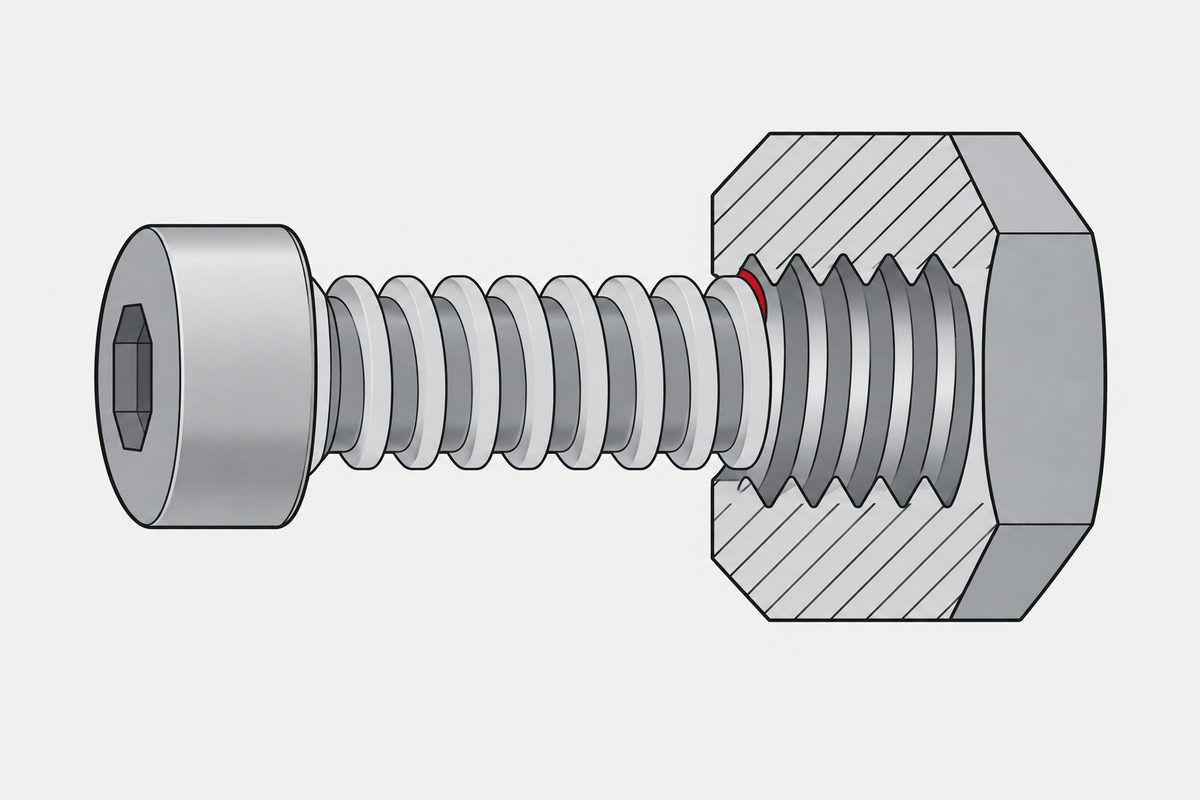
Coating goes on both the screw thread and, if the mating part is threaded, the nut thread. The clearance between them has to absorb both, and that clearance does not scale down as fast as the screw does:
- The pitch shrinks, so the flanks come closer. The same 8 µm deposit that disappears into an M10 thread is a significant fraction of an M1.6 one
- Coating on a flank is measured perpendicular to the surface, but it eats clearance along the pitch diameter — the effect on fit is larger than the thickness figure suggests
- Deposition is uneven. Crests get more, roots get less — so the number that matters for fit is the maximum on the crest, not the average
This is why the finish decision has to come before the thread tolerance decision, not after. At M1–M1.4 the tolerance sets nothing aside for coating at all, and the pitch at those sizes is smaller than the diameter ratio suggests, and a drawing that specifies both a fine tolerance and a thick coating is asking for something that cannot be manufactured — usually discovered after the tooling exists.
The second column decides whether the screw can break
Every electrolytic process puts hydrogen into the steel. Below a certain strength that does not matter; above it, it produces delayed fracture — failures hours or days after assembly, which incoming inspection cannot catch.
- If the part is hardened and highly stressed, the non-electrolytic route exists specifically for this reason — zinc flake is dip-spin applied, not plated
- If it is electroplated anyway, the bake is not optional and the delay before it is a controlled variable, not a scheduling preference
- If the choice on the table is actually plated steel versus stainless, that is a strength decision as much as a corrosion one
- If the part is a low-carbon steel screw at ordinary strength, this column is not your problem — and paying for a zinc flake process to solve it would be paying for nothing
Three questions that pick the finish for you
- What does the screw touch, and is there an electrolyte? Dissimilar metals plus moisture is a different mechanism from atmospheric corrosion, and the fastener is usually the small side of the couple — a better coating does not fix a bad pairing
- Is the part hardened? If yes, the electrolytic column is a risk to be managed rather than a free choice
- What thread tolerance is on the drawing? This one is answered by arithmetic, and it eliminates options faster than the other two
Note what is not on the list: salt spray hours. They belong at the verification stage, not the selection stage — the test compares processes, it does not predict service life, and specifying hours makes a supplier optimise for the cabinet rather than for your joint.
Side by side across more finishes than fit in one table, see comparing finishes; how long a coating actually lasts is in estimating coating life; and what happens when two of them meet in one assembly is in mixed coatings.
If the joint puts two metals together, coating only the anode is the trap — the anodic index table.
What to ask a supplier, and what a straight answer sounds like
- Is plating in-house or outsourced? Both are normal. What matters is whether the answer is specific, because it determines who controls the bake clock and who holds the records
- What thickness class, measured where? “Zinc plated” is a colour, not a specification — and even the minimum on a certificate is the lowest of several averages, not a floor that holds everywhere
- Is there a supplementary passivate or sealer? Much of the corrosion figure comes from this layer rather than the zinc — and it is also what decides how the parts survive the weeks in a container before first use
- What happens to the thread gauge after coating? If the answer is that gauging is done before plating only, the fit risk has not been checked at all
The last one is the highest-yield question on the list, and it is almost never asked. A part that gauges correctly bare and binds after coating was never verified in the condition it ships in.
This page covers step 5, the finish. The whole order is substrate, thread, head, drive, finish, documentation, and why doing it out of order is rework rather than a tweak is in specifying a screw.
Common questions
Can you hot-dip galvanize an M2 screw?
No. Hot-dip galvanizing deposits roughly 50 to 100 micrometres, which exceeds the entire thread tolerance of a small metric thread. On larger fasteners the accepted practice is to over-tap the mating nut to make room for the coating; that practice does not extend down to sizes in the M1 to M3 range. At these sizes the realistic options are electroplated zinc, electroplated zinc-nickel, or a zinc flake dip-spin coating.
Which finish gives the most corrosion resistance per micron of thickness?
Of the electroplated options, zinc-nickel gives more corrosion resistance per micron than plain zinc, which is the relevant trade when thread tolerance limits how many microns are available. Zinc flake systems achieve high corrosion figures at moderate thickness and are applied without electrolysis, so they do not charge hydrogen into the steel during the coating process.
Does black oxide prevent rust?
Not on its own. Black oxide produces essentially no dimensional change, which makes it attractive on fine threads, but it provides very little corrosion protection without a supplementary oil or wax, and that oil is consumed in service. It is best understood as an appearance and mild anti-galling finish rather than a corrosion coating.
Should the finish be chosen before or after the thread tolerance?
Before. Coating consumes thread clearance, deposition is thicker on the crest than in the root, and the effect on fit is larger than the nominal thickness suggests. A drawing that specifies both a tight thread tolerance and a thick coating can be unmanufacturable, and that is usually discovered after tooling exists.
References
- ISO 4042:2022 — Fasteners — Electroplated coating systems (coating thickness classes; hydrogen embrittlement relief)
- ISO 965-2 — ISO general purpose metric screw threads — Tolerances — Part 2
- ISO 10683 — Fasteners — Non-electrolytically applied zinc flake coating systems
- ASTM B633 — Standard Specification for Electrodeposited Coatings of Zinc on Iron and Steel
- Hot-dip galvanization — Wikipedia
Enquiries
Not sure whether the coating on your drawing will fit the thread you have specified? Send the drawing with the thread tolerance and the coating callout. We will work through the clearance and say whether it fits — and if it does not, which of the two we would change and why.
Request a quotation
Tell us the part and the quantity. We will come back on feasibility, lead time and price.
Or email us directly sales@tigerfasteners.com