 TIGERFASTENERS
Zinc plated or stainless: two different questions, one decision
The short version: “stainless is better” collapses two separate questions into one. Zinc is a consumable — a sacrificial layer with a finite amount of material that will eventually be used up. Stainless is the material itself, repairing its own passive film indefinitely wherever there is oxygen to repair it with. Those are different kinds of protection, not different amounts. And at the same size, the stainless fastener is the weaker one — which is the half of the trade that rarely reaches the change request.
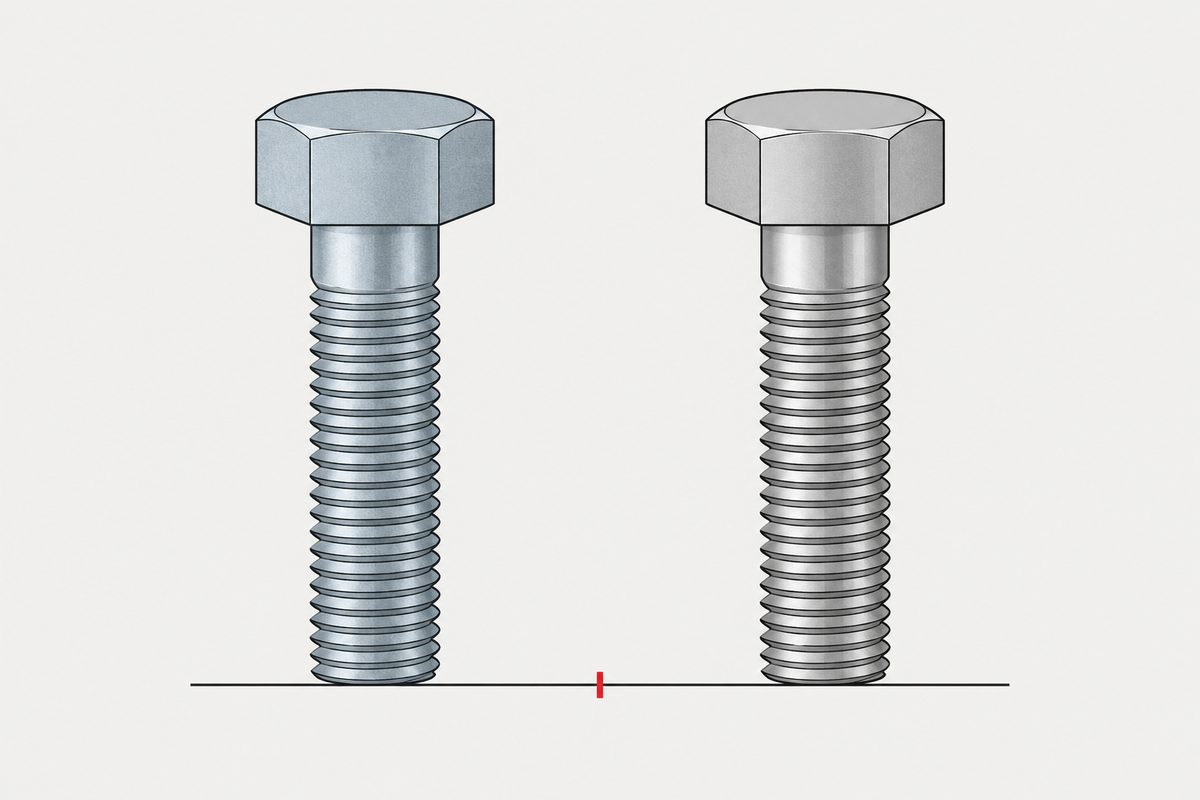
Everyone ranks them, and the ranking mostly works
Zinc-plated is the cheap one, stainless is the good one. That is how they get quoted, how they get compared, and how a purchasing decision usually gets made. It is not a foolish way to think about it.
It also predicts the right answer in ordinary indoor use, which is most use. Where it breaks is anywhere the environment does something specific rather than something general.
So stainless is just the better one — and that is not the comparison
| Zinc plated carbon steel | Stainless | |
|---|---|---|
| Mechanism | Sacrificial. Zinc corrodes preferentially so the steel does not | Self-repairing passive film, formed by the alloy itself |
| Lifetime | Finite. There is a fixed amount of zinc; when it is gone, protection ends | Indefinite — where oxygen reaches. In a crevice it is not indefinite at all |
| Damage tolerance | Good. A scratch is still protected by surrounding zinc | Good, but conditional. The film re-forms only if oxygen is present |
| Failure mode | Gradual: white rust, then red rust when consumed | Local and sudden: pitting and crevice corrosion |
The failure modes are the useful row. Zinc warns you — it goes white, then brown, over time. Stainless does not warn you; it looks perfect until a pit has already gone deep, and a screw is a series of oxygen-starved crevices by construction. On an inspectable joint, gradual and visible is worth more than perfect-looking.
Swapping to stainless makes the joint weaker
This is the part that surprises people, because “upgrade to stainless” sounds like an upgrade in every respect:
- A common carbon steel property class carries a minimum tensile strength of around 800 MPa at class 8.8, while a common stainless class, A2-70, is around 700 MPa. Same size, less strength
- The tightening torque has to be lower too, not just because of strength but because stainless has a higher friction coefficient and galls — so the same torque produces a different clamp force
- The strength grade and the corrosion grade are independent. A4-80 encodes two decisions and buyers routinely change one while assuming they changed both
So “change it to stainless” is a strength change disguised as a corrosion change, and if the joint was sized against the original class, it needs re-checking — the re-verification is the real cost of the swap, not the unit price.
Galling: a failure mode the zinc coating largely prevents
Stainless against stainless can cold weld under pressure and sliding — the threads seize partway in, and the part is then neither installed nor removable.
- It happens during assembly, so it is a line-stoppage problem rather than a field problem
- Speed makes it worse. Powered drivers generate more interface heat than hand tightening
- Zinc plating has some lubricity, which is part of why carbon steel joints tolerate rougher handling
- If stainless is required, the mitigation is lubricant or a dissimilar pairing — and a lubricant changes the friction coefficient, which changes the clamp force again
The usual account of why stainless does this is inverted, and it is worth knowing which way round it goes: the oxide layer does not cause galling, it delays it.
Magnetism: the column that matters at our size range
- “Stainless is non-magnetic” is only true of austenitic grades in the annealed condition
- Cold forming induces some martensite in the microstructure, and a screw is made by cold forming — the head and the thread both. So a finished A2 screw is commonly weakly magnetic
- For most products this is irrelevant. For sensors, speakers, hard drives and precision instruments it is not — and it is the kind of requirement that gets discovered at qualification rather than at design
If low magnetic permeability is an actual requirement, state it as a requirement with a limit — not as the word “stainless”. Specifying a material and hoping for a property is how this one goes wrong.
Four questions that decide it
- Will anyone ever look at this joint again? If it is inspectable or replaceable, zinc’s visible, gradual failure is a feature and the cost saving is real. If it is buried for the life of the product, that argument disappears
- Is chloride present? Salt air, cleaning chemicals, sweat. If yes, plain zinc is short-lived and even A2 may not be enough — the molybdenum-bearing group is what that question is about
- What does the screw touch? Dissimilar metals plus moisture is a third mechanism, and the fastener is usually the small side of the couple — stainless into aluminium is a worse pairing than zinc into aluminium
- Was the joint sized against the original strength class? If yes, the swap is a structural change
It is often not a choice between two things
The framing itself is usually the problem. Between plain zinc and stainless sit the options that solve the actual complaint:
- Zinc-nickel — more corrosion resistance per micron than zinc, on the same carbon steel strength
- Zinc flake — high corrosion figures without an electrolytic process, which also removes the hydrogen embrittlement risk on hardened parts
- A thicker zinc class plus a supplementary sealer — often the cheapest real improvement
All three keep the carbon steel strength. Which of them fits below M6 is a thread clearance question before it is a corrosion question — and that is the constraint that eliminates options fastest at these sizes.
This page covers step 5, the finish. The whole order is substrate, thread, head, drive, finish, documentation, and why doing it out of order is rework rather than a tweak is in specifying a screw.
Common questions
Are stainless screws stronger than zinc plated screws?
At the same size, usually not. A common carbon steel property class such as 8.8 carries a minimum tensile strength around 800 MPa, while a common stainless class such as A2-70 is around 700 MPa. Stainless also has a higher friction coefficient and galls, so the tightening torque must be lower as well. Changing to stainless for corrosion reasons is therefore also a strength change, and a joint sized against the original class needs re-checking.
Which lasts longer outdoors, zinc plated or stainless?
It depends on whether the joint is inspectable. Zinc is sacrificial and finite: it corrodes preferentially to protect the steel, goes white and then brown, and gives visible warning as it is consumed. Stainless repairs its own passive film indefinitely wherever oxygen reaches it, but a screw is a series of oxygen-starved crevices by construction, so it can look perfect while a pit goes deep. For a buried, unserviceable joint stainless is generally the safer choice; for one that gets looked at, zinc’s gradual visible failure is worth something.
Are stainless steel screws magnetic?
Austenitic grades such as A2 are non-magnetic in the annealed condition, but cold forming induces some martensite in the microstructure — and a screw is made by cold forming. A finished A2 screw is therefore commonly weakly magnetic. If low magnetic permeability is a real requirement, for sensors, speakers, drives or instruments, specify it as a requirement with a limit rather than relying on the word stainless.
Why do stainless screws seize during assembly?
Galling. Cold welding is a common initiating event rather than a synonym for it. Under pressure and sliding, stainless against stainless can weld at the thread contact, seizing partway in so the part is neither installed nor removable. It is an assembly-line problem rather than a field one, and powered drivers make it worse by generating more interface heat. Mitigations are lubricant or a dissimilar pairing — and a lubricant changes the friction coefficient, which changes the clamp force obtained from a given torque.
Is there anything between zinc plating and stainless?
Yes, and it is usually the better answer. Zinc-nickel gives more corrosion resistance per micron than plain zinc on the same carbon steel strength; zinc flake achieves high corrosion figures without an electrolytic process, which also removes the hydrogen embrittlement risk on hardened parts; and a thicker zinc class with a supplementary sealer is often the cheapest real improvement. All three keep the carbon steel strength that a stainless swap would give up.
References
Enquiries
Considering a change from zinc plated to stainless? Send the current specification, the service environment, and what the screw is threaded into. We will come back with what the swap costs in strength and torque as well as in price — including the common case where a different finish on the same carbon steel solves the corrosion complaint without touching the strength class.
Request a quotation
Tell us the part and the quantity. We will come back on feasibility, lead time and price.
Or email us directly sales@tigerfasteners.com