 TIGERFASTENERS
Stainless screws do rust: three kinds, one material problem
The short version: stainless is not rust-proof — it is self-repairing. A very thin passive film protects it, and that film needs oxygen to form and to heal. So the useful question is not “did we get counterfeit stainless” but which kind of rust is this — surface contamination, pitting, or crevice corrosion. The three have different causes, consequences and remedies, and only one of them is actually about the material.
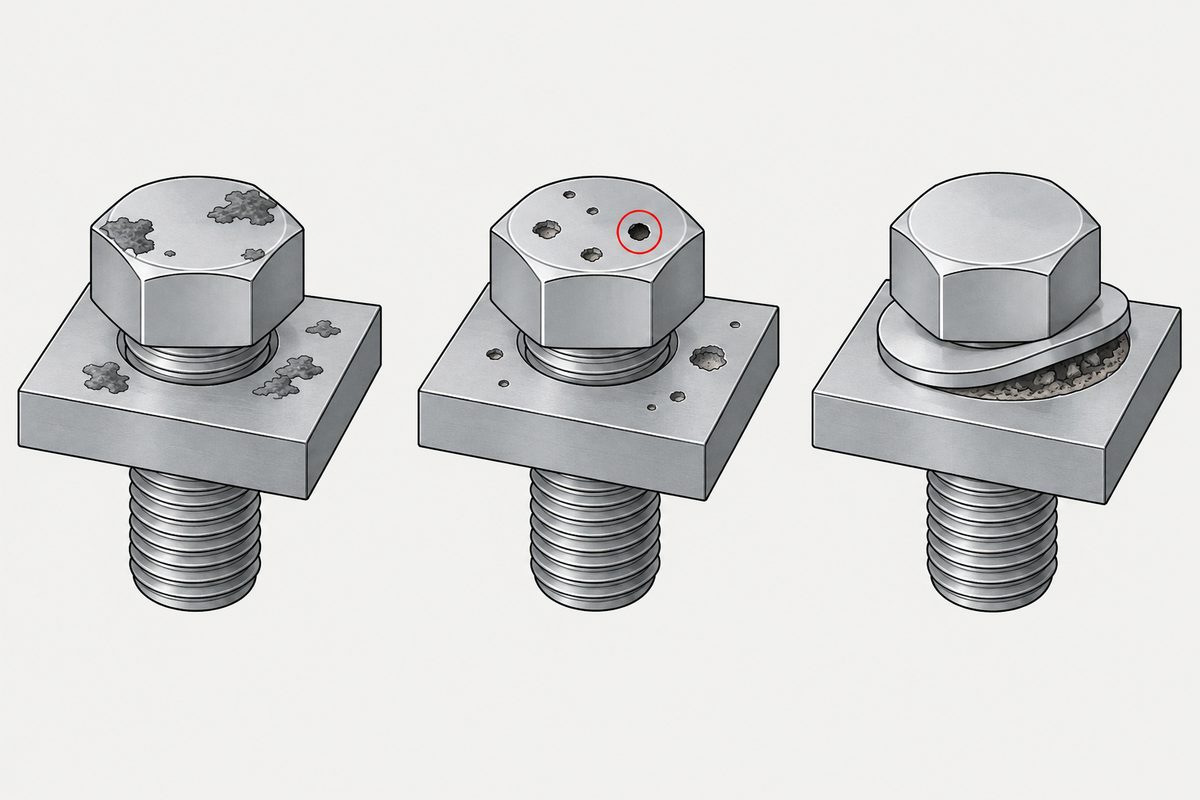
Establish which one first
| Type | Cause | Appearance | A material problem? |
|---|---|---|---|
| Surface contamination | Free iron from carbon steel tooling, fixtures or pallets | Scattered spots, usually wipe off, no pit underneath | No — the iron rusts, not the fastener |
| Pitting | Chloride breaking the passive film on an open surface | Small holes; section loss often worse than it looks | Yes — a question of grade |
| Crevice corrosion | Oxygen starvation in a narrow gap | Hidden between threads, under the head, beneath washers | Partly — but mostly design and environment |
Treating all three as one problem produces the wrong decision. Upgrading to a more expensive grade because of free iron spends money and leaves the cause in place; polishing out genuine pitting removes the evidence rather than the cause.
Why the fastener is the part that gets caught
All three conditions are present on a single screw:
- A thread is a series of crevices. The space between flanks is narrow and oxygen does not reach it — the defining condition for crevice corrosion
- The underhead bearing face is also a crevice, as is the annulus beneath a washer
- Driving it scratches the passive film. Driver torque, friction against the hole, and contact with dissimilar metals all create initiation sites at the moment of assembly
- It is the smallest piece of metal in the assembly, so the same amount of attack is proportionally far worse
So “same stainless, the sheet is fine and the screws rusted” is not a contradiction — it is what you would expect. The sheet is an open surface with plenty of oxygen and the film holds. The screw is not.
Three checks you can make on the bench
- Does it wipe off? Use a clean white cloth and a chloride-free cleaner. If what is underneath is bright and unpitted, it is most likely free iron contamination
- Is it scattered or concentrated? Scattered points to contamination; concentrated in the threads, under the head or at washer faces points to crevice corrosion
- Is there a pit? Look with magnification. A hole means pitting, and that is not a surface problem — do not polish it away
These three are useful in a rejection dispute, because they turn “this batch is bad” into three verifiable cases — and responsibility differs: contamination usually sits in machining and logistics, pitting in grade selection, crevice corrosion in design and service environment.
So passivate it — and that is not the process you meant
- Pickling dissolves surface metal and inclusions — the more aggressive treatment
- Passivation removes free iron and promotes the passive film, without setting out to remove parent material
For free iron contamination, passivation is generally enough. At small sizes, though, any acid treatment has to be weighed against hydrogen embrittlement — thin sections carry a higher proportion of hardened layer, and ISO 4042 grants no shortened-bake exception for small parts.
This page covers step 5, the finish. The whole order — substrate, thread, head, drive, finish, documentation — and why doing it out of order is rework rather than a tweak, is in specifying a screw.
Three questions before choosing a grade
- Is chloride present? If so, move toward the molybdenum-bearing group — that is what separates A2 from A4, not strength
- What metal does it touch? Dissimilar metals plus an electrolyte is a separate mechanism, and the fastener is usually the small side
- Does anything in machining or logistics involve carbon steel? The most frequently missed question, and the one whose rust is most often misread as a material fault
Put the service environment on the enquiry — one sentence is enough. A supplier who knows where the parts are going can flag the wrong grade before production; one who receives only a part number cannot.
Enquiries
Received a batch with rust spots and not sure which kind it is? Send photographs, the service environment and the current specification. We will help establish whether it is contamination, pitting or crevice corrosion — including the case where the batch is actually fine.
Request a quotation
Tell us the part and the quantity. We will come back on feasibility, lead time and price.
Or email us directly sales@tigerfasteners.com