 TIGERFASTENERS
Thread-Forming Screws
A trilobular screw has a three-lobed section and displaces material rather than cutting it. No swarf makes it suitable where debris is unacceptable, and the displaced zone shows plastic deformation, elongated grains and local work hardening. Higher pull-out strength than a cut thread is not something we will claim between the two screw types — the sound comparative studies are between forming and cutting taps, and that does not carry across. What the evidence does and does not support.
Specification options
| Volume range | M1.0 – M5.0 |
|---|---|
| Maximum size | M16 |
| Standards | DIN 7500-1:2021-07 · DIN 7500-2:2016-04 ISO 7085 was withdrawn 2010-02-10; no current ISO equivalent |
| Materials | see Materials |
| Finishes | see Finishes |
| Minimum order | From 10,000 pcs, depending on the part |
The two numbers cover different things, and the hole is in part 2. DIN 7500-1 gives the technical delivery conditions for thread rolling screws for ISO metric thread, case hardened and tempered. DIN 7500-2 gives guideline values for hole diameters — the word in the title is Richtwerte, guideline values, not requirements. ISO 7085 carried the mechanical and performance requirements for the same case hardened and tempered screws, but it was withdrawn on 2010-02-10 and no current ISO equivalent replaced it — the European version went over technical problems with its breaking torque and hardness provisions, and DIN 7500-1 took over. A drawing that still calls out ISO 7085 is citing a document that no longer exists. The first item under “where it most often goes wrong” below is the hole tolerance window, and the document behind it is the one that only offers guideline values — so the hole belongs to your drawing. The standards position in full, including why DIN 7500-1 does not specify the trilobular section.
Head styles
%20Pan%20Head'%3e%3ctitle%3e圓頭(盤頭)%20Pan%20Head%3c/title%3e%3cg%20fill='none'%20stroke='%2316181A'%20stroke-width='2.4'%20stroke-linejoin='miter'%20stroke-linecap='butt'%3e%3cpath%20d='M%2034%2046%20L%2034%2037%20Q%2034%2026%2060%2026%20Q%2086%2026%2086%2037%20L%2086%2046%20Z'%20/%3e%3cpath%20d='M%2049%2046%20L%2052%2049.5%20L%2049%2053%20L%2052%2056.5%20L%2049%2060%20L%2052%2063.5%20L%2049%2067%20L%2052%2070.5%20L%2049%2074%20L%2052%2077.5%20L%2049%2081%20L%2052%2084.5%20L%2049%2088%20L%2052%2091.5%20L%2049%2095%20L%2052%2098.5%20L%2049%20102%20L%2052%20105.5%20L%2049%20109%20L%2052%20112.5%20L%2049%20116%20L%2052%20119.5%20L%2049%20123'%20/%3e%3cpath%20d='M%2071%2046%20L%2068%2049.5%20L%2071%2053%20L%2068%2056.5%20L%2071%2060%20L%2068%2063.5%20L%2071%2067%20L%2068%2070.5%20L%2071%2074%20L%2068%2077.5%20L%2071%2081%20L%2068%2084.5%20L%2071%2088%20L%2068%2091.5%20L%2071%2095%20L%2068%2098.5%20L%2071%20102%20L%2068%20105.5%20L%2071%20109%20L%2068%20112.5%20L%2071%20116%20L%2068%20119.5%20L%2071%20123'%20/%3e%3cpath%20d='M%2049%20123%20L%2071%20123'%20/%3e%3c/g%3e%3c/svg%3e)
%20Countersunk%20/%20Flat%20Head'%3e%3ctitle%3e皿頭(平頭)%20Countersunk%20/%20Flat%20Head%3c/title%3e%3cg%20fill='none'%20stroke='%2316181A'%20stroke-width='2.4'%20stroke-linejoin='miter'%20stroke-linecap='butt'%3e%3cpath%20d='M%2030%2026%20L%2090%2026%20L%2071%2046%20L%2049%2046%20Z'%20/%3e%3cpath%20d='M%2049%2046%20L%2052%2049.5%20L%2049%2053%20L%2052%2056.5%20L%2049%2060%20L%2052%2063.5%20L%2049%2067%20L%2052%2070.5%20L%2049%2074%20L%2052%2077.5%20L%2049%2081%20L%2052%2084.5%20L%2049%2088%20L%2052%2091.5%20L%2049%2095%20L%2052%2098.5%20L%2049%20102%20L%2052%20105.5%20L%2049%20109%20L%2052%20112.5%20L%2049%20116%20L%2052%20119.5%20L%2049%20123'%20/%3e%3cpath%20d='M%2071%2046%20L%2068%2049.5%20L%2071%2053%20L%2068%2056.5%20L%2071%2060%20L%2068%2063.5%20L%2071%2067%20L%2068%2070.5%20L%2071%2074%20L%2068%2077.5%20L%2071%2081%20L%2068%2084.5%20L%2071%2088%20L%2068%2091.5%20L%2071%2095%20L%2068%2098.5%20L%2071%20102%20L%2068%20105.5%20L%2071%20109%20L%2068%20112.5%20L%2071%20116%20L%2068%20119.5%20L%2071%20123'%20/%3e%3cpath%20d='M%2049%20123%20L%2071%20123'%20/%3e%3c/g%3e%3c/svg%3e)


Drive types


Choosing the thread
-
Trilobular section
The lobes sweep the hole wall continuously as the screw turns — there are no three fixed contact points and the forming does not pause. What the shape does is reduce the contact area at any instant, which lowers friction and forming torque. No generally citable percentage exists; if a supplier quotes one, ask which hole, which material and which thickness it was measured on.
Where it most often goes wrong
Each of these causes scrapped lots or rework on the floor. None of them is theoretical.
The hole tolerance window is narrower than for self-tapping. Oversize and the thread forms incompletely with no grip; undersize and driving torque climbs sharply, up to head failure. Look the range up for the material — do not reuse self-tapping hole sizes. How much narrower is worth having in front of you, because it is the figure that decides whether your existing drilling process can hold it:
| Nominal | H11 — forming, DIN 7500-2 | H12 — ST self-tapping, DIN 7975 | Band width |
|---|---|---|---|
| 1 to 3 mm | 0.060 mm | 0.100 mm | 60.0% |
| 3 to 6 mm | 0.075 mm | 0.120 mm | 62.5% |
| 6 to 10 mm | 0.090 mm | 0.150 mm | 60.0% |
Using it in brittle material. Displacement makes the material flow. Cast iron and rigid plastics crack at the hole mouth. Those want a cutting thread instead.
Ignoring the gap between driving and failure torque. That window is narrower than on a machine screw, so automated driving torque has to be established by test rather than copied from machine screw settings.
How length is measured
One rule covers it: if the head sinks into the work, measure overall; if it stays on the surface, measure under the head.
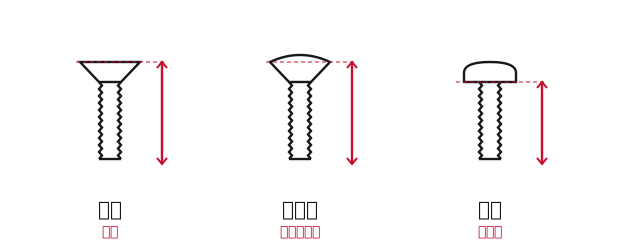
| Head style | Datum | Why |
|---|---|---|
| Countersunk (flat) | Overall length | The head sits flush in the countersink, so it counts |
| Oval (raised countersunk) | Overall to the head diameter | The cone sinks, the dome stays proud; measure to where they meet |
| Pan / round | Under head | The head stays entirely on the surface |
| Button | Under head | Same |
| Hex / hex washer | Under head | Same |
| Socket head cap | Under head | Same |
Full explanation → Where the standards stop at this size → Tolerance stack-up and the screw →
Enquiries
Thread-Forming Screws come in a lot of combinations. Tell us the item, size, material, finish, annual usage and application, and we will come back on feasibility and lead time. A drawing or a sample is fastest — quoting against the real part saves a great deal of guessing.
Volume range M1.0 – M5.0, standard fasteners up to M16. Minimum order From 10,000 pcs, depending on the part.
Request a quotation
Tell us the part and the quantity. We will come back on feasibility, lead time and price.
Or email us directly sales@tigerfasteners.com