 TIGERFASTENERS
Stainless screws into aluminium: which side is the small one?
The short version: dissimilar metals in contact do not automatically corrode. Galvanic corrosion requires three conditions at once — a potential difference, a continuous electrolyte, and an electrical path — and removing any one of them stops it. What sets the severity is often not the materials but the area ratio. A fastener is the smallest piece of metal in the assembly, so whether the screw is the anode or the cathode sends the same material pairing to completely different outcomes.
The same arithmetic applies when the two metals are two coatings on parts that are otherwise identical — a zinc-coated bolt with a black oxide nut is a galvanic couple in which the coating you paid for is quietly protecting the part you did not.
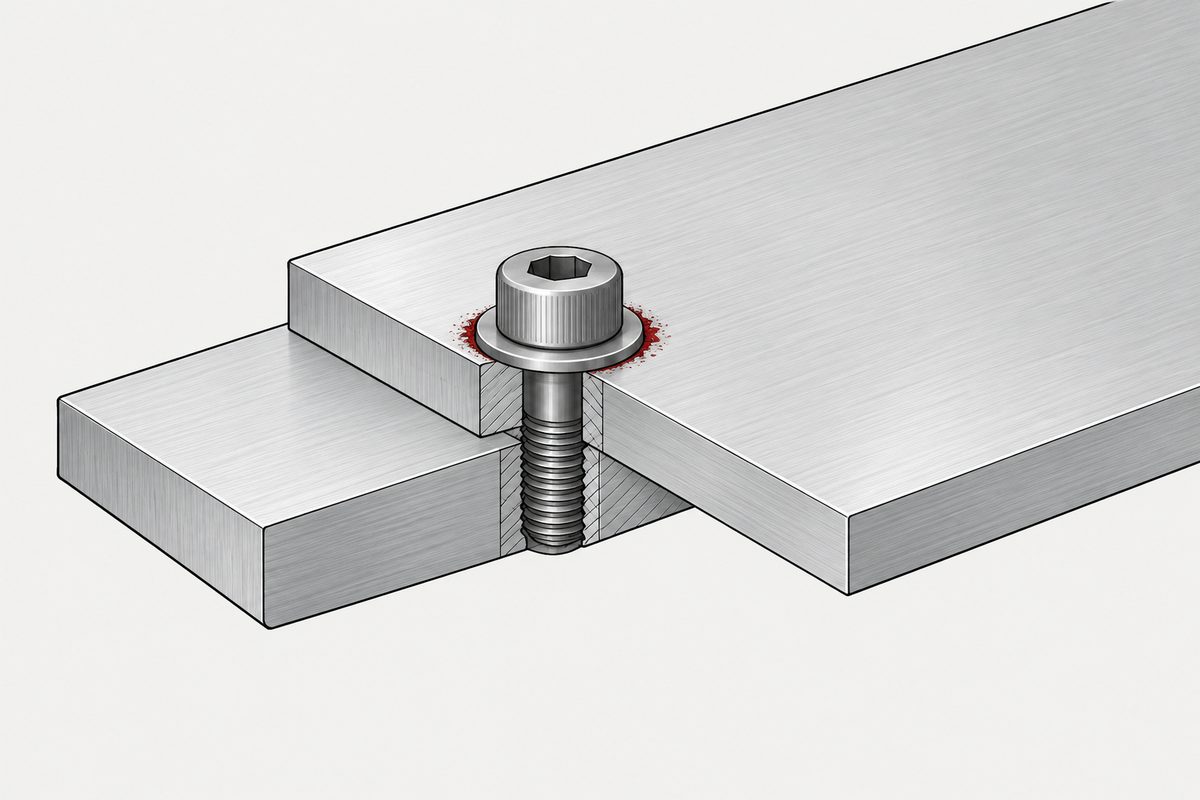
Three conditions, all of them required
| Condition | Meaning | How to break it |
|---|---|---|
| Potential difference | The two metals sit at different potentials in that environment | Choose materials closer together |
| Electrolyte | A continuous conductive film: condensation, salt spray, wash-down, rain | Coating, sealing, drainage, controlling the environment |
| Electrical path | A conductive route between them — usually the contact itself | Insulating washers, insulating sleeves |
All three, or nothing — so “different metals always corrode” is wrong. In a dry indoor cabinet, stainless screws into aluminium last a long time, because the second condition never holds. The joints that break this promise were all called dry: an unconditioned warehouse crosses the dew point at night, road splash carries chloride into assemblies that never see the sea, and wash water sits in thread roots long after the surface looks dry. So count wet hours per year, rather than trusting the room’s name. Establishing whether your environment produces that film is worth more than any materials table.
Severity is set by the area ratio
The total current is a property of the whole cell, but the corrosion happens at the anode. The same current spread over a large area is mild general loss; concentrated into a small one it is rapid local attack.
| Arrangement | Anode | Areas | Outcome |
|---|---|---|---|
| Stainless screw into aluminium | The aluminium | Large anode, small cathode | Attack spread over a large area; comparatively tolerable |
| Aluminium screw into stainless | The screw | Small anode, large cathode | Attack concentrated on the fastener — the worst arrangement |
Which is why fastener material cannot be chosen on “which is more corrosion resistant” alone. The screw is the smallest piece of metal present, so putting it on the anodic side concentrates the whole joint's corrosion current onto it. The general design principle follows: prefer the fastener to be cathodic.
The compatibility table people reach for at this point is attributed to a standard that does not contain it — the anodic index table.
Stainless carries a precondition that gets forgotten
Stainless sits toward the noble end of the galvanic series — but that is stainless in its passive state. The passive layer needs oxygen to maintain itself, and a thread is an oxygen-starved crevice by construction.
Inside such a crevice stainless can lose passivity and shift toward active behaviour, moving its potential and invalidating the relationship you designed around. It is also why crevice corrosion is discussed alongside pitting, and why the molybdenum in A4 opens a gap in chloride environments.
So plate it — and the barrier has a shelf life
A coating either separates the electrolyte or changes the potential at the contact. Its effect depends on staying intact — and once there is wear, scoring from tightening, or an area that was never covered, the exposed base metal is small, which is exactly the unfavourable small-anode condition.
Zinc points the couple the other way. In the seawater series zinc sits anodic to aluminium, so on a zinc-plated screw in an aluminium part it is the coating that corrodes in place of the aluminium — the opposite division of labour from a stainless screw, where the surroundings pay. A 2024 study in Electrochemistry found the polarity held for zinc against A1050 aluminium across 0.01 to 2 M chloride. Treat it as a strong default rather than a physical constant, and remember the micrometres of zinc are a budget: what runs out first decides which way to buy.
At small sizes this is sharper: coatings are thin to begin with, and at M1–M1.4 the thread tolerance sets nothing aside for plating, so the available thickness is limited. Treat plating as something to be maintained, not as a barrier that holds forever.
Four things available in design
- Cut the electrical path. Insulating washers and sleeves — note that both are needed; doing one side still leaves continuity. A screw driven into a tapped hole cannot be isolated this way at all — the thread contact is the joint — so there the working line of defence is the next one down, sealing
- Cut the electrolyte. Coating, sealing, drainage; stop water standing in the joint
- Reduce the potential difference. Choose materials closer together, or keep both sides in one group
- Change the area ratio. Avoid a small anode against a large cathode; where something must be sacrificial, make it the larger part
In practice two or more are combined, because any single measure can fail in service — seals age, insulators get crushed by tightening, coatings wear through. A design resting on one line of defence is betting reliability on that line never failing.
⚠️ Also note: the washer on a SEMS screw is paired at manufacture — if your corrosion strategy needs a washer in a different or insulating material, a SEMS screw cannot deliver it.
Send these together with the enquiry
- What the mating material is — not just “metal”; aluminium, magnesium, galvanised steel and carbon composite all behave differently
- The service environment: dry indoors, inland outdoor, coastal, chloride wash-down
- The material and finish in use now
- Whether there are insulators or seals, and whether servicing removes them
The second is the one most often left out, and it decides whether the three conditions hold at all. One sentence is enough — the same point as the four lines to put on a stainless order.
Frequently asked questions
Do stainless steel screws corrode aluminum?
It is the aluminium that corrodes: it is the anode of the couple, so the attack appears as white deposits and pitting in the aluminium around the hole while the screw stays bright. In a joint that stays genuinely dry the galvanic current is close to nil. The direction is also the tolerable one — a small noble screw in a large aluminium part spreads the attack thin, whereas an aluminium fastener in a stainless assembly concentrates it.
Do zinc-plated screws corrode aluminum?
Usually the opposite. In the seawater series zinc sits anodic to aluminium, so the plating sacrifices itself and protects both the steel underneath and the aluminium around it; a 2024 study confirmed the polarity for zinc against A1050 aluminium from 0.01 to 2 M chloride. It is a strong default rather than a guarantee, and the zinc is a consumable — micrometres of coating are a finite budget of wet hours.
Does a nylon washer stop galvanic corrosion?
On its own, no. It insulates the head face while the threads remain metal to metal, and the threads are most of the contact area. A through-bolt can be genuinely isolated with an insulating sleeve plus washers on both sides; a screw in a tapped hole cannot be electrically isolated at all, so there the working measures are sealing the joint and keeping water out.
This page covers step 5, the finish. The whole order — substrate, thread, head, drive, finish, documentation — and why doing it out of order is rework rather than a tweak, is in specifying a screw.
References
- Galvanic corrosion — Wikipedia
- NASA — fastener design and joint testing report
- Electrochemistry 92 (2024), 24-00061 — Zn/A1050 galvanic polarity in 0.01–2 M NaCl
This page describes mechanism and design trade-offs. Galvanic series ordering varies with environment and reference electrode, so materials are described only by which end of the series they sit toward, without quoting potentials. Material selection follows from your environment and the standards that apply to you.
Enquiries
Fastening into aluminium, magnesium or composite and unsure whether it will hold up? Send the mating material, the environment and the specification in use. We will set out which side is anodic, whether the area ratio is working for or against you, and which line of defence is most likely to fail first.
Request a quotation
Tell us the part and the quantity. We will come back on feasibility, lead time and price.
Or email us directly sales@tigerfasteners.com