 TIGERFASTENERS
A zinc-flake bolt and a black oxide nut is not one question but three
This question comes up on engineering forums in roughly this shape: I have zinc-aluminium flake coated bolts, and the nuts I can get are black oxide, or yellow zinc. Is that a problem?
The replies split into “that is fine” and “never do that”, and both camps sound confident. They are not disagreeing. They are answering different questions.
Mixing coatings on one joint bundles three questions together, and they have three different answers: will they attack each other, which part now decides how long the joint lasts, and what happened to the torque figure. The first is the one everybody asks. The third is the one that goes wrong first.
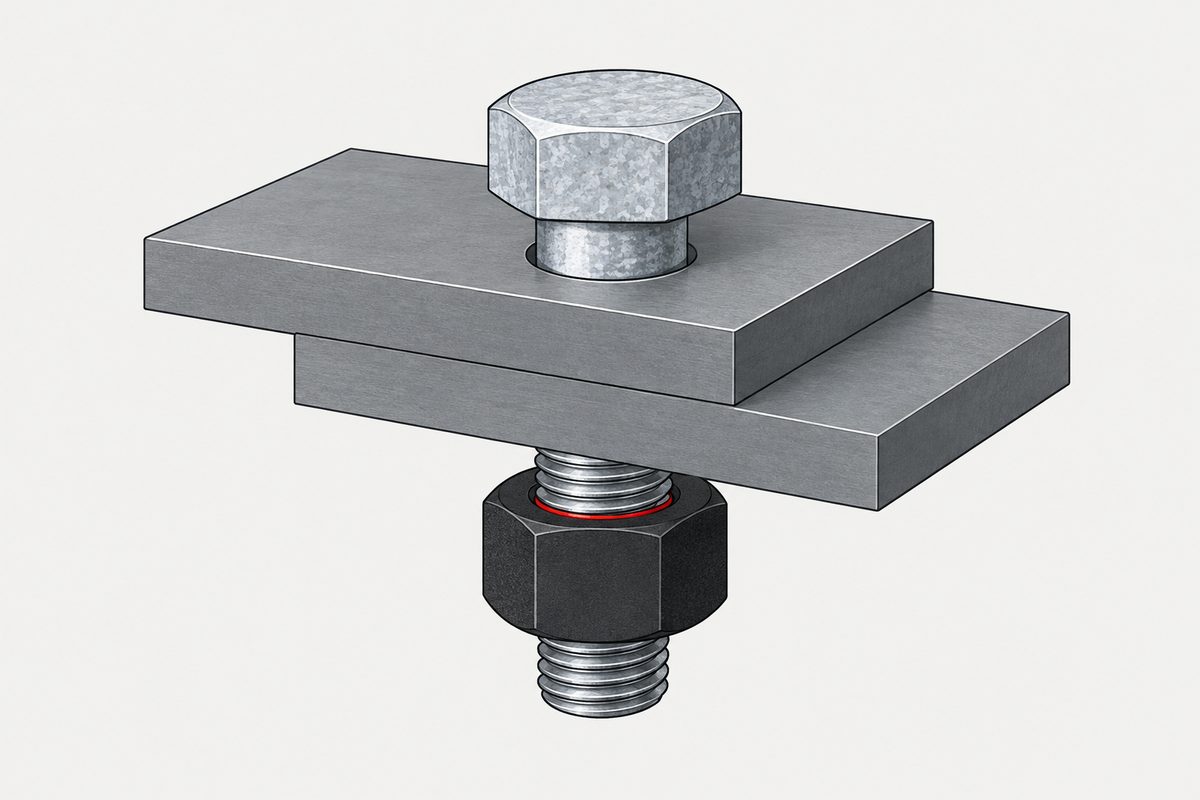
Question one: will they attack each other?
Mostly not in the way people fear, and the reason is worth understanding rather than memorising.
Black oxide is a conversion coating — an oxide grown out of the steel itself, mostly magnetite, rather than a different metal laid on top. It is thin and generally permeable, which is why it is normally oiled or waxed. That does not make it electrochemically identical to bare steel: the film still raises impedance and limits how fast the steel underneath dissolves, and a post-treatment adds more. Far less protected than a coated part, but not nothing.
And zinc is anodic to steel. Where the two are wet and connected, the zinc gives itself up first and keeps the steel intact. That is the same mechanism that makes zinc worth putting on a screw at all.
This is where most explanations stop, and where this one should not, because “zinc protects steel” is a statement about a couple, not about your joint. For the bolt’s zinc to protect any particular part of the nut, several things have to be true at once: the two must be electrically connected; a continuous electrolyte must bridge them; the coating must have conductive, still-active zinc available to give; and the protective current must actually reach that spot against distance, area ratio and polarisation.
Sacrificial protection has a range, and it is short. Published figures for flat hot dip galvanized steel put the distance over which zinc protects an adjacent bare area in the single millimetres — shorter as the exposed area grows, and approaching nothing where the zinc has passivated. Those numbers are for flat panels and do not transfer to a thread, still less to a zinc flake coating, whose sacrificial behaviour also depends on flake content, contact between flakes, binder and topcoat. What they establish is the shape of the answer: some of the nut, near the contact, sometimes. Not the whole nut, and not reliably.
So the honest version is narrower than the usual one. The bolt does not get eaten by the nut, and some of its zinc may be spent protecting parts of the nut rather than itself — a cost rather than a bonus. How much depends on the area ratio, which is the subject of the galvanic corrosion page.
That also puts a caveat on an arithmetic you may have done. Estimating coating life as thickness divided by corrosion rate assumes the coating only has to protect itself. Where it is covering more than that the estimate is optimistic — by an amount that depends on your geometry and that nobody has measured for you.
Question two: which part decides how long the joint lasts?
This is the question people meant to ask, and the answer is blunt: an assembly is only as protected as its least protected part. Not the average of the two. There is no averaging in corrosion — rust starts where the protection ran out first, and a red-stained joint is a red-stained joint regardless of which half started it.
So the real question is what a black oxide nut is actually protected by. For that, read the standard that defines the coating. ISO 11408:1999 opens by listing what black oxide is for:
Black oxide coatings can be used to diminish friction between sliding or bearing surfaces or for decorative purposes or to reduce light reflection.
Corrosion protection is not on that list. It is not an omission either, because the scope goes on to say so directly:
Only very limited corrosion protection is obtained under mildly corrosive conditions even with preservative treatment.
Read that carefully, because it is doing two things at once. Very limited protection, and only under mildly corrosive conditions, and that is the verdict with the oil or wax already applied. Note what it still does not say: very limited is not none, and the oxide film does offer some resistance. The point is not that a black oxide nut is bare steel — it is that it is protected far less than the bolt is, and the oil does not close that gap.
Which settles it. Put a black oxide nut on a coated bolt and the nut governs. Whatever you paid for on the bolt is now bounded by the cheapest component in the joint. This is the same shape of error as comparing finishes by adjective: the name told you the colour, not the protection.
Yellow zinc nuts are a different case. That is a zinc coating with a conversion layer over it — genuinely a corrosion system, unlike black oxide. So the question is not whether the nut is protected, but whether it is protected to the same level as the bolt: a thickness and passivation comparison rather than a category one.
One thing the colour does not tell you. ISO 4042:2022 distinguishes passivation, which is free of hexavalent chromium, from chromatation, which is not — and yellow or iridescent finishes exist in both. If Cr(VI) content matters to you, and under RoHS and ELV it may, “yellow zinc” has not answered the question. Ask for the designation and a Cr(VI)-free declaration.
Question three: what happened to the torque figure?
This is the one that goes wrong first, because it goes wrong on the day of assembly rather than in year three — and it is the one nobody asks about.
Torque does not become clamp force. Most of it is spent on friction in the threads and under the head, and only the remainder pulls the joint together. Change the coating on either mating surface and you have changed that split. A torque figure that produced the right preload on a matched pair does not produce it on a mixed one, and nothing about the joint looks different while it is happening. The mechanism is set out on the torque and clamp force page, whose central point applies directly here: the friction coefficient is not a property of the screw, it is a property of the pair. Mixing coatings changes the pair.
There is a specific trap on top of that. ISO 11408 lists coefficient of friction among the things the purchaser has to ask for — alongside wear resistance and oxalic acid resistance, in the clause covering additional information to be supplied to the supplier. It is optional.
So on a normal black oxide order there is no agreed friction figure attached to the parts. That is not the same as saying it cannot be obtained — a supplier may hold process or batch data, or be able to run the test. But it is a question you have to raise rather than a number that arrives with the goods, and it is far cheaper to raise before the parts are made than after. Failing that, establish it by test on the actual pair.
What to do about it
- Match the coatings if you can. The cheapest fix is usually to specify the nut rather than accept whatever came in the box — nuts are a smaller line item than the problem they cause.
- If you cannot match them, choose which part governs, and write it down. An undocumented mixed joint becomes an argument later; a documented one becomes a decision you can defend.
- Re-establish the torque figure on the actual pair. Do not carry a number over from a different combination, and do not accept one from a catalogue that does not say which pair it was measured on.
- Treat any coating life estimate as optimistic until you know how much bare area the sacrificial layer is being asked to cover.
- Say what the joint is for in the enquiry. Most mixed-coating problems arrive because the nut was sourced separately from the bolt, by someone who was not told what the bolt was coated with — which is a specification problem before it is a chemistry one.
And the general version, which is the point of this whole series: the finish is one decision in a sequence, not a line you fill in at the end. A coating chosen without reference to what it will be bolted against has only been half chosen.
Common questions
Can I use a zinc-coated bolt with a black oxide nut?
Mechanically yes, and they will not destroy each other. But you changed three things at once. The zinc is anodic to the steel under the black oxide, so it protects the nut as well as itself and is consumed faster. The nut is the least protected part, so it governs the life of the joint. And the friction changed, so your torque figure no longer produces the preload it used to.
Is black oxide a corrosion coating?
Not according to ISO 11408, which lists its purposes as reducing friction, decoration and reducing light reflection, and then states that only very limited corrosion protection is obtained under mildly corrosive conditions even with preservative treatment. For service life, treat a black oxide part as close to bare steel.
If the zinc protects the nut too, is that not good?
It is the mechanism working, and it is still a cost, because sacrificial protection is consumption. Zinc spent on the nut is zinc not spent on the bolt, and how quickly it goes is set by the area ratio — small anode, large cathode, fast.
Does mixing coatings change my torque spec?
Yes, and usually first. Friction belongs to the pair, not to the screw, so changing either half changes how much of your torque becomes clamp force. ISO 11408 makes coefficient of friction an optional purchaser requirement, so on a normal order the number does not exist.
Are yellow zinc nuts on a zinc-flake bolt also a problem?
A different and much smaller one. Both are genuinely corrosion coatings, so the question becomes whether they protect to the same level rather than whether one protects at all. Compare thickness and passivation. The friction question still applies.
Related
- The order in which to specify a screw — where the finish decision sits
- Galvanic corrosion — the area ratio that decides how fast the zinc goes
- How long will the coating last — the estimate this page makes optimistic
- Torque and clamp force — why friction belongs to the pair
- “Very good” and “good” — why the coating name is not the protection
- Choosing a finish — the decision upstream of this one
- What to put in a fastener enquiry — where the mismatch usually originates
Enquiries
Tell us what the mating part is coated with, not just what you want on the screw. Half the mixed-coating problems we see arrive because the nut was bought from somewhere else, by someone who was never told what the bolt was finished with.
Request a quotation
Tell us the part and the quantity. We will come back on feasibility, lead time and price.
Or email us directly sales@tigerfasteners.com