 TIGERFASTENERS
How long will the coating last?
Every few months an engineer asks a forum how many years a zinc coating will protect a part, and usually offers a guess to help things along: five years for plating and twenty for galvanizing, or is it one and fifty? The thread fills up with people saying it depends.
It does depend. But “it depends” is the start of the answer, not the end of it, and what it depends on has been written down and measured since 2012. This page is about why the number cannot be printed in a catalogue, and what you can calculate instead.
The short version: the thing that varies most is not the coating — it is where the part lives, and that is what the standards classify. Across the corrosivity categories of ISO 9223:2012, the published zinc rates span more than two orders of magnitude: the top of the harshest category is 250 times the top of the mildest. No single number could be printed that was not badly wrong for most readers.
Asking how long it lasts is a fair question
Every other component comes with a life. Bearings have hours, batteries have cycles, paint has a warranty. Asking a supplier how many years the coating is good for is the same question anybody would ask about anything else.
And the industry answers it, in a way. Salt spray hours get quoted precisely because they look like an answer. The problem is that the number belongs to a test cabinet rather than to your part.
So how many years does it last — and nobody can tell you
This is the whole reason, so it is worth stating plainly. ISO 9223:2012 classifies atmospheres into six corrosivity categories and gives the measured first-year corrosion rate of zinc in each of them. These are its numbers, from Table 2:
| Category | Corrosivity | Zinc, µm per year |
|---|---|---|
| C1 | Very low | ≤ 0,1 |
| C2 | Low | 0,1 – 0,7 |
| C3 | Medium | 0,7 – 2,1 |
| C4 | High | 2,1 – 4,2 |
| C5 | Very high | 4,2 – 8,4 |
| CX | Extreme | 8,4 – 25 |
Read the first and last rows together. The upper limit of CX is 250 times the upper limit of C1 — that is a comparison of the category limits, not of two particular sites, and two real locations in those categories could differ by less. Either way the span is more than two orders of magnitude, and a catalogue that printed “lasts eight years” would be off by a factor of a hundred for a large share of the people reading it.
So the catalogue writes very good instead. That is not laziness — it is the only claim that survives being read by everyone. It is also useless for making a decision, which is the subject of a separate page on why finish comparisons tell you nothing.
On matching your site to a category: ISO 9223 does offer descriptions of typical environments, but it puts them in an informative annex and warns in Clause 6 that estimating a category by comparing local conditions with those descriptions “can lead to misinterpretations”. The normative routes are measuring standard specimens for a year, or calculating from the standard’s dose-response functions, whose inputs are sulfur dioxide, airborne chloride, temperature and relative humidity. If the answer matters, do not eyeball it.
The estimate you are allowed to make
One sentence in another standard turns that table into arithmetic. ISO 14713-1:2017, Clause 5, carries this note:
The life for a zinc coating in any particular atmospheric exposure condition is approximately proportional to the thickness of the coating.
That is your licence to divide. Life ≈ thickness ÷ rate. And the same standard defines what “life” means here — its term is life to first maintenance, the interval before “coating deterioration reaches the point when maintenance is necessary to restore protection of the basis metal”. Note what that is not: it is not the day the part fails. It is the day it needs attention.
One thing to know about borrowing that sentence. ISO 14713-1 is written for zinc coatings on structures, and its scope carries a note saying that product-specific standards — it names fasteners explicitly — “will take precedence over these general recommendations”. So the proportionality is a sound basis for a first estimate on a screw, and it is not a fastener requirement. Where ISO 4042 or ISO 10684 says something about your part, those win.
Now put a real fastener in. ISO 4042:2022, Table 10, lists the thickness designations available for electroplated fasteners: 3, 5, 8, 10, 12, 15, 20, 25 and 30 µm minimum local thickness. Take 8 µm of zinc, a common choice, and run it through two atmospheres:
| Atmosphere | Rate, µm/a | 8 ÷ rate | Estimate |
|---|---|---|---|
| C3 medium | 0,7 – 2,1 | 3,8 – 11,4 | about 4 to 11 years |
| C5 very high | 4,2 – 8,4 | 0,95 – 1,9 | about 1 to 2 years |
Two answers, one screw, and they do not overlap. Nobody was being evasive with you; the answers were always plural, and the question as asked did not contain the information needed to pick one.
In C1 the same division returns eighty years and up. We have left it out of the table on purpose: that is an extrapolation far beyond the exposure data anybody has, and a number with nothing behind it is worse than no number. Read C1 as “not the thing that will fail” rather than as a figure.
The five-versus-twenty guess was right, and the reason is worth knowing
ISO 10684:2004 says, in its own words, that hot dip galvanizing of fasteners deposits a coating “always in excess of 40 µm”. Note the wording: 40 is a floor, not a target. Against an electroplated 8 µm that is at least five times the zinc, and since life is approximately proportional to thickness, at least roughly five times the life. In C3: 40 ÷ 2,1 = 19 years at the fast end, 40 ÷ 0,7 = 57 at the slow one.
So the forum guess of “five for plating, twenty for galvanizing” is not folklore. It is a thickness ratio, and it survives because the relationship is close enough to linear for the ratio to carry through.
That also tells you what you are buying when you pay for hot dip. Not a better kind of zinc — more of it. Which is exactly why the same clause of ISO 10684 goes on to say that because the coating is that thick, “it is necessary to manufacture screw threads to special limits”. A coating thick enough to last five times as long is also thick enough to stop the nut going on, and that trade-off has its own page.
The same standard also decides when the nut thread is cut, and stamps a letter on the part to record which of two schemes was used: the galvanized nut is tapped after the zinc goes on, and two of those letters must never be assembled together.
Four reasons this is an estimate, not a warranty
Each of these comes from the standards themselves. None of them makes the arithmetic useless; all of them tell you how far to trust it.
1. The rate you divided by is a first-year rate
ISO 9223 is blunt about this in Clause 7: “The first-year corrosion rates cannot be simply extrapolated for the prediction of long-term corrosion behaviour.” It points you to ISO 9224 for long-term guiding values, which model the attack with a time exponent below one — zinc slows down as its own corrosion products accumulate on the surface.
So where the rate really does decay, the naive division underestimates the life rather than overestimating it. That is the direction you want an error to point — but it is a conditional, not a guarantee, and ISO 9224 names its own exceptions. Its guide values come from long-term exposure of flat panels; it warns that electroplated, mechanically plated and hot dip zinc each behave differently, so a generic exponent may not predict any of them well; and in high-sulfur-dioxide environments it recommends taking the exponent as 1,0, which is to say assuming no slowdown at all.
So do not carry “the arithmetic errs on the safe side” around as a general rule. Trapped water, a thin coating in a cavity, a failed passivate or a polluted site can all push the real answer the other way, and the C5 figure above — under a year at the fast end — is not even in the regime that long-term extrapolation was built for.
2. The standard deliberately ignores your part
From the introduction to ISO 9223: “This International Standard does not take into consideration the design and mode of operation of the product, which can influence its corrosion resistance, since these effects are highly specific and cannot be generalized.”
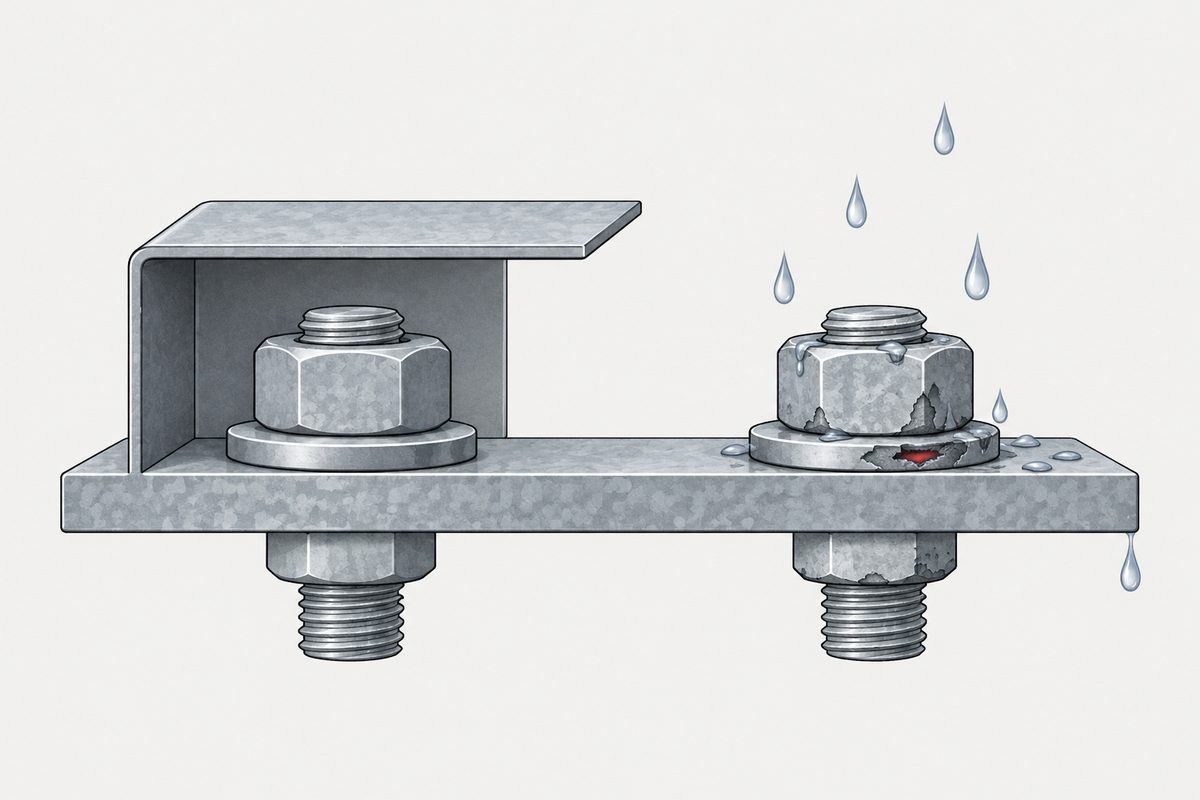
A screw in a blind hole that traps water is not a flat coupon on an exposure rack. A joint that stays wet for a day after every rain has a longer time of wetness than the panel next to it that drains. The standard is not dodging — it is naming the boundary of the question it answered. Everything inside that boundary is yours, and it is usually the part that decides the outcome.
3. The thickness is not the thickness everywhere
ISO 4042 gives this one a name. Its Table 10 note describes the dog bone effect: electroplating deposits more at external edges and less in cavities. That is why the standard defines reference areas for measurement at all — and it then states outright that “lower local thickness in a location other than reference areas shall not be cause for rejection”.
Your 8 µm is 8 µm on the reference area. In the thread root, in the drive recess, under the head, it is legitimately less, and the supplier has not done anything wrong. If the place your part will corrode is a cavity, the number on your drawing is not the number governing your life estimate.
4. Passivation and topcoat are not in the arithmetic
The rate in Table 2 is for zinc metal. A trivalent passivate, a sealer or an organic topcoat changes the early behaviour of the surface, which is largely what a salt spray test is measuring. That is why salt spray hours and service life are different quantities and why converting between them has never worked. The thickness calculation on this page answers a different question from the one the salt spray cabinet answers, and neither substitutes for the other.
What to write instead of a number of years
Do not ask a supplier to guarantee a service life. They do not know your atmosphere, and ISO 9223 says in writing that it does not model your geometry — so a demand for years transfers a judgement to the one party with no way to make it. Specify the things that can be delivered and measured, and state your assumption about the environment separately.
- The coating and its thickness designation — e.g. ISO 4042 zinc, designation 8
- The passivation, and any sealer or topcoat, named
- Where on the part the thickness is to be measured, if a cavity is the critical area
- The corrosivity category you believe the part will sit in, stated as a category, with how you arrived at it
- Any geometry that will hold water, called out as such
Now the estimate is yours to make and yours to defend, the supplier is being asked for something they can actually hit, and if the part comes back rusty in two years there is a written assumption to check against reality. That is worth more than a promised number nobody could have kept.
This is the same move the rest of this series keeps making: turn an adjective into a specified quantity, then put the quantity somewhere both sides can see it — which for a purchase means the enquiry itself.
Common questions
How many years will zinc plating protect my part?
There is no answer that depends only on the plating. ISO 9223:2012 puts the first-year corrosion rate of zinc at no more than 0,1 µm a year in its mildest category and between 8,4 and 25 in its harshest — the top of one band is 250 times the top of the other, and the categories span more than two orders of magnitude. What you can do is estimate: life ≈ thickness ÷ rate. An 8 µm electroplated zinc in C3 gives about four to eleven years; the same screw in C5 gives about one to two. Note that “coastal” is not a category: depending on airborne chloride, wetness and shelter, a seaside site can land anywhere from C3 to CX.
Is hot dip galvanizing really about five times better than electroplating?
Roughly — and it is mostly a thickness ratio rather than a better kind of zinc. ISO 10684 puts hot dip fastener coatings always above 40 µm; ISO 4042 electroplated designations run 3 to 30 µm. Five times the zinc, life approximately proportional to thickness, so roughly five times the life. The same thickness is why ISO 10684 has to specify oversize threads.
Can I just divide coating thickness by the corrosion rate?
As a first estimate, yes, provided you know what you divided. ISO 9223 Clause 7 states the first-year rates cannot be simply extrapolated for long-term prediction and directs you to ISO 9224. Zinc slows as its corrosion products build up, so the simple division tends to underestimate the life. Safer direction, still an error.
Why won't the standard account for my actual part?
Because it says it does not: design and mode of operation are excluded, in its own words, because those effects “are highly specific and cannot be generalized”. A screw in a water-trapping blind hole is not a flat coupon on a rack. The standard is naming the boundary of what it answered.
If I specify 8 µm, is the whole screw 8 µm?
No. ISO 4042 Table 10 gives minimum local thickness on defined reference areas, describes the dog bone effect that makes plating thicker at edges and thinner in cavities, and states that lower thickness elsewhere shall not be cause for rejection. Thread root, drive recess and underhead can legitimately carry less.
Does a longer salt spray result mean a longer life?
Not in any way you can convert. Salt spray compares coatings under identical accelerated conditions; the thickness calculation on this page estimates consumption of zinc in a classified atmosphere. They answer different questions, and the hours were never a forecast.
Related
- The order in which to specify a screw — where finish sits in the decision sequence
- What salt spray hours do and do not tell you — the other number people try to convert into years
- “Very good” and “good” — why the catalogue adjective cannot answer this
- Choosing a finish — the decision this estimate feeds
- Plating thickness and thread fit — why more zinc stops the nut going on
- White rust in storage — corrosion that happens before the part is ever installed
- Zinc-coated or stainless — when thickness arithmetic stops being the right frame
- What to put in a fastener enquiry — where the assumption gets written down
Enquiries
Tell us the atmosphere you believe the part sits in and what it is bolted to. We will come back with a thickness and passivation we can actually hold, and say plainly where on the part we will measure it — because on a screw, the reference area and the place it corrodes are often not the same place.
Request a quotation
Tell us the part and the quantity. We will come back on feasibility, lead time and price.
Or email us directly sales@tigerfasteners.com