 TIGERFASTENERS
“Very good” and “good”: why finish comparisons tell you nothing
An engineer went looking for the difference in corrosion resistance between zinc plating and black phosphate. All he could find was that one was “very good” and the other “good”.
You cannot decide anything with an adjective. The two can be compared, in the same test. The problem is that neither name states the things that decide the result.
The sharpest example: ISO 9717:2024 states that a phosphate conversion layer without post-treatment provides no corrosion protection. Not merely unsealed — oiling, waxing and painting are all post-treatments. So “black phosphate” on its own does not describe a corrosion performance at all — what was done to it afterwards does.
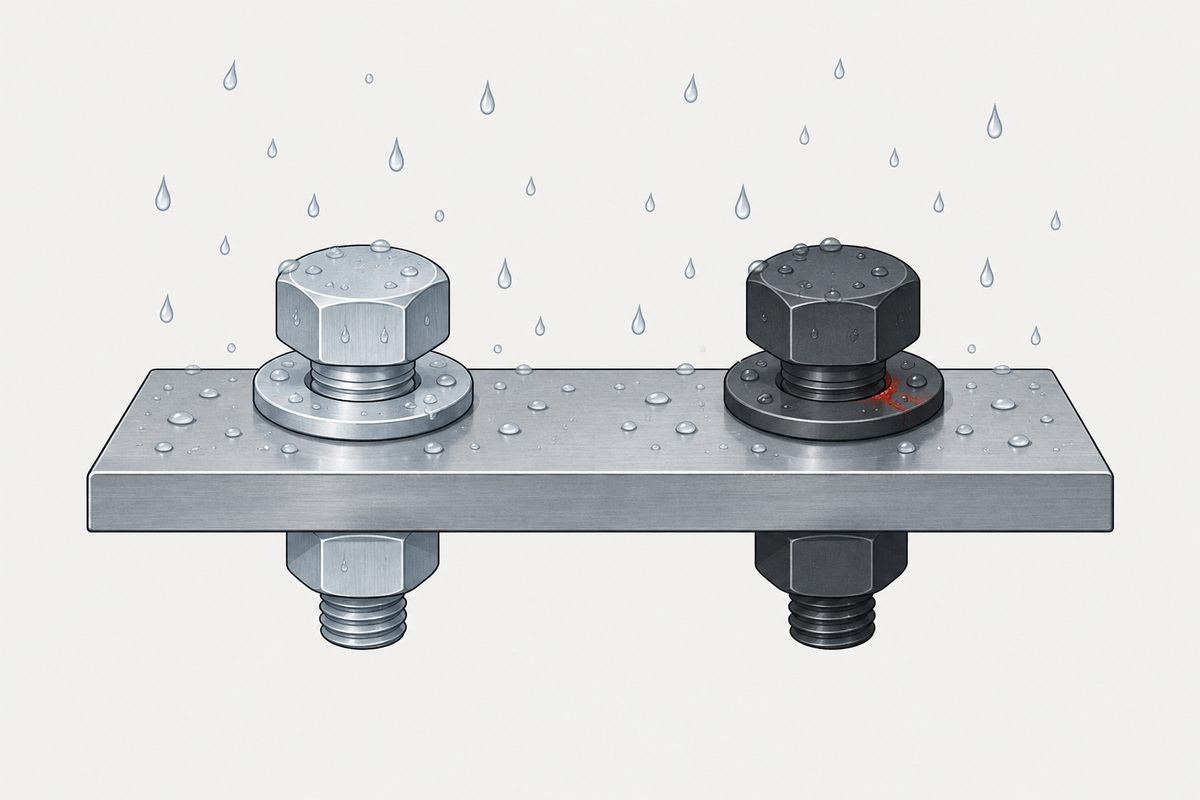
Lining them up side by side is how anyone would do it
Zinc, zinc-nickel, phosphate, black oxide. Put them in a table with salt spray hours, price and appearance, and pick. Every supplier presents them this way and every comparison chart is built like that.
The table works for most of the row. One of those entries only protects in combination with an oil or a sealer, so its bare salt-spray figure describes something nobody actually ships — and reading that number as a weak version of the others gets the decision backwards.
What the adjectives are hiding
When two finishes are ranked with words, every variable that actually moves the result has been left out. These are the ones that do the moving:
| If the answer is phosphate | If the answer is zinc |
|---|---|
| Which phosphate — iron, zinc or manganese are used for different jobs | What thickness — and measured where, since threads and heads do not plate evenly |
| Coating weight | Which passivation |
| Oiled, sealed, painted — or bare. This is the big one | Is there a topcoat or sealer |
Two specifications naming those can be compared honestly. Two adjectives cannot, and no amount of reading around will fix that — the information was never in the words.
So compare the finishes — and one of them is not competing
ISO 9717:2024 lists the purposes of a phosphate conversion coating as corrosion protection, improved paint adhesion, assistance in cold forming, and adjustment of sliding friction. On fasteners that mostly means three jobs: a base for paint, a carrier for oil or wax, and reduced galling.
- Iron phosphate — used primarily as a pre-paint treatment.
- Zinc phosphate — a paint base that also slows corrosion creeping underneath the paint film.
- Manganese phosphate — the one specified for wear resistance and anti-galling, which is why it turns up on gears and running surfaces.
The layer is crystalline and porous, and that porosity is the point: it holds oil, sealer or paint. But do not reduce it to a container. The same layer promotes adhesion, changes the surface chemistry and inhibits creep under a film. It is doing several things at once.
The sentence to quote. ISO 9717:2024 §6.3 states that phosphate conversion layers without post-treatment do not provide corrosion protection. So “how good is phosphate against corrosion” is not answerable until you know whether there is a post-treatment — and if there is, a good part of the answer belongs to the oil, sealer or paint rather than to the phosphate.
Electroplated zinc: barrier and sacrifice, not one or the other
A recurring question is whether zinc works by sealing water out or by some electrochemical route. It is both, and the two are not alternatives.
The layer is a physical barrier. Zinc is also anodic to steel, so at a scratch, a cut thread or a sheared edge the exposed zinc corrodes preferentially, inhibiting or delaying corrosion of the steel for as long as the surrounding zinc can still protect it. That is why a scratch through zinc behaves differently from a scratch through paint — and why zinc is a consumable in a way stainless is not.
Which means thickness is not cosmetic. It roughly represents how much zinc is available to be consumed — though uniformity, passivation, topcoat and environment all still bear on the outcome. On small threads, and especially below M6, you have to confirm the thread's tolerance headroom before fixing a thickness — there is no standard that makes M6 itself the dividing line, and pitch, tolerance position and pre-plate size all come into it. That is the subject of plating and thread tolerance and half of choosing a finish.
Zinc flake: the one usually reached for on high-strength parts
ISO 10683:2018, Fasteners — non-electrolytically applied zinc flake coating systems, covers the family that includes the products usually referred to by brand names.
The deposition is not electrolytic, so it does not itself generate hydrogen. That is the reason these systems are so often specified for high-strength fasteners — see hydrogen embrittlement for why that matters.
But that is a statement about the deposition, not the whole process. ISO 10683 warns that acid pickling and phosphating pre-treatments can introduce hydrogen, and prohibits acid pickling for fasteners above 390 HV and for property class 12.9 and above. So “zinc flake, therefore no hydrogen risk” is not a safe conclusion. Ask what the pre-treatment is.
Two more things worth knowing. A brand name is not a conformance statement — a product meets ISO 10683 when the specified system meets the standard's requirements, not because of what it is called. And ISO 10683 does not cover mechanical galvanising, which is a different process again.
And the hours will not settle it either
The usual next move is to compare salt spray hours. That does not rescue the comparison, and the standards say so directly: ISO 9227:2022 states the method should not be used to rank the corrosion resistance of different materials against each other, nor to predict long-term corrosion resistance. ISO 10683 §5.1 adds that accelerated results do not correspond directly to behaviour in a given service environment.
Salt spray hours works through what the number is genuinely good for, and what has to be written next to it before it means anything.
What to ask instead
Replace “which finish is better” with the questions that have answers:
- What is the part actually exposed to? Indoors dry, outdoors, splash, salt? A finish is only better relative to an environment.
- What is the full stack? Not “phosphate” but phosphate type, coating weight, and what went on top. Not “zinc” but thickness, passivation and topcoat.
- What is the strength class? It constrains which processes are even allowed — see the pre-treatment warning above.
- What does the thread have room for? On small threads the available tolerance can decide the thickness before corrosion does.
- What is the acceptance criterion? If it is not stated, and not carried in by a cited standard, nothing has been specified — and white rust and red rust are two different endpoints.
Common questions
Which is better for corrosion, zinc plating or black phosphate?
The question cannot be answered as asked, and and the reason is that neither name states the things that decide the result. The two can be compared, in the same test. For the phosphate: which phosphate, at what coating weight, and above all whether it was oiled, sealed or painted afterwards. ISO 9717:2024 says a phosphate conversion layer without post-treatment provides no corrosion protection, so a bare phosphate and an oiled one are not the same product. For the zinc: what thickness, which passivation, and is there a topcoat. Two specifications naming those will give you a comparison. Two adjectives will not.
So what is phosphate actually for?
ISO 9717:2024 lists corrosion protection, improved paint adhesion, assistance in cold forming, and adjustment of sliding friction. In practice on fasteners that means a paint base, a carrier for oil or wax, and reduced galling. Iron phosphate is used primarily as a pre-paint treatment. Zinc phosphate is a paint base that also slows corrosion creeping under the film. Manganese phosphate is the one chosen for wear and anti-galling.
Is zinc plating just a physical barrier?
No — it is both. The layer is a barrier, and zinc is also anodic to steel, so where the coating is scratched or cut the zinc corrodes preferentially, inhibiting or delaying corrosion of the steel for as long as the surrounding zinc can still protect it. Both mechanisms matter, and describing it as only sacrificial understates the barrier as much as describing it as only a barrier misses the point.
What is a zinc flake coating, and is it free of hydrogen embrittlement risk?
ISO 10683:2018 covers non-electrolytically applied zinc flake coating systems for fasteners. Because the deposition is not electrolytic it does not itself generate hydrogen, which is the reason these systems are often specified for high-strength parts. But that is a statement about deposition, not about the whole process: the standard warns that acid pickling and phosphating pre-treatments can introduce hydrogen, and prohibits acid pickling for fasteners above 390 HV and for property class 12.9 and above. Ask what the pre-treatment is.
Does Dacromet or Geomet mean it meets ISO 10683?
Not by itself. Those are brand names for zinc flake systems; a product conforms to ISO 10683 when the specified system meets the standard's requirements, not because of what it is called. Note also that ISO 10683 does not cover mechanical galvanising, which is a different process.
References
- ISO 9717:2024 — Metallic and other inorganic coatings — Phosphate conversion coating of metals. Fourth edition. Lists the purposes of phosphating; §6.3 states that layers without post-treatment do not provide corrosion protection.
- ISO 10683:2018 — Fasteners — Non-electrolytically applied zinc flake coating systems. §4.4 on hydrogen and pre-treatment; §5.1 on accelerated corrosion tests.
- ISO 9227:2022 — Corrosion tests in artificial atmospheres — Salt spray tests.
- DIN EN ISO 9717:2024-10 is the current German version. Note that DIN 50942 was superseded by DIN EN 12476, and that document is itself now withdrawn — so a specification still citing either is citing a withdrawn standard.
- Manufacturer handbooks were used for the working distinctions between iron, zinc and manganese phosphate. Those are supplier engineering literature, not standards, and we have not found a standardised hardness comparison between phosphate types — which is why this page says manganese is chosen for wear resistance rather than claiming it is the hardest.
Ask us
Tell us what the part is exposed to and what strength class it is, and we will tell you which finishes are actually available to you at that size — and what each one costs you in thread tolerance. sales@tigerfasteners.com
Request a quotation
Tell us the part and the quantity. We will come back on feasibility, lead time and price.
Or email us directly sales@tigerfasteners.com