 TIGERFASTENERS
Salt spray hours: what 500 hours buys, and what it does not
The short version: salt spray is a comparison test, not a prediction. ASTM B117 says so in its own text — results carry no general correlation to service life. So “500 hours” on a quotation tells you that one batch behaved like another batch in the same cabinet. It does not tell you how many years the screw survives on your product — and it does not even say which failure was being counted.
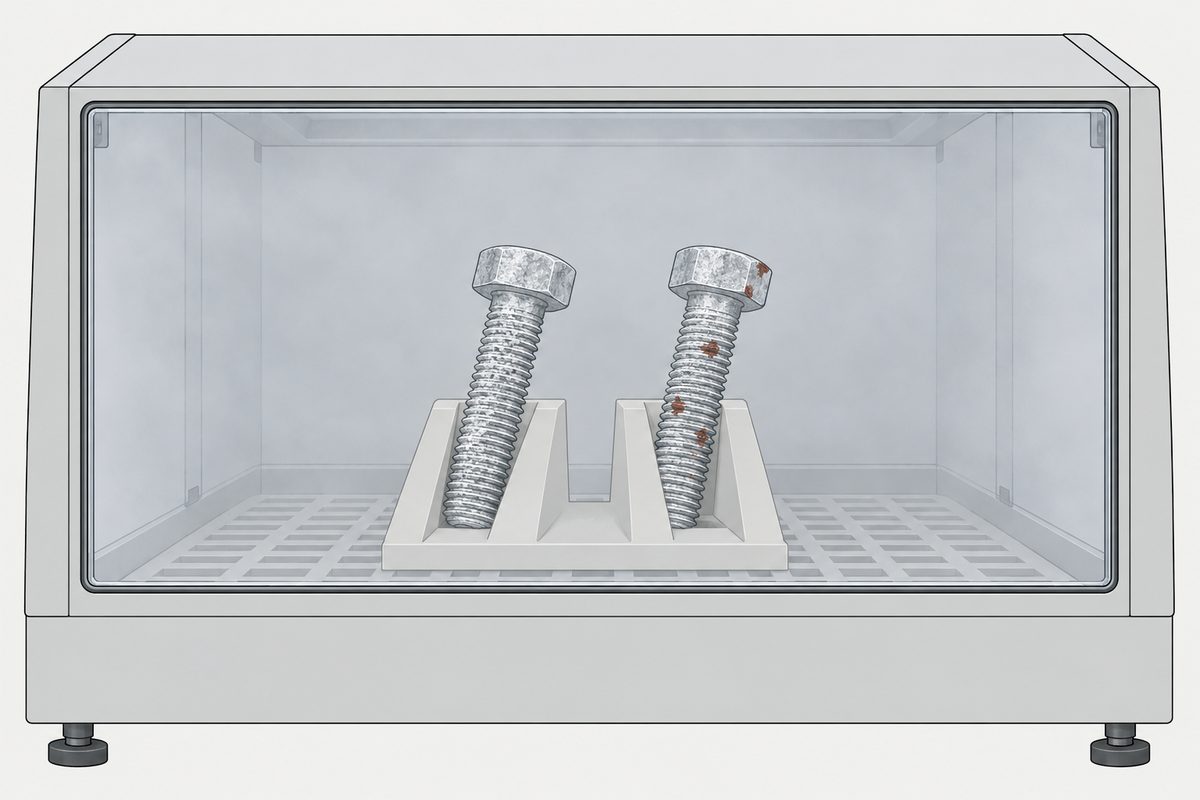
Two clocks, and most specifications name neither
A zinc-coated screw fails a salt spray test twice, at two different times, for two different reasons.
| Endpoint | What is corroding | What it means |
|---|---|---|
| White rust | The zinc coating | The coating is doing its job. Zinc corrodes preferentially so the steel does not |
| Red rust | The steel underneath | The coating has been consumed at that point — protection has ended |
“500 hours salt spray” with no endpoint named is not a specification, it is a number. 500 hours to white rust and 500 hours to red rust are different requirements, at different prices, and a supplier quoting against the first while you assumed the second is not necessarily doing anything wrong. Name the endpoint, or you have agreed to nothing. And white rust on parts that were never installed is a storage question rather than a coating one.
What the number is genuinely good for
The test is not useless. It is useful for exactly one thing, and that thing is worth paying for:
- Lot-to-lot consistency. Same coating, same process, same cabinet — a drop in hours means something changed on the plating line
- Comparing two coating processes under identical conditions, when you are choosing between them
- Catching a process that has drifted — thin deposit, poor passivate, contaminated bath — before it ships
Read it as a process-control instrument, not a warranty. The right question to a supplier is not “how many hours” but “how many hours, on how many lots, and what did you do the time it came back low” — the second question is the one that separates a laboratory report from a controlled process.
So ask for more hours — and the number stops meaning anything
The cabinet and the real world corrode metal by different mechanisms:
- The cabinet is permanently wet. Continuous neutral salt fog, constant temperature, no drying cycle
- Real service is wet, then dry, then wet again. That cycle is what lets zinc build the stable carbonate film that carries most of its long-term protection — and the cabinet never lets it form
- Real service has chloride, but also sulphur, UV, temperature swings and mechanical wear. The cabinet has one variable
So the ranking can invert. A finish whose protection depends on building a passive corrosion product is penalised by the test, and a finish that simply has more sacrificial zinc is flattered by it. A coating that survives fewer hours in the cabinet can outlast one that survives more, on the same product. This is not a defect in the test — it is what the test was designed to do, and the standard says so.
The panel is not the part
Most published salt spray figures are measured on a flat test panel. A screw is not a flat panel, and the difference is not cosmetic:
- Electroplating does not deposit evenly on a thread. Current density is highest at the crest and lowest in the root, so the thinnest coating sits exactly where the part is most highly stressed
- The underhead radius and the recess are low-current areas too — the recess is also where a driver will scrape the coating during assembly
- Barrel plating adds part-to-part scatter. Parts shield one another as the barrel turns; a screw that spent more of the cycle buried gets less coating
Ask whether the hours were measured on the part you are buying. A panel figure and a part figure for the same bath are not the same number, and at small sizes the gap widens — a smaller part spends proportionally more of its surface in low-current geometry.
Four lines that make the number mean something
Replace “500h salt spray” on the drawing with these:
- The coating standard and thickness class — not the hours. Hours are an outcome; thickness is the thing being bought. Below M1.4 the thread tolerance limits what thickness is even possible
- Both endpoints, separately. Hours to white rust and hours to red rust
- Tested on the finished part, in the delivered condition — after baking, after any supplementary passivate or sealer
- How many parts, how often. One report from one lot two years ago is not process control
The order matters. Specifying hours makes the supplier optimise for the cabinet; specifying coating, thickness and process makes them optimise for the part. Buy the process, verify with the test — not the other way round.
When to ask for a different test
If the parts genuinely go outdoors and the decision is expensive, a cyclic corrosion test — wet, dry and humid stages in rotation, as in SAE J2334 and equivalents — is designed to reproduce the wet/dry cycle that neutral salt spray removes. It costs more and takes longer. That is the trade: neutral salt spray is cheap and fast because it is not trying to be realistic.
And before changing coating to chase a corrosion number, price the re-verification — a coating change alters the friction coefficient, which changes the clamp force you get from the same torque. That is a joint change, not a finish change.
This page covers step 5, the finish. The whole order is substrate, thread, head, drive, finish, documentation, and why doing it out of order is rework rather than a tweak is in specifying a screw.
Common questions
Does 500 hours of salt spray mean the screw lasts a certain number of years?
No. ASTM B117 states in its own scope that the practice provides a controlled corrosive environment and that results have not generally been found to give a reliable prediction of service life. The hours are a comparison between coatings tested under identical conditions, not a forecast of field performance.
What is the difference between white rust hours and red rust hours?
White rust is corrosion of the zinc coating itself, which is the coating working as intended — zinc corrodes preferentially so the steel does not. Red rust means the coating has been consumed at that point and the steel substrate is corroding. They occur at very different times, so a salt spray requirement that does not name which endpoint is being counted has not specified anything.
Why can a coating with fewer salt spray hours outlast one with more in real service?
Because the mechanisms differ. Neutral salt spray is continuously wet, while real exposure is wet then dry. The drying cycle is what allows zinc to build a stable carbonate film that carries much of its long-term protection, and the cabinet never allows it to form. A finish that relies on building that film is penalised by the test; a finish with simply more sacrificial zinc is flattered by it.
Should salt spray be tested on a panel or on the actual screw?
On the actual part, in the delivered condition. Electroplating deposits unevenly on a thread — current density is highest at the crest and lowest in the root — so the thinnest coating sits where the part is most highly stressed. Barrel plating adds further part-to-part scatter. A flat panel figure and a finished-part figure from the same bath are not the same number.
References
- ASTM B117 — Standard Practice for Operating Salt Spray (Fog) Apparatus. The scope states that the practice provides a controlled corrosive environment and that results have not generally been found to give a reliable prediction of service life
- ISO 9227 — Corrosion tests in artificial atmospheres — Salt spray tests (the ISO equivalent, including NSS, AASS and CASS)
- ISO 4042:2022 — Fasteners — Electroplated coating systems (coating thickness classes)
- SAE J2334 — Cosmetic Corrosion Lab Test (cyclic wet/dry/humid test)
- The VW steering bolt recall — fracture after corrosion reduced the section
Enquiries
Have a drawing that says “500h salt spray” and no endpoint? Send it with the service environment and the mating material. We will come back with the coating and thickness class that requirement implies at your thread size — including the case where the thread tolerance will not accept it, which below M2 is a real answer more often than buyers expect.
Request a quotation
Tell us the part and the quantity. We will come back on feasibility, lead time and price.
Or email us directly sales@tigerfasteners.com