 TIGERFASTENERS
White rust before first use: the screws corroded in the box
The short version: white powder on unused zinc-plated screws is the zinc corroding, not the steel. It is called wet storage stain, and it is a packing and logistics event rather than a plating defect — usually. The counterintuitive part is that freshly plated parts are the most vulnerable, not the least, because the stable film that carries zinc’s long-term protection has not formed yet. Which makes plating line straight into a sea container the highest-risk route there is.
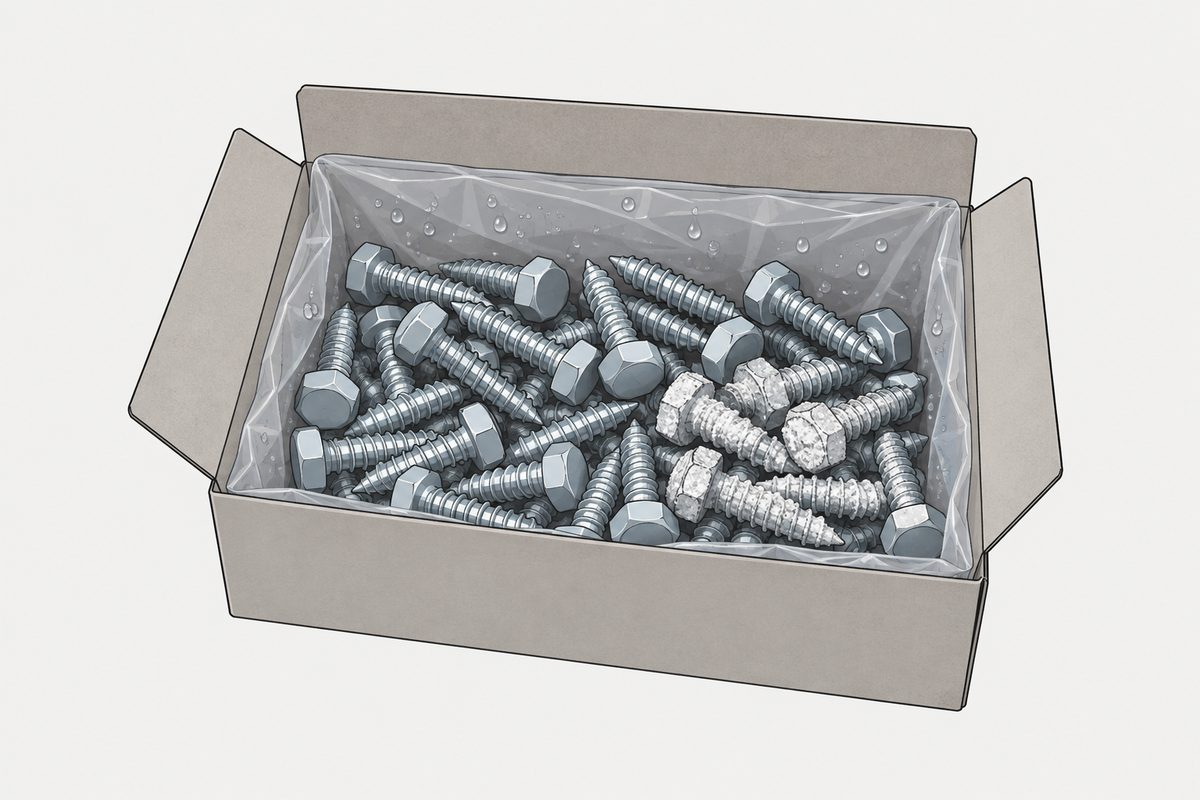
So it is rusting — except white is not red, and that decides who pays
| What you see | What it is | Is the part still usable? |
|---|---|---|
| White, powdery, bulky | Zinc corrosion products — zinc hydroxide rather than the stable carbonate | Usually yes. The steel has not been reached; the coating has been partly consumed |
| Red-brown, localised | The steel substrate corroding | The coating has failed at that point. This is a different conversation |
| White that wipes off, bright underneath | Early stage — surface only | Yes, but the cause is still in the warehouse and the next batch will do the same |
Establish which one before writing the rejection. White rust on unused parts is normally a storage and packing issue and the remedy is upstream in handling; red rust on unused parts points at coating thickness or coverage, which is a plating question. Sending back a whole shipment for the first while describing it as the second gets you a defensive supplier and no fix.
Why new plating is the vulnerable plating
Zinc protects steel in two stages, and only the first is finished when the parts leave the plating line:
- Stage one is the zinc itself, plus whatever passivate was applied — present from day one
- Stage two is a stable zinc carbonate film, which forms slowly from exposure to air and carbon dioxide, and which carries a large part of zinc’s long-term durability
- Stage two needs air. Sealed in a bag, packed tight in a carton, stacked on a pallet and shrink-wrapped, the parts get moisture but not carbon dioxide — so they form bulky zinc hydroxide instead of the protective carbonate
This inverts the intuition that newer stock is safer stock. A carton that went from plating to packing to container in three days is at higher risk than one that sat on an open rack for a month. Speed through the supply chain is usually a virtue; here it is the exposure.
The sea container is where most of it happens
The mechanism needs condensation, and a container crossing latitudes manufactures it:
- Air sealed in at a warm, humid port carries a lot of water. Taiwan in summer supplies this reliably
- Night-time steel cools faster than the cargo. Water condenses on the container roof and rains back down onto the pallets
- Repeat for four weeks. Each cycle wets the parts again, and the packaging that keeps rain out also keeps the drying air out
- Warm parts sealed in cold-weather packaging do the same thing in miniature — anything wrapped before it has cooled seals its own humidity in
So “the parts were fine when they left” and “the parts had white rust on arrival” can both be true, with nobody at fault at either end — and that is exactly why the remedy has to be specified in the order rather than argued about afterwards.
What actually prevents it
- VCI paper or VCI film inside the carton — a vapour-phase inhibitor works in the sealed volume where airflow cannot reach
- Desiccant sized to the packed volume, not one token sachet per pallet
- Do not wrap warm. Parts must reach ambient before sealing, or the packaging traps the humidity it was meant to exclude
- Do not pack to maximum density. Parts pressed together create the oxygen-starved gaps this mechanism needs — the same crevice geometry that causes crevice corrosion on stainless
- First in, first out, and off the floor. Concrete gives up moisture for a long time
All of this belongs on the purchase order, not in an email after the event. “VCI liner and desiccant, parts at ambient before sealing” is one line, costs very little, and moves the question from who is to blame to what was agreed.
Taiwan rates ISO 9223 C4 at the Port of Taichung, which is why “indoors” is not a controlled environment: the anodic index table.
Three checks when a box arrives white
- Does it wipe off, and is the surface bright underneath? If yes, the coating is largely intact and the cause is storage
- Is any of it red-brown? Red means the zinc has been consumed through to steel at that point — that is a coating question, not a packing one
- Is it worst at the outside of the pallet or the middle of the carton? Outside points at handling and ambient; middle points at sealed-in moisture, which points at how it was packed
If the parts are stainless rather than zinc-plated, the same-looking marks have entirely different causes — free iron contamination, pitting and crevice corrosion are three separate problems and only one of them is about the material — and the two materials fail in visibly different ways.
This page covers step 5, the finish. The whole order is substrate, thread, head, drive, finish, documentation, and why doing it out of order is rework rather than a tweak is in specifying a screw.
Common questions
What is the white powder on zinc-plated screws that have never been used?
It is white rust, also called wet storage stain. It is the zinc coating corroding rather than the steel underneath. It forms when moisture reaches the surface but air circulation does not, so the zinc produces bulky zinc hydroxide instead of the stable, protective zinc carbonate film that normally develops on exposure to air.
Are screws with white rust still usable?
Usually yes, if the deposit wipes off and the surface underneath is bright and unpitted. Part of the sacrificial zinc has been consumed, so the remaining corrosion life is shorter, but the steel has not been reached. Red-brown staining is a different matter: it means the coating has been consumed through to the substrate at that point.
Why do freshly plated screws get white rust more easily than older stock?
Because zinc protects in two stages and only the first is complete when parts leave the plating line. The stable zinc carbonate film that carries much of the long-term protection forms slowly from exposure to air and carbon dioxide. Parts sealed and shipped immediately after plating receive moisture but not air, so the protective film never forms and the hydroxide forms instead.
How do you prevent white rust during sea freight?
Use VCI paper or film inside the carton, add desiccant sized to the packed volume, let the parts reach ambient temperature before sealing so the packaging does not trap warm humid air, avoid packing to maximum density so moisture is not held in tight gaps, and keep pallets off concrete floors. Specifying these on the purchase order is far cheaper than arguing about a rejected shipment afterwards.
References
Enquiries
Received a shipment with white deposit and need to establish whether it is a plating problem or a packing one? Send photographs, where in the pallet the affected cartons were, and the route. We will help work out which — including the case where the coating is fine and the packing specification is what needs to change.
Request a quotation
Tell us the part and the quantity. We will come back on feasibility, lead time and price.
Or email us directly sales@tigerfasteners.com