 TIGERFASTENERS
What to send in a fastener enquiry, and why each item moves the price
You need to send an enquiry and you are not sure what to put in it. Whatever you leave out does not stay blank — each supplier fills it in with a guess, and they do not all guess the same way.
That is why quotes for what you thought was the same screw come back describing different things. So do not use price to work out who included more — read what each quote says it covers.
What to state, most important first: the drawing (or part number) → quantity → what it goes into → material and grade → finish → inspection paperwork. Below, why each one moves the number.
Second in the beginner series; the first is the order the decisions happen in.
Sending the drawing feels like sending everything
The drawing has the geometry, the material, the finish and the tolerances. It is the document the part is defined by, so attaching it and asking for a price is a complete-looking request.
And for the technical questions it genuinely is complete. What decides the price and the lead time is mostly not on it.
Why leaving a few things out makes quotes uncomparable
When something is not specified, the supplier still has to put a number on it. They will do one of three things:
- Come back and ask you
- Quote to an assumption and write the assumption and exclusions down
- Quote to whatever their standard process happens to produce
All three are legitimate. But they are not quoting the same thing, so the numbers that come back cannot be compared directly.
The common mistake is seeing the lowest price and assuming it must include less. It might. It might also just be that they already have the tooling, the wire is in stock, it can run alongside another job, their yield is better, or their margin is thinner.
From the price alone you cannot tell which. What you can do is state the scope so everyone quotes the same thing, then read each quote's own assumptions and exclusions rather than its total.
The items below are where enquiries most often leave a blank.
So send the drawing — and the drawing leaves out the expensive part
Before any of the five below: a drawing or part number with its revision, or a complete product standard with dimensions. The revision matters: approving against a drawing that has since changed is how people end up unable to say what was agreed. Thread size and pitch, length, head style, drive, tolerances. Without this nobody knows which item they are pricing, and the rest of the list cannot rescue that — see what a designation leaves out.
This is also where tolerances live. They belong to the drawing or the product standard, not to the inspection paperwork — the certificate only records what was found. Untoleranced dimensions still need a stated source (the title block), and two references can disagree about the same feature (worked example).
1. Quantity — and how it repeats
Why it moves the price: changeover, machine set-up and first-article approval are costs a production batch incurs once, so they divide across whatever you order. How much that matters depends on the part. On a special or a small batch they can dominate the unit price; on a mature standard item at volume, wire, machine time, heat treatment, plating and yield usually matter more. If the item can be run alongside an existing job, there may be no dedicated set-up at all.
The part people leave out: whether it repeats. A committed annual quantity with a predictable release schedule can earn better terms, because material and scheduling can be planned instead of squeezed in. But scheduled releases are not automatically cheaper — if each release is produced, inspected and shipped separately, it adds changeovers, paperwork and freight, and if it is produced once and held, someone is financing the inventory. So state three numbers separately: annual estimate, production batch, and delivery batch. Set-up economics are also why small orders wait behind large ones — see why lead times slip.
2. What it goes into
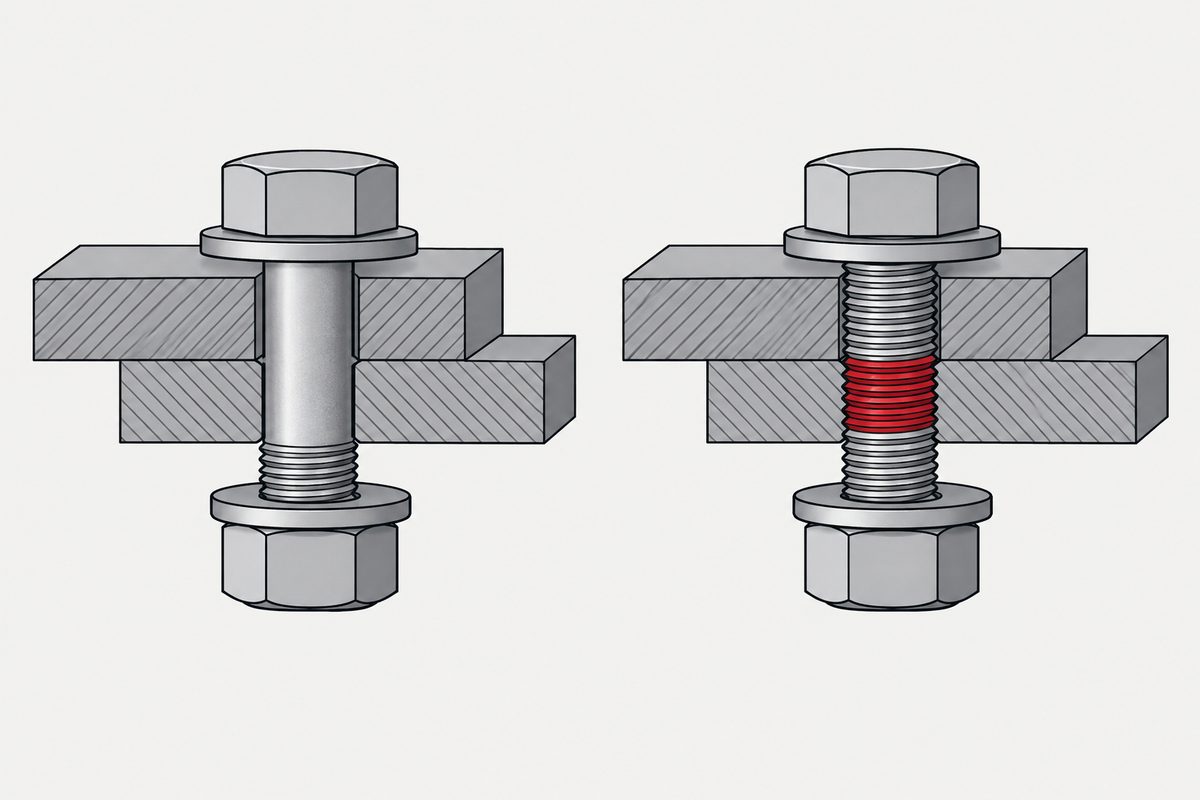
Why it can move the price: the substrate constrains which thread forms, pilot holes and failure modes are available. If that changes the product, process or inspection, it changes the price. If the drawing is already fully specified, it may not change the number at all — but it lets the supplier tell you whether the part you chose actually suits the application, which is worth more than the quote. It is step one of the decision order for that reason.
It also tells the supplier which failures are plausible, and therefore what is worth checking. A screw going into plastic has different failure modes from one going into a tapped hole, so the inspection that protects you is different too.
3. Material and strength grade
Why it moves the price: it selects the wire, and whether heat treatment is involved. It also constrains step 4 below, because plating risk depends on hardness — hydrogen embrittlement.
The trap: asking for “stainless” is not a grade. A2 and A4 are different alloys whose corrosion behaviour depends on the actual environment, and the property class — 70, 80 and others — is specified separately from the alloy. Steel and stainless are also not a like-for-like swap that only changes corrosion resistance: re-specify and re-check the property class, proof stress, head load capability and friction behaviour. A2-70 is not an equivalent for 8.8, for instance — the comparison.
4. Finish — and what it has to achieve
Why it moves the price: this is where quotes most often stop being comparable, because a finish is three specifications wearing one word.
- Thickness, which consumes thread tolerance — below M6 that is a dimensional decision first (choosing a finish, plating and thread tolerance).
- Process, which determines whether hydrogen is introduced and whether baking is required.
- Acceptance criterion — if it is not stated, and not already carried in by the product or coating standard you cited, it is not specified. Note that salt spray hours do not predict service life, and on zinc-coated steel white rust and red rust are two different endpoints — one is the coating corroding, the other is the steel.
Corrosion also depends on what the screw sits against rather than on the screw alone — galvanic pairing.
5. Inspection documentation — by type, not by name
Why it moves the price: the types differ in what the document actually contains — whether it carries test results at all, whether those results came from specific inspection of your order, and who confirmed them. Higher types imply specific inspection, batch segregation, record keeping and sometimes external confirmation, and each of those has a cost. Traceability is a separate thing you have to ask for. A document type does not by itself guarantee traceability back to the original melt — state the level you need, whether that is delivery batch, production batch or heat number.
Name the standard as well as the type number. “3.1” on its own is incomplete, because more than one standard uses that numbering. For finished fasteners the document standard is ISO 16228, whose types are written F2.1, F2.2, F3.1 and F3.2, and which was developed as the preferred alternative to EN 10204 for fasteners. It also notes that although “certificate” is in common use, the term for a fastener inspection document is test report. So write something like ISO 16228 F3.1 plus the traceability level you need. The document's colloquial name — certificate, report, mill cert — carries no evidence level at all. See inspection documents.
Tolerances do not belong here, incidentally — they belong to the drawing or the product standard, which is item 0. The inspection document only records what was found against them.
The enquiry, as a block you can paste
| State this | Because it decides |
|---|---|
| Annual estimate, production batch, delivery batch | How set-up is amortised, and whether releases add cost rather than remove it |
| What it screws into | Whether the thread is formed, cut or matched — and what to inspect |
| Material and strength grade | Wire, heat treatment, and whether plating carries embrittlement risk |
| Finish, thickness and acceptance | Thread allowance, process route, and what “passed” means |
| Document standard, type and traceability level | What the document contains and who confirmed it — e.g. ISO 16228 F3.1, plus heat or batch traceability, stated separately |
| Drawing, or the standard cited | Which document governs when two references disagree — they do (worked example) |
If you cannot answer some of these yet, send it anyway and say which are open. A quote against stated unknowns is still comparable between suppliers. A quote against silent unknowns is not.
Common questions
What is the minimum I need to send to get a useful screw quote?
A drawing or part number with its revision, or a complete product standard with dimensions, comes first — without it nobody knows which item they are pricing. Then quantity split into annual estimate, production batch and delivery batch; what the screw goes into; the material and property class; the finish with its thickness and acceptance criterion; and the document standard, type and traceability level you need. Anything left out is interpreted rather than left blank, and different suppliers interpret differently.
Why does quantity change the unit price?
Changeover, set-up and first-article approval are incurred once per production batch, so they divide across whatever you order. How much that matters depends on the part: on a special or a small batch those costs can dominate, while on a mature standard item at volume, wire, machine time, heat treatment, plating and yield usually matter more. If the job can run alongside an existing one there may be no dedicated set-up at all.
Do scheduled releases always price better than ordering ad hoc?
No. A committed annual quantity with a predictable schedule can earn better terms because material and production can be planned. But if every release is separately produced, inspected and shipped it adds changeovers, paperwork and freight, and if it is produced once and held then someone is financing the stock. State the annual estimate, the production batch and the delivery batch as three separate numbers and let the supplier tell you which combination is cheapest.
Is it enough to say I want it plated?
No, because a finish is three specifications wearing one word. There is a thickness, which consumes thread tolerance and matters most below M6; a process, which determines whether diffusible hydrogen is introduced and whether baking is needed; and an acceptance criterion. If the acceptance criterion is not stated, and not already carried in by the product or coating standard you cited, it is not specified — and salt spray hours are not a service life prediction in any case.
How should I ask for inspection documentation?
Name the standard, the type and the traceability level separately. For finished fasteners the document standard is ISO 16228, with types F2.1, F2.2, F3.1 and F3.2 — developed as the preferred alternative to EN 10204 for fasteners, and noting that “certificate” is not the right word for these documents — F2.2, F3.1 and F3.2 are test reports, while F2.1 is a declaration of compliance. Writing 3.1 alone is incomplete because more than one standard uses that numbering, and the type does not by itself promise traceability back to the heat number. Say what you need.
Send it to us
If you are missing several of the five, say so and we will tell you which ones actually change your number and which do not matter at your quantity. sales@tigerfasteners.com
Request a quotation
Tell us the part and the quantity. We will come back on feasibility, lead time and price.
Or email us directly sales@tigerfasteners.com