 TIGERFASTENERS
SEMS screws: why the washer goes on at the factory
The short version: a SEMS screw makes the washer part of the screw. It is slid on while the shank is still plain, and once the thread is rolled its major diameter exceeds the bore of the washer — which then spins freely but cannot be removed. The value is not in the screw. It is one less pick-and-place on the line, and one less way to lose a part. This page covers how that works, what it changes in engineering terms, and where it is the wrong choice.
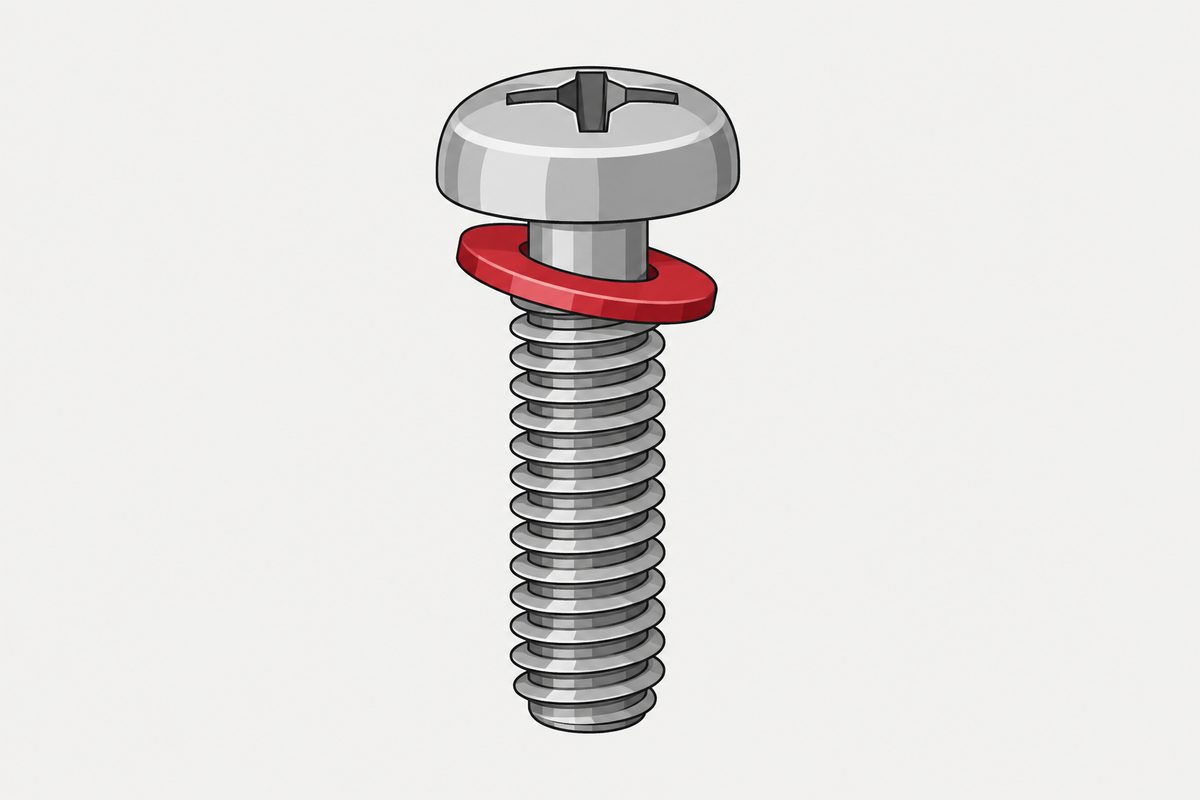
It looks like a screw with a washer already fitted
That is a fair description of what you are holding, and it is why sems get specified: one part number instead of two, nothing to drop on the floor, one fewer thing for an operator to forget.
Those savings are real and they are usually the reason for the change. What gets missed is that the washer is no longer a separate item in any sense that matters.
Nothing is pressed on
The usual assumption is that the washer is pressed or bonded afterwards. What actually holds it there is the order of operations:
- While the shank is still plain, the washer is slid on from the end and pushed up under the head
- Then the thread is rolled. Rolling is a forming operation, and the major diameter ends up larger than the plain shank was
- The washer is now trapped between the head and the thread — free to turn, impossible to take off
So a SEMS screw is not a packaging arrangement, it is a structure created by the process. Which is also why the pairing is fixed once it leaves the factory — the strength and the limitation are the same fact.
So it is a screw with a washer on it — and that is not what changed
| Aspect | Separate screw and washer | SEMS |
|---|---|---|
| Line motion | Pick washer, place washer, pick screw, drive | One pick-and-place fewer |
| Automated feeding | Two items; loose washers nest and tangle in a bowl feeder | One item, one track |
| Failure modes | Missing, reversed, wrong type, dropped | Those simply stop existing |
| Flexibility | Any pairing of material and size; changeable at the bench | Fixed pairing, not changeable |
| Part numbers | Two | One |
The washer still does its own job: spreading underhead load over a larger area. That matters most in soft material, thin sheet and plastics — too little bearing area leads to embedment or pull-through.
Washer type is a statement of intent
- Plain washer: spread load, protect the surface
- Spring washer: adds compliance and friction into the joint
- Toothed lock washer (internal or external): teeth bite into the bearing face
- Plain plus spring: both intents stacked
⚠️ Resistance to loosening depends on the joint, and cannot be inferred from the washer type alone. Clamp force, the bearing face material, the finish and whether the joint is re-tightened all move the result — the same argument as the torque coefficient belonging to the whole contact system. If loosening matters, it has to be verified under your conditions rather than specified away with a washer.
Where it is the wrong choice
- Countersunk and flush heads. The head sinks into the hole and there is no bearing face for a washer
- When the washer needs a different material — chosen deliberately to avoid galvanic pairing, for instance. The combination here is fixed
- When a much larger washer diameter is required. Available combinations are limited; spreading more load usually means going back to separate parts
- When servicing replaces the washer. A SEMS screw is replaced whole
Comparing it fairly on cost
A SEMS screw costs more than a screw and a washer bought separately. Unit price is not the total, though — the rest of the comparison is:
- One fewer part number to carry and control
- One fewer incoming inspection
- One fewer pick-and-place per joint on the line
- One fewer failure mode, and the time not spent chasing it
Which side wins depends on how much those weigh in your cost structure. Automated lines and high-mix assembly stations are usually where it pays; low volume hand assembly with washers changed in service usually is not.
This page covers step 3, the head. The whole order — substrate, thread, head, drive, finish, documentation — and why doing it out of order is rework rather than a tweak, is in specifying a screw.
What we need in order to quote
- The screw specification: diameter, pitch, length, head, drive, material, finish
- Washer type and dimensions — bore, outside diameter, thickness
- Parent material and thickness, which set how much bearing area is needed
- Whether it is automatically fed, and by what kind of feeder
SEMS screws are within what we supply; ask us directly about a specific screw-and-washer combination rather than taking “anything you need” for an answer. What we can confirm is that below M6 the forming, inspection and packing are in house, and have been since 1994.
Enquiries
Still placing washers by hand, or weighing up a change to SEMS? Send the screw specification, the washer type and the parent material. We will come back with workable combinations, and with whether the change is worth making in your case.
Request a quotation
Tell us the part and the quantity. We will come back on feasibility, lead time and price.
Or email us directly sales@tigerfasteners.com