 TIGERFASTENERS
Washer specification: “an M4 washer” is three different parts
The short version: the nominal size does not specify a washer. The same “M4 washer” exists in a small series, a normal series and a large series, and the outer diameters differ by more than double. A purchase order that says only the size will be filled with whichever one the supplier stocks — correctly. And the second thing worth knowing is that a washer is not mainly there to spread load, which is why adding one to an already-validated joint changes more than people expect.
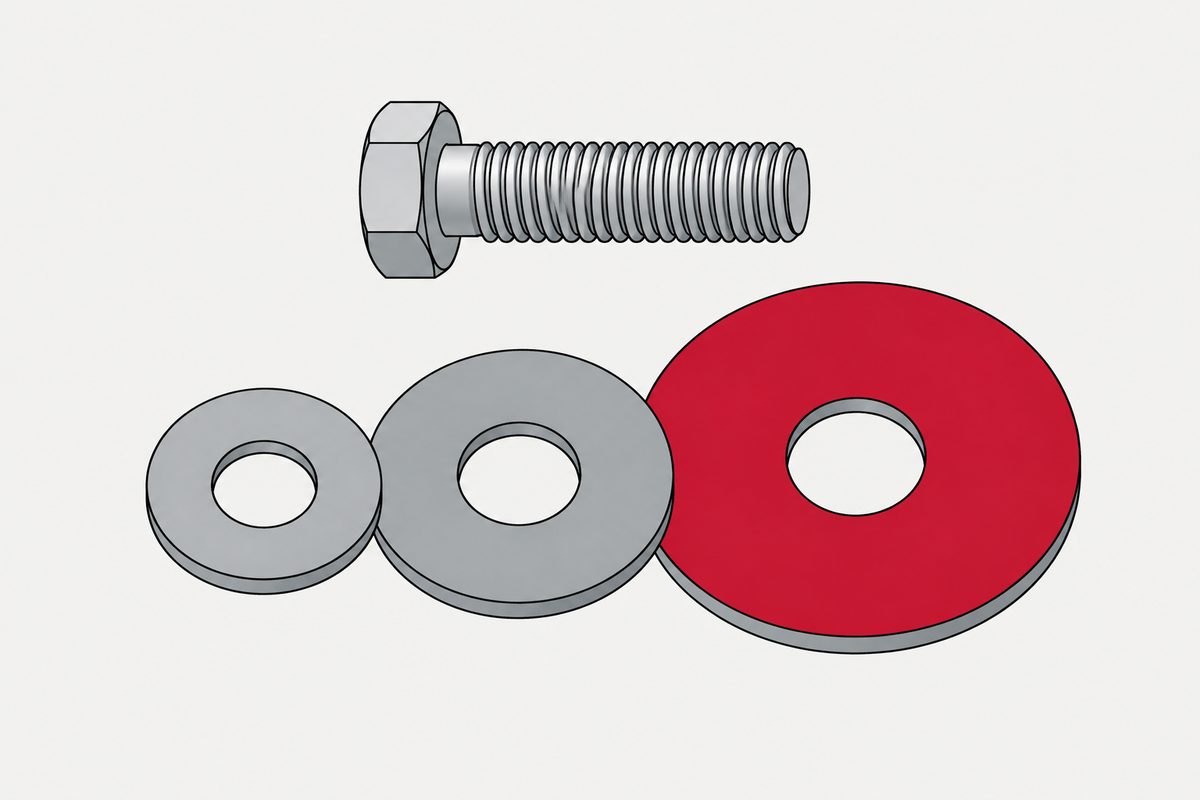
Three outer-diameter series, one nominal size
| Series | ISO | DIN | Outer diameter |
|---|---|---|---|
| Small | ISO 7092 | DIN 433 | Smallest — for confined bearing faces |
| Normal | ISO 7089 (chamfered: 7090) | DIN 125 A / 125 B | The default assumption when nothing is stated |
| Large | ISO 7093 | DIN 9021 | Roughly 3× the nominal diameter — for soft materials and oversized holes. At M3 that is roughly five times the bearing area of the bare head |
| Extra large | ISO 7094 | — | Larger again |
Between the small and the large series the outer diameter more than doubles. That is not a detail — it decides whether the washer clears the counterbore, whether it fouls the adjacent part, and how much bearing area the soft material actually gets. Write the standard number, not the size.
ISO 7091 is the normal series at a coarser product grade, which is why the same nominal washer can also differ in tolerance and finish quality without differing in dimensions on paper.
How to read a washer specification
A washer is specified by five things, and the first three are dimensions:
- Inside diameter — and note it is larger than the screw, because the screw has to pass through. An “M4 washer” has an inside diameter above 4 mm, not 4 mm
- Outside diameter — the series above
- Thickness — which at small sizes is comparable to the head height, so it is not free
- Material — carbon steel, stainless, brass, nylon, fibre
- Hardness class and finish — the one most often omitted, and the one that matters most
Hardness is not cosmetic. A washer softer than the parts it sits between will simply deform under the head, and that deformation is embedding — preload lost without the screw ever rotating. A soft washer added to solve a loosening problem can make it worse.
So add a washer — and what it is actually doing is not that
“It spreads the load” is the usual answer and it is the least important of the four, except in soft materials. In order of how often it is the real reason:
- It gives a consistent bearing surface. The underhead friction coefficient is most of what decides how much of your torque becomes clamp force, and a washer makes that surface the same every time regardless of what the part surface is like — which is the whole problem with torque control
- It protects the surface from being scored by the rotating head — cosmetic on a painted part, functional on a sealing face
- It bridges an oversized or slotted hole, which is the case where the large series exists for a reason
- It spreads the bearing pressure — genuinely important in aluminium, plastic and wood, and largely irrelevant in steel
Read the first item again, because it inverts the usual reasoning. A washer is often there to make the joint repeatable, not stronger. Which means removing one to save a cent per unit changes the torque-to-clamp relationship — and nothing on the drawing will warn you.
Adding a washer is a joint change
Put a washer under a head that previously bore directly on the part and the friction interface moves. It is now screw-to-washer and washer-to-part rather than screw-to-part, with different coefficients and a second interface that can slip.
- The clamp force from the same torque changes, usually upward with a smooth hard washer — which can overload a thread that was previously fine
- The grip length increases by the washer thickness, which is slightly helpful against embedding and slightly reduces thread engagement if the screw length is unchanged
- A free washer can rotate with the head, moving the sliding interface to the washer-to-part face without warning
So “we added a washer” belongs on the change list, next to a coating change or a length change — the same re-verification questions apply. It is the cheapest-looking change on a bill of materials and it is not free.
Sometimes the bearing area you wanted is available as a specified collar instead — marked 08.8.
The types, and whether they do what they claim
| Type | Purpose | Verdict |
|---|---|---|
| Plain | Bearing surface, load spread, hole bridging | Does what it says |
| Split spring lock | Anti-loosening | NASA’s fastener design manual calls the split type useless for locking once flattened by preload, and it flattens well below normal clamp force |
| Tooth / serrated | Anti-loosening by biting the surface | Works by damaging the mating face — which removes the coating and starts the corrosion problem |
| Wedge-lock (ramped pair) | Anti-loosening | Effective under transverse-vibration testing, unlike the two above. How that test sets its conditions |
| Disc spring (Belleville) | Maintains preload through thermal cycling and settling | Addresses preload loss rather than rotation — a different problem, and often the right one |
| Nylon / fibre | Insulation, sealing, surface protection | Will creep under sustained load. Do not put it in the clamp path of a structural joint (the material that insulates is the one that will not hold preload) |
| Bonded seal | Sealing under the head | A sealing part that happens to be washer-shaped |
Note that the disc spring is solving a different problem from all the locking types. If the marker-line check shows the screw never rotated, no locking washer helps and a disc spring might.
One thing a plain washer does not do is clear the head transition — that needs a countersunk bore, and ISO 7090’s chamfer is on the outside diameter. See the fillet under the head. The other thing it cannot do is compensate for a seat that is not parallel — that takes a wedge-section beveled washer, whose slope is copied from the beam flange.
Below M3, three things change
- Washer thickness becomes a significant fraction of the head height — and so does everything else at these sizes, so it visibly changes how much thread is left engaged
- Handling cost rises sharply. Feeding a loose M2 washer reliably is harder than feeding the screw, which is exactly why SEMS screws exist — the washer is assembled at the factory and cannot fall off
- Flatness and burr matter proportionally more. A burr that is negligible under an M8 head is a tilt under an M2 one
What to put on the drawing
- The standard number — ISO 7089, ISO 7092 or ISO 7093, not “M4 washer”
- Material and hardness class, because a soft washer is an embedding source
- Finish, and check it against the parts it touches — a washer is a third metal in the joint
- Whether it is required at all, stated as a function. “Washer to provide a consistent bearing surface” survives a cost-down review; an unexplained line item does not
One row of that table has lost its paperwork entirely: the wave and curved spring washers sold as DIN 137 refer to a standard that was withdrawn with no replacement.
This page covers step 3, the head. The whole order is substrate, thread, head, drive, finish, documentation, and why doing it out of order is rework rather than a tweak is in specifying a screw.
Common questions
Which way round does a flat washer go?
For an ordinary plain washer the standards do not say, because there is nothing to orient. Neither ISO 7089 nor ISO 7090 specifies an assembly orientation. The common advice to put the chamfered side toward the bolt head does not apply to ISO 7090 either, because its chamfer is on the outside diameter — its scope says so in those words — and its bore is the same as ISO 7089, so turning it round provides no clearance for the underhead fillet. A washer that genuinely clears the fillet needs a countersunk bore, and the rule that exists for it is in NASA-STD-5020A: countersunk face toward the bolt head. What does matter on an ordinary stamped washer is flatness and burr, and that matters proportionally more at small sizes.
How do you read a washer specification?
By five things: inside diameter, outside diameter, thickness, material, and hardness class with finish. The inside diameter is larger than the screw, since the screw must pass through — an M4 washer has an inside diameter above 4 mm. The outside diameter is set by the series, and hardness is the item most often omitted and the one that matters most, because a washer softer than the surrounding parts deforms under the head and loses preload.
Why do washers of the same size have different outer diameters?
Because plain washers exist in several outer-diameter series. Smallest to largest: small (ISO 7092 / DIN 433), normal (ISO 7089 / DIN 125), large (ISO 7093 / DIN 9021, roughly three times the nominal diameter) and extra large (ISO 7094). Between small and large the outer diameter more than doubles, which decides whether the washer clears a counterbore and how much bearing area a soft material gets. Specify the standard number rather than the size.
What is a washer actually for?
Most often, to give a consistent bearing surface so the underhead friction is repeatable — and underhead friction is most of what decides how much of the applied torque becomes clamp force. Protecting the surface from the rotating head and bridging an oversized or slotted hole come next. Spreading the bearing pressure, the usual textbook answer, genuinely matters in aluminium, plastic and wood and is largely irrelevant in steel.
Does adding a washer change the joint?
Yes. The friction interface moves from screw-to-part to screw-to-washer plus washer-to-part, with different coefficients and a second surface that can slip, so the clamp force obtained from the same torque changes — usually upward with a smooth hard washer, which can overload a thread that was previously fine. Grip length also increases by the washer thickness. Treat it as a change requiring re-verification, not as a free bill-of-materials addition.
Do spring lock washers work?
NASA’s fastener design manual assesses the split type as useless for locking once flattened by preload, and it flattens well below normal clamp force. Toothed washers work by biting into the mating face, which removes the coating and can start a corrosion problem. Wedge-lock ramped pairs are effective under transverse-vibration testing. A disc spring solves a different problem again — it maintains preload through settling and thermal cycling rather than preventing rotation.
References
Enquiries
Need a washer that is not in a standard series — a non-standard inside diameter, a thickness between two stock sizes, or a material the catalogue does not carry? Send the drawing with the mating parts and the clamp load. We will say whether it is an existing tool, a tooling change — which carries its own lead time — or a part that should stay standard — including the case where a standard series washer does the job and a special one is money spent for nothing.
Request a quotation
Tell us the part and the quantity. We will come back on feasibility, lead time and price.
Or email us directly sales@tigerfasteners.com