 TIGERFASTENERS
An Insulating Washer Changes the Creepage, Not the Clearance
Someone asked how to electrically isolate two plates that still have to be bolted together, and said they were imagining an insulating bushing. The application was an electric fence at around 10 kV. Sixty-three replies came back and the two best of them declined the question as put: one pointed at the dielectric strength of air, the other said an arc will simply go around the outside and that one of the parts should be made from something non-conductive instead. Both were right, and the reason has names.
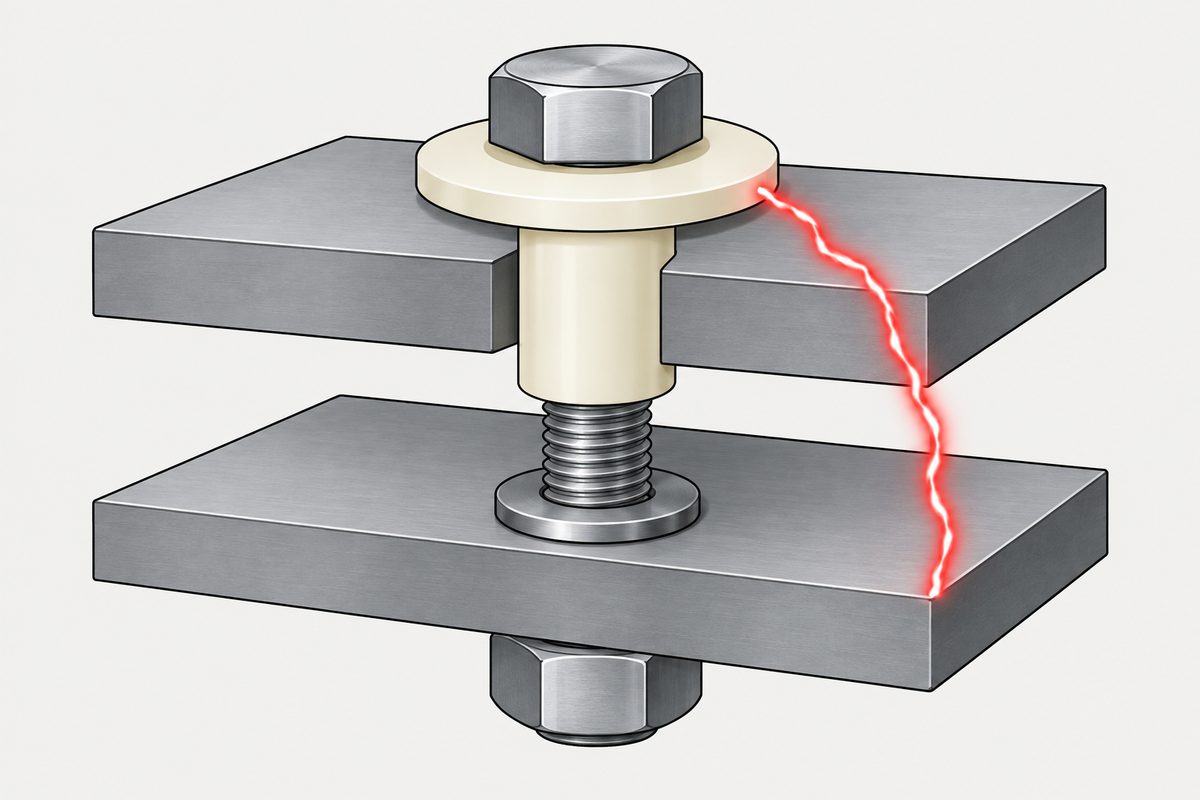
Two distances, and only one of them is yours
IEC 60664-1 is the basic standard for insulation coordination, and its terms section separates two quantities that people usually treat as one.
| Term | Definition |
|---|---|
| Clearance | The shortest distance in air between two conductive parts |
| Creepage distance | The shortest distance along the surface of a solid insulating material between two conductive parts |
Read them next to a bolted joint and the split is obvious. A shoulder washer, a top-hat bushing, a sleeve in the bore: every one of those is a piece of solid insulating material inserted into the path, and what it lengthens is the second distance. The air around the outside of the joint is unchanged.
So the reply saying an arc will jump around the parts was not dodging the question. It was observing that the asker had proposed a fix for the creepage path while the clearance path was the one that would fail, and that no amount of hardware inside the hole moves a distance that is measured outside it.
What the hardware is actually doing
The usual arrangement is a top-hat washer whose shoulder lines the clearance hole and whose flange sits under the head, with a plain washer on top and often a matching one on the far side. Each surface has a job, and each has a way of not doing it.
- The shoulder keeps the bolt off the bore. This is the failure that gets found last, because it is invisible once assembled. A bolt that has been pulled sideways by the joint, or a hole that was drilled slightly off, puts metal on metal inside a part that looks correct from outside.
- The flange lengthens the surface path under the head. That is the creepage distance doing its work, and it is why the flange diameter matters rather than just the thickness.
- The far side has to be insulated too. One insulated end and one metal-to-metal end is a conductive joint with an expensive washer on it.
- A coating is not the insulator. Anodising, paint and passivation are thin, they are damaged by exactly the bearing pressure a fastener applies, and nobody specified them as a dielectric. If the design depends on them, it has an insulator with no drawing.
- The mirror image of this page is a joint that has to conduct. There the same coatings are the problem from the other side, and one published standard bans anodized and plated washers for electrical bonding for that reason.
The conflict nobody warns you about
There is a direct contradiction between the two things this part is being asked to do, and it is already stated in one line on our own washer page: nylon and fibre washers provide insulation, sealing and surface protection, and they creep under sustained load, so they do not belong in the clamp path of a structural joint. The rest of that table is washers explained.
Both halves are true at once. The material that insulates is the material that will not hold your preload. A polymer in the clamp path relaxes, the clamp force falls, and the joint loosens by a mechanism that has nothing to do with anything unscrewing, which is the second failure mode in why screws loosen.
The way out is to stop asking one part to do both. Put a metal sleeve in the clamp path so the compressive load goes through something that does not creep, and use the polymer only where it has to interrupt a conductive path rather than carry the load. If the whole fastener has to be non-conductive instead, that is a different design with its own limits, and what a polymer fastener can and cannot promise is closer to screws for plastic than to anything in a steel fastener catalogue.
And at 10 kV the standard has already stepped back
IEC 60664-1 states its own limits in the first paragraph of its scope: equipment with a rated voltage up to AC 1 000 V or DC 1 500 V, frequencies up to 30 kHz, use up to 2 000 m above sea level. The question in the thread was about 10 kV, which is an order of magnitude outside that. The tables everyone reaches for are not applicable, and no substitute number appears on this page because we are not the document that should be supplying it.
Two further sentences in the same scope are worth carrying even at low voltage, because they describe the situations where the numbers stop being numbers. The minimum clearances specified do not apply where ionized gases are present, and the document does not deal with distances through liquid insulation, through gases other than air, or through compressed air. A joint that is wet, dusty, or sitting in something other than clean air is outside the model rather than at the edge of it.
There is also a note in the scope that reads as a warning to anybody isolating a joint inside a piece of equipment: higher voltages can exist in internal circuits. The rated voltage on the label is not necessarily the voltage across your washer.
The other reason people ask for this
Electrical isolation is not the only reason an insulating washer appears on a drawing. The more common one in our world is breaking a galvanic couple, where the fastener is frequently the small anodic part in a large cathodic joint and the objective is to interrupt the electrolytic path rather than an electrical one. That is a different requirement with a different failure mode, and it is galvanic corrosion, with the ranking that decides which pairs matter in the anodic index table.
Worth separating the two on the drawing, because they do not want the same thing. A galvanic break needs the moisture path interrupted everywhere the two metals could share an electrolyte. An electrical isolation needs a creepage distance and a clearance that survive a specified voltage. A washer that satisfies one has not automatically satisfied the other.
What to settle before the hardware is chosen
- Say which of the two distances is the problem. If the answer is the clearance, hardware inside the hole will not fix it and the geometry has to change.
- Say what is carrying the clamp load. If it is the insulator, the preload is on a countdown. A metal sleeve separates the two jobs.
- Say whether the far side is insulated as well, and whether the bolt is prevented from touching the bore.
- Do not let a coating be the insulator. If anodising or paint is in the isolation path, it needs to be specified and inspected as insulation, or it needs to not be load-bearing on that surface.
- Check whether the joint was also a bonding path. Insulating it removes whatever continuity it was providing, and that is a question to answer deliberately rather than discover.
This is not one of the six steps. It shows up across them, or after assembly. Where the decisions that lead here were made is in specifying a screw, which sets out the order and why doing it out of order is rework.
Common questions
What is the difference between clearance and creepage distance?
IEC 60664-1 defines them separately. Clearance is the shortest distance in air between two conductive parts. Creepage distance is the shortest distance along the surface of a solid insulating material between two conductive parts. An insulating washer, bushing or sleeve is solid insulating material placed in the path, so it works on the creepage distance. The air path around the outside of the joint is unaffected by it.
Will an insulating shoulder washer isolate a high voltage joint?
It addresses the path through the fastener and not the path around it, so on its own the answer is usually no at high voltage. That is what the best answers in the source thread were saying when they suggested changing the design rather than adding hardware. IEC 60664-1 also covers equipment only up to AC 1000 V or DC 1500 V, so at 10 kV the standard people would normally consult for numbers does not apply, and this page does not offer a substitute figure.
Can I put a nylon washer in a structural bolted joint?
Not in the clamp path, if the joint has to keep its preload. Polymer washers creep under sustained load, the clamp force falls with them, and the joint loosens without anything having rotated. The usual arrangement is a metal sleeve carrying the compressive load with the polymer only where it has to interrupt a conductive path, so that the part doing the insulating is not also the part holding the joint together.
Is an insulating washer the same fix as a galvanic isolation washer?
They overlap but they are not the same requirement. Electrical isolation is specified by a voltage and needs a creepage distance and a clearance that survive it. Galvanic isolation is about interrupting an electrolytic path, so it needs the moisture route broken everywhere the two metals could otherwise share an electrolyte, including places a voltage would never have jumped. A part that satisfies one has not automatically satisfied the other, and the drawing should say which is being asked for.
Does anodising count as electrical insulation?
Not unless somebody specified and verified it as insulation. Coatings are thin, their dielectric behaviour is not what the finish was purchased for, and the bearing pressure under a fastener is exactly the condition that damages them. If a design depends on a coating to isolate a joint, the insulator has no drawing and no inspection, which is a different problem from the one the washer was bought to solve.
References
- IEC 60664-1:2020 — insulation coordination for equipment within low-voltage supply systems; clause 1 scope, and 3.1.4 and 3.1.5 defining clearance and creepage distance
- IEC 60050-151 — International Electrotechnical Vocabulary, the source IEC 60664-1 cites for the creepage distance definition
IEC 60664-1:2020 was read from the publicly available preview PDF, which carries the scope in full and the terms and definitions section including both definitions quoted here. The preview does not carry the clearance and creepage tables, and no value from them appears on this page; nor would they apply to the 10 kV case in the source thread, which is an order of magnitude above the standard’s rated voltage limit. The figure for the dielectric strength of air quoted in that thread is deliberately not reproduced here: the commonly cited value is for a uniform field at sea level, and points, edges, humidity, pressure and contamination all move it, so a single number would be misleading in exactly the situation the question describes. The IEC 60050-151 catalogue number was not cross-checked against a second source. Whether insulating a joint disturbs a protective bonding path is raised here as a question to answer rather than a requirement quoted from any code.
Enquiries
If a joint has to be electrically isolated, tell us the voltage and which part is carrying the clamp load. Those two answers change the fastener, and they usually change it more than the thread size does.
Request a quotation
Tell us the part and the quantity. We will come back on feasibility, lead time and price.
Or email us directly sales@tigerfasteners.com