 TIGERFASTENERS
The Star Washer Is on the Do Not Use List for Electrical Bonding
An aircraft mechanic photographed a washer he had not seen before and asked what the deal was. It had something to do with electrical bonding. Ninety seven upvotes, twenty seven replies. The general answer is more interesting than the part, because the intuition almost everybody brings to this is the wrong way round. The washer is not the conductor, and in at least one published standard the washer people reach for is banned outright.
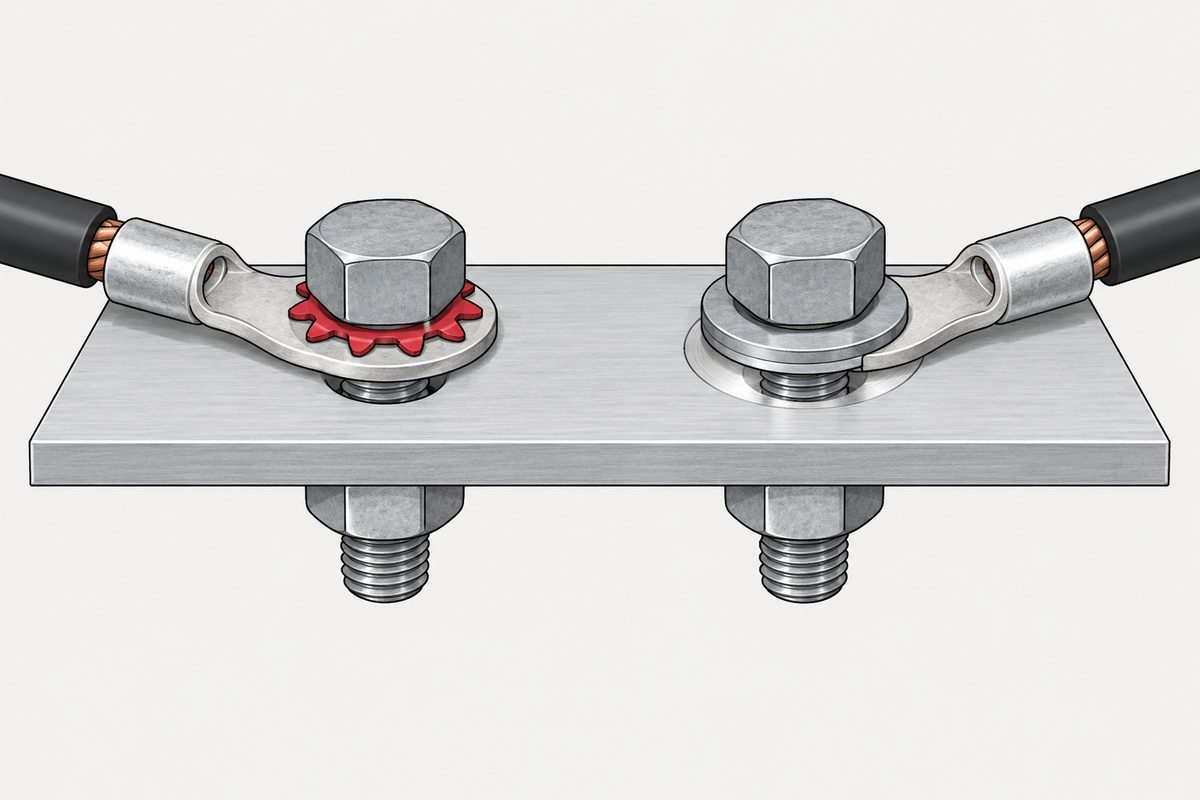
NASA-STD-4003A, clause 5.1.3 c, requirement EBR 77: “The following are problematic and shall not be used for electrical bonding purposes: (1) Self-tapping screws. (2) Zinc-plated bolts, nuts, or screws. (3) Star, anodized, or zinc-plated washers. (4) Cadmium-plated hardware.” The paragraph above it says what fasteners are for instead: “Fasteners should be primarily used to maintain pressure on faying surfaces.”
Two limits before anything else. This is a NASA standard for launch vehicles, spacecraft, payloads and flight equipment. It is not an aircraft standard, not a building standard, and not a rule about your machine. And we have not identified the washer in the forum photograph, which carries no part number we can read and belongs to some other document we do not have. What follows is one authority’s reasoning about bonding, quoted because it is free to read in full and because it contradicts the common intuition.
The document is publicly released. NASA’s own catalogue entry marks it “Internet Public, Standard is cleared for public accessibility on the internet” and the cover carries “Approved for public release, distribution is unlimited”. Forty seven pages, revalidated in March 2026.
“Bonded” is not one number
The first thing the standard does is refuse the single question. Table 1 splits bonding into five classes by purpose, and each carries its own resistance requirement.
| Class | Purpose | DC bond resistance |
|---|---|---|
| C | power current return | depends on current |
| H | shock and fault protection | 0,1 ohm or less |
| R | radio frequency and EMI | 2,5 milliohms or less |
| L | lightning protection | depends on current, 500 volts or less across any joint |
| S | electrostatic discharge | 1,0 ohm or less |
Put two of those side by side and the arithmetic, which is ours, is startling. Class S allows four hundred times the resistance of Class R. Class H allows forty times. A joint that is comfortably bonded for static dissipation can be forty or four hundred times too resistive for the job next to it.
So is it bonded? has no answer until somebody says which class. That is the part the forum question cannot settle from a photograph, and it is why a washer that is correct in one place is wrong in another.
The classes differ in method too, not only in number. For Class C, H and S the standard accepts “jumpers and straps”. For Class R it says “Direct contact preferred. No jumpers. Short, wide strap may be used as last resort.”
The bond is the interface, not the hardware
Clause 5.1 names the preferred method plainly: “the metal-to-metal method being the preferred method”, and its subclause is titled Metal-to-Metal (faying surface to faying surface). A faying surface is defined in clause 3.2 as “the surface of metal materials in contact with each other and joined together”. Two areas of metal, pressed together.
Welded and brazed joints are treated as permanent and inherently bonded, because the two pieces have become one. Everything held by screws, rivets or clamps is a semi-permanent joint, and for those EBR 62 requires the faying surfaces to be prepared before assembly rather than after. The clamping pressure is then a mechanical requirement, handled by the ordinary assembly rules.
That is the frame the fastener clause sits inside. The bolt supplies pressure. The pressure holds two prepared metal faces together. The current crosses at the faces. A washer that promises to make the connection by itself is solving a problem the standard has already solved a different way.
Four things that shall not be used
Now the list, in full, with the requirement number the standard gives it.
[EBR 77] The following are problematic and shall not be used for electrical bonding purposes:
- Self-tapping screws.
- Zinc-plated bolts, nuts, or screws.
- Star, anodized, or zinc-plated washers.
- Cadmium-plated hardware.
The standard gives no reason for this list. It states it and moves on, which is worth saying because the reading that follows is ours and not the document’s. Three of the four items are a plating: zinc on the bolt, zinc or anodising on the washer, cadmium on anything. Those are corrosion finishes, and a corrosion finish is by design a barrier. Anodising in particular is an oxide, which is to say an insulator. The part you were counting on to conduct is wearing a coat that is there to stop things reaching the metal.
The star washer is the interesting one because it is not obviously a plating problem. Our reading is that it fails the geometry test rather than the material test: its teeth make a handful of small, high pressure contact points, and what the standard wants is a prepared area in continuous contact. A few bright points that bit through a finish are also a few points where the finish is now broken and the bare metal is exposed to moisture, which is the beginning of the corrosion the rest of the standard spends pages avoiding. Again, that is inference. The line itself is four words long and offers nothing.
Note what the ban does not say. It bans these things for electrical bonding purposes. A star washer as a locking device is a different question entirely, and this site has looked at what locking devices actually do elsewhere.
Two more requirements sit around the list and are easy to miss. EBR 75: when bolts are part of the bond path, “an analysis shall be performed showing that the number of bolts used in the path is sufficient”. So the count is not a rule of thumb, it is a deliverable. And EBR 76: fasteners “shall be sealed against moisture and air to prevent corrosion of the threads”. Rivets get their own line, in italics: “Rivets are acceptable if a minimum of three rivets is used per junction and they are match-drilled.”
The 2003 edition was blunter, and the 2013 one relaxed it
The baseline edition of this standard, from September 2003, is also public and is twenty five pages. Its clause 5.1 contains a sentence the current edition does not:
“Fasteners or their threads shall not be used as primary bonding paths.”
Flat prohibition, no conditions. The 2013 revision replaced it. Its document history log records “Added section 5.1.3 Fasteners”, and that new section opens by permitting what the old one forbade: “If the bond application is approved by the procuring agency, fasteners may be used to meet bonding requirements.” It even gives a physical reason a bolted path can beat a strap: “The inductance of multiple bolts between otherwise isolated materials may be less than the inductance of a strap between surfaces.”
So over ten years the rule moved from never to with approval and an analysis. And through that whole change, the sentence banning star washers survived word for word. In the 2003 edition it reads as a single run-on line: self-tapping screws; zinc-plated bolts, nuts, or screws; star, anodized, or zinc-plated washers; or any cadmium-plated hardware shall not be used for bonding purposes. In the 2013 edition it is the same four items, broken into a numbered list and given a requirement number.
The 2003 edition also explains cadmium and zinc a second time, for a reason that has nothing to do with conductivity: “Cadmium plated steel is prohibited for space applications. Cadmium sublimates and may deposit on optics, solar arrays, etc. Zinc plating is also prohibited.” Two of the four items on the bonding list are separately banned from the vehicle for outgassing. They are on the list twice, for unrelated reasons.
A factor of five nobody wrote down
Class H, shock and fault protection, requires exposed cases and chassis to reach structure at 0,1 ohm or less. Near flammable vapours it gets much harder, and the standard prints a figure with a data table under it. This is where a poor bond stops being an electrical inconvenience.
| Fault current, A | Max allowable, mΩ | Hazard, mΩ |
|---|---|---|
| 30 | 3,6 | 18 |
| 49 | 1,86 | 9,3 |
| 58 | 1,54 | 7,7 |
| 100 | 0,74 | 3,7 |
| 200 | 0,37 | 1,85 |
| 1000 | 0,074 | 0,37 |
| 5000 | 0,0148 | 0,074 |
Two patterns fall out of that table, and both are our arithmetic rather than anything the standard states.
- The hazard value is exactly five times the allowable value in every row. Seven rows, seven times 5,00. The standard never writes the number 5 anywhere near this table; the safety factor is only visible if you divide
- From 100 A upward, current times allowable resistance is exactly 0,074 volts, in all four rows, and current times the hazard resistance is exactly 0,37 volts. The high current half of the table is a fixed voltage drop rule wearing a resistance costume
- The three low current rows are not on that rule. At 30, 49 and 58 A the permitted drop works out at 0,108, 0,091 and 0,089 volts, so the small currents are allowed slightly more
Two more figures from the same clause put a size on it. EBR 16 requires the fault return path to carry 500 percent overload current for 0,5 second, while the text notes that typical personnel protection breakers trip within 0,2 second of a hard short. That is a factor of two and a half in time, held in reserve. And the voltage on the affected enclosure “should not exceed 4,5 volts”.
Then the sentence that makes the whole subject concrete. EBR 17: magnesium alloy structure shall not be used as a primary fault current return path. The reason is one line long: “The temperature of a poor joint could rise to the ignition temperature of magnesium.”
The finish is the whole argument
Clause 5.2 says the faying surfaces of all electrically bonded metal-to-metal joints “shall be cleaned of all nonconductive materials and protected against corrosion”. Read that twice: cleaned of all nonconductive materials, and protected against corrosion. Those two instructions pull in opposite directions, because most corrosion protection is nonconductive.
The standard resolves it with one sentence that is worth carrying into any joint that has to conduct. EBR 81: “The protection method or finish selected shall not negate the electrical bond between the two surfaces.” The finish is not optional and neither is the bond, so the finish has to be chosen to survive being a conductor.
The practical consequences are strict. EBR 82: treated mating surfaces “shall be protected by packaging materials or protective films until just prior to mating”. EBR 84: surfaces expected to remain mated indefinitely “shall be inspected periodically”, which is an admission that a bond is not a thing you make once.
And where two different metals meet, Appendix B gives a threshold this site has met from the other direction: “Two materials may be placed in direct contact if the electromotive force difference between their groups is not more than 0,25 volts.” That is the same 0,25 volt figure that governs the anodic index table, arriving here because corrosion at the interface is what eventually destroys the bond.
What to take from it
- A bond has a class before it has a number. Five classes in this standard, from 2,5 milliohms for radio frequency to 1,0 ohm for static, a range of four hundred to one
- The preferred method is metal to metal. Prepared faying surfaces held together, with the fastener supplying pressure
- Four items shall not be used for bonding in this standard: self-tapping screws, zinc-plated bolts, nuts or screws, star, anodized or zinc-plated washers, and cadmium-plated hardware
- Three of the four are a plating problem, which is our reading and not the standard’s, since it gives no reason at all
- The ban is for bonding purposes only. A star washer as a locking device is a separate question
- The 2003 edition forbade fasteners as primary bonding paths outright. The 2013 edition permits them with approval and an analysis, and the star washer line survived unchanged through that reversal
- The finish has to be chosen so it does not negate the bond, and joints that stay mated are inspected periodically
None of this identifies the washer in that photograph, and it is not meant to. What it does is answer the question underneath it. The washer is rarely the conductor. The two clean faces it is holding together are.
What holds those faces together is a separate question with its own document. The federal standard for electrical work never gives a tightening figure at all, and asks instead for a good connection without damaging the conductor.
This is not one of the six steps. It shows up across them, or after assembly. Where the decisions that lead here were made is in specifying a screw, which sets out the order and why doing it out of order is rework.
Common questions
Are star washers good for electrical bonding?
NASA-STD-4003A says they shall not be used for that purpose. Its requirement EBR 77 lists four problematic items: self-tapping screws, zinc-plated bolts, nuts or screws, star, anodized or zinc-plated washers, and cadmium-plated hardware. That is one standard, for launch vehicles and spacecraft, and it governs nothing else. It gives no reason for the list.
Why would a star washer be a problem if its teeth bite through paint?
The standard does not say. Our reading is that the teeth make a few small high pressure contact points, whereas the method the standard prefers is a prepared area of metal in continuous contact, with the fastener supplying pressure rather than carrying current. Points that break through a finish are also points where bare metal meets moisture. Treat that explanation as ours.
What actually carries the current in a bolted electrical bond?
The faying surfaces, which the standard defines as the surfaces of metal materials in contact with each other and joined together. Clause 5.1 names metal-to-metal as the preferred method, and the fastener clause says fasteners should be primarily used to maintain pressure on those surfaces.
What resistance counts as a good bond?
It depends entirely on why you are bonding. In this standard, radio frequency bonds require 2,5 milliohms or less, shock and fault protection requires 0,1 ohm or less, electrostatic discharge typically 1,0 ohm or less, and lightning and power return depend on the current. The electrostatic limit is four hundred times the radio frequency limit.
Can bolts be used as the bonding path at all?
In the current edition, yes, if the bond application is approved by the procuring agency and an analysis shows the number of bolts is sufficient for a low impedance path. The standard even notes that multiple bolts can have less inductance than a strap. The 2003 edition said flatly that fasteners or their threads shall not be used as primary bonding paths.
Why are zinc and cadmium plated fasteners excluded?
They appear on the bonding list without a stated reason. The 2003 edition separately prohibits both for space applications for an unrelated reason: cadmium sublimates and may deposit on optics and solar arrays, and zinc plating is also prohibited. So they are excluded twice over, once from the bond and once from the vehicle.
How many rivets does a bonded joint need?
This standard says rivets are acceptable if a minimum of three rivets is used per junction and they are match-drilled. For lightning bonds it requires multiple rivets, bolts or other fasteners at joints in vehicle skin and structure, so that several metallic contact areas share the current.
Does corrosion protection interfere with bonding?
It is the central tension in the surface clause, which requires faying surfaces to be cleaned of all nonconductive materials and protected against corrosion in the same breath. The standard resolves it with a requirement that the protection method or finish selected shall not negate the electrical bond between the two surfaces. Where dissimilar metals meet, it allows direct contact when the electromotive force difference is not more than 0,25 volts.
Does this standard apply to aircraft or to my machine?
No. It is a NASA standard for launch vehicles, spacecraft, payloads and flight equipment, publicly released but written for that domain. We quote it because it is free to read in full and because it states plainly something that is widely believed the other way round. It is not a rule for anything else and we do not present it as one.
References
- NASA-STD-4003A w/Change 1, Electrical Bonding for NASA Launch Vehicles, Spacecraft, Payloads, and Flight Equipment. Complete, publicly released, 47 pages, revalidated March 2026
- NASA-STD-4003, the 2003 baseline edition, 25 pages, available from the same catalogue page and used here only to compare the two editions
- r/aviationmaintenance, where a photograph of an unfamiliar bonding washer produced the question
Both editions of NASA-STD-4003 were read in full. NASA’s catalogue entry marks the standard “Internet Public, Standard is cleared for public accessibility on the internet”, and the cover carries “Approved for public release, distribution is unlimited”. The current edition is revision A with Change 1, approved February 2013, changed January 2016, revalidated 13 March 2026, forty seven pages, from NASA HQ Office of the Chief Engineer. The baseline is dated 8 September 2003 and runs twenty five pages. This is a standard for launch vehicles, spacecraft, payloads and flight equipment. It is not an aircraft, building or machinery standard, and nothing here should be read as a rule for any of those. We do not identify the washer in the forum photograph, which we could not read a part number from, and we make no claim about which document specifies it. The following are our own arithmetic, not statements by the standard: the ratio of four hundred between the Class S and Class R limits and forty between Class H and Class R, the finding that the hazard resistance is exactly five times the maximum allowable resistance in all seven rows of the flammable vapour table, the finding that current times allowable resistance is exactly 0,074 volts in the four rows at and above 100 A while the three lower rows permit 0,108, 0,091 and 0,089 volts, the two and a half times margin between the 0,5 second requirement and the 0,2 second typical breaker trip, and the page count comparison. The standard gives no reason for the list in EBR 77, so the explanation offered here for why a star washer is on it is our reading and is marked as such in the text. The ban is stated for electrical bonding purposes only and says nothing about star washers as locking devices. Figure 1 and its data table, and the wording of clause 5.1.3 including EBR 77, were checked against rendered images of the printed pages rather than extracted text. NASA-STD-6012, NASA-STD-6016 and SAE-ARP-5414, which this standard references for finishes and corrosion, have not been read and nothing is quoted from them. We read the forum post and not its replies, and no company or product brand is named.
Enquiries
If a joint on your drawing has to conduct as well as clamp, say which class of bond it is and what resistance it has to meet, because that decides the finish before it decides the fastener. A plated fastener and a bonded joint are usually two different requirements fighting over the same part.
Request a quotation
Tell us the part and the quantity. We will come back on feasibility, lead time and price.
Or email us directly sales@tigerfasteners.com