 TIGERFASTENERS
The Rule for a Terminal Asks for No Damage, and Never Says Torque
An electrician posted a photograph of an aluminium conductor in a lug, captioned with the fact that it was tightened to the specified figure, and a hundred and two replies argued about whether it looked crushed. Another post reported factory terminations coming loose far below their marked figure. Both arguments are about a number. The federal standard that governs the work does not contain a number, does not contain the word torque, and asks for something else entirely.
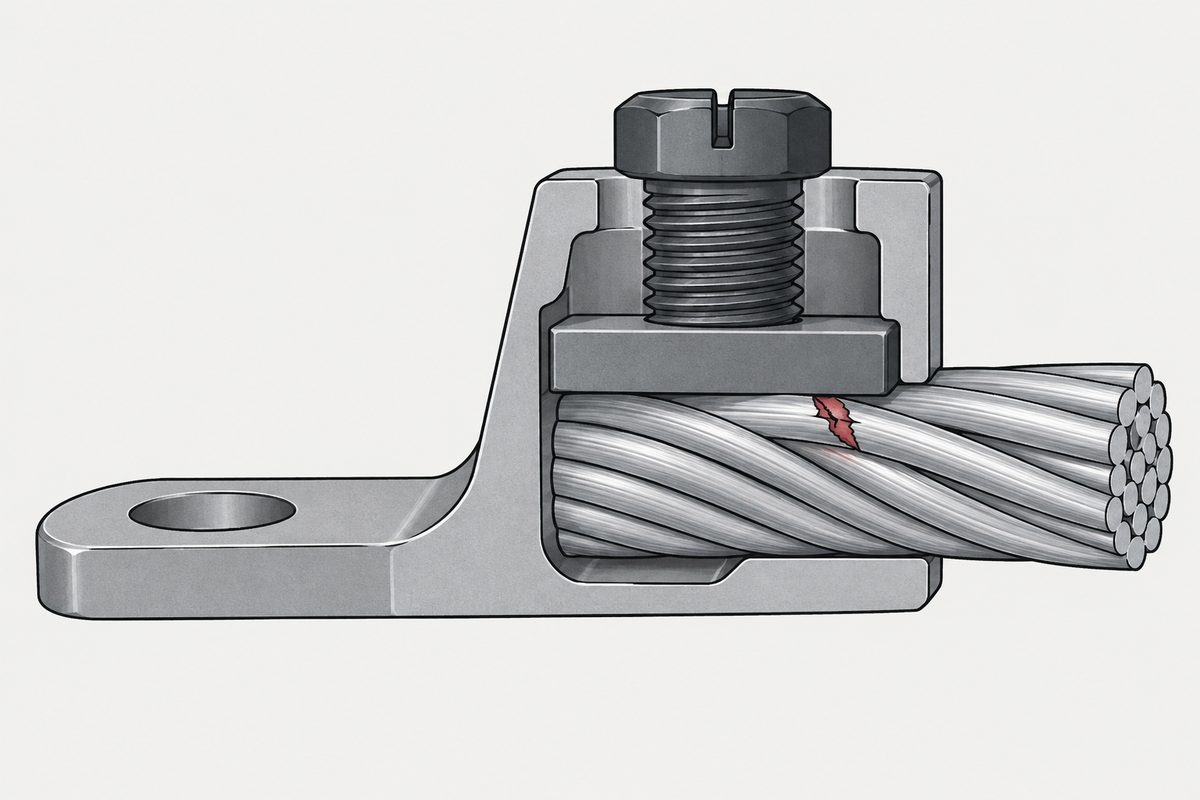
29 CFR 1910.303(c)(2)(i): connection of conductors to terminal parts “shall ensure a good connection without damaging the conductors”. Two requirements in one clause. A torque figure on its own demonstrates neither of them.
This is a United States workplace safety standard for general industry. It is not a wiring design code, it is not the law anywhere else, and nothing on this page is electrical advice. We recommend no torque value, comment on no photograph, and take no side in either argument below.
The argument, twice
On an electricians’ forum, one post is a photograph of an aluminium conductor in an insulated lug. Eighty six points, a hundred and two replies. The caption already tells you the conductor was tightened to the figure the equipment specifies. Everything after that is people looking at the same picture and disagreeing about whether the metal has been damaged.
A second post runs the other way. Factory made terminations on new equipment broke free at roughly a quarter of the figure marked on them, and the poster writes down the received idea along the way: “I understand that the torque can be altered during shipping and you’re not supposed to re-torque an already torqued lug to its full listing.” And of the same equipment, “the crush on the conductors didn’t even look close to the spec”.
That post names two manufacturers in its title and its body and we name neither, so only the two brand free sentences appear here. We read the posts and not their replies, and no forum username appears on this page.
Between them the two posts frame the whole question. One conductor is at the number and looks damaged. The other is at the number on paper and is loose in the hand. So what does the number actually buy.
What the standard says, and what it never says
Subpart S of 29 CFR part 1910 is the electrical section of the United States general industry safety standard. We downloaded the whole of it and counted. The counts below are ours, not the standard’s.
torque: 0. tighten: 0. foot-pound: 0. inch-pound: 0.
wrench: 2, and both are about threaded conduit being made wrench-tight, not about a terminal.
What makes the figure on the equipment binding is one sentence elsewhere in the same section. 1910.303(b)(2): “Listed or labeled equipment shall be installed and used in accordance with any instructions included in the listing or labeling.”
Read the shape of that. The number never becomes federal. The obligation to obey whatever number the manufacturer put on the part does. Which is why searching the standard for a torque table returns nothing and always will.
Then the electrical connections clause adds three more requirements that have nothing to do with tightness at all. Pressure connectors and soldering lugs must be identified for the material of the conductor. Dissimilar metals may not be intermixed in a terminal unless the device is identified for that purpose. And “terminals for more than one conductor and terminals used to connect aluminum shall be so identified”. A lug is either marked for two conductors or it is not one, whatever torque it is at.
The same undefined word, in a different industry
Those two occurrences of wrench-tight are worth a moment. In the electrical subpart they apply to threaded conduit: all conduits shall be threaded and shall be made wrench-tight, and elsewhere the conduit shall be made wrench tight to prevent sparking when fault current flows through the conduit system. The standard does not define the term.
The same word turns up four times in the steel erection subpart of the construction standard, also undefined, where it is the condition two bolts have to be in before a crane releases a beam. Two unrelated bodies of federal safety rules reach for the same word and neither one says what it means. In the electrical case it is not even about the joint people argue over. It is about pipe.
And not all of it applies to an old installation
Paragraph 1910.303(b)(1) lists the requirements that apply to all electrical installations regardless of when they were designed or installed. Reading that list against the clauses above is our own comparison and is worth checking against your own copy.
- 1910.303(b), examination, installation and use of equipment, which carries the listed or labeled sentence, is on the list
- 1910.303(c)(3), electrical connections, splices, is on the list
- 1910.303(c)(1) and (c)(2), the paragraphs about dissimilar metals and about terminals, are not on it
What catches those is the next paragraph, which applies the whole of sections 1910.302 to 1910.308 to every installation made or overhauled after 15 March 1972. So the sentence about a good connection without damage does reach an enormous amount of existing work, but not by the same route as the sentence about following the label, and there is a date attached to it.
Where a number does come from
One free federal document does publish torque figures for electrical connections. It is a Bureau of Reclamation field manual from November 1991, twenty pages, on electrical connections for power circuits.
Before quoting any of it: that manual is about bus work and switchyard hardware at hydroelectric facilities. It is not a rule for a panel in a house, its table is about bolts through bus bars rather than the set screw in a breaker, and it is thirty five years old. We quote it for its structure, not as a figure anyone should use.
Its clause on torque moments sets the same hierarchy the federal standard does. All bolts in bolted connectors should be tightened with a torque wrench “to the torque value recommended by the connector manufacturer”, and “in the absence of manufacturer’s specific torque values, the torque values in table 4 should be used”. The manufacturer first. The table is the fallback.
And here is the table, in newton metres with foot pounds in brackets, for lubricated bolts.
1/4 in − 20: silicon bronze 8.1 (6), aluminium not given
5/16 in − 18: 13.6 (10) and 10.8 (8)
3/8 in − 16: 23.0 (17) and 14.9 (11)
1/2 in − 13: 47.5 (35) and 31.2 (23)
5/8 in − 11: 67.8 (50) and 54.2 (40)
3/4 in − 10: 88.1 (65) and 74.6 (55)
Two things about that table are ours rather than the manual’s. First, all eleven filled cells convert exactly from the foot pound figure, so the imperial column is the original and the metric column is a conversion of it. Second, the ratio between the aluminium and silicon bronze values is not constant: 0.79, 0.65, 0.66, 0.80 and 0.85 down the table. It is not one number scaled.
But the note underneath the table is the part worth carrying away. There is no column for steel bolts. Instead:
“If steel bolts are used, the torque moment will depend on the compression of the Belleville washer (which should always be used with steel bolts). Care must be taken to avoid overcompression (flattening) of the Belleville washer.”
For the most ordinary bolt material in the table’s world, the manual declines to print a torque figure at all and points at a spring washer instead. The thing being controlled was never the wrench reading. It was the clamping force, and for a steel bolt in this application the manual would rather you watched the washer.
Two passes, and a zig-zag
The procedure clause is four steps and none of them is a single pull.
- Lubricate the bolt threads with a suitable nongrit joint compound
- Fit the connector to the conductor and tighten all nuts “finger tight”
- With a torque wrench, tighten the nuts alternately to one-half of the recommended torque, in the figure’s sequence
- “Go back to nut No. 1 and tighten all bolts in sequence to the full recommended torque. This will ensure full clamping force and contact area.”
The sequence figure is worth describing because it is not the one people expect. Eight bolts on a clamp, odd numbers along the top row and even along the bottom, and the arrows run diagonally from one end of the clamp to the other. It is a zig-zag, not the star pattern used on a flange.
Going round twice while installing a connector is not the same thing as re-tightening one that has been in service, and we are not equating them. The manual’s installation procedure says nothing about the second case. What it does say about connections already in service is somewhere else entirely, and it does not involve a wrench.
The check on an old connection is a thermometer
The manual’s section on temperature explains why. Heat cycling on a poorly designed or improperly installed connection is “frequently progressive deterioration and ultimate failure”, and therefore “temperature rise provides an important and quite convenient method of monitoring the condition of electrical connections”.
With one condition attached that is easy to miss. To evaluate a connection by temperature, “the conductor must be energized and carrying as near rated load as possible”. A cold connection tells you nothing, and neither does a lightly loaded one.
So the argument on the forum about whether to put a wrench back on a lug is being had with the wrong instrument, at least according to the one free federal manual that covers the subject. It checks an installed connection by making it work and looking at how hot it gets. That is a result measurement rather than a process measurement, and it is the same move the aviation rule makes when it judges the condition a part ends up in rather than the technique that got it there.
What to take from it
- The federal electrical standard never says torque, or tighten, or foot-pound, or inch-pound. That is our count of the whole subpart
- What makes the manufacturer’s figure binding is one sentence: listed or labeled equipment shall be installed and used in accordance with any instructions included in the listing or labeling
- The requirement on a terminal is a good connection without damaging the conductors. Both halves, and a torque reading demonstrates neither by itself
- A lug for two conductors, or for aluminium, has to be identified as such, which is a marking question rather than a tightness question
- The terminals paragraph is not on the list that applies regardless of installation date. It reaches installations made or overhauled after 15 March 1972
- Where a federal manual does publish torque values, it puts the manufacturer first and its own table second
- That table has no column for steel bolts. For those it points at the compression of a spring washer and warns against flattening it
- Its procedure is two passes, half then full, in a zig-zag sequence, after finger tight and after lubricating the threads
- Its check on a connection already in service is temperature under load, not a torque wrench
Neither photograph on that forum can be settled from here, and this page does not try. What the documents settle is narrower and more useful: the number is the manufacturer’s, the requirement is a result, and if you want to know whether a connection made years ago is still good, the instrument the free manual reaches for is not the one in the argument.
This is not one of the six steps. It shows up across them, or after assembly. Where the decisions that lead here were made is in specifying a screw, which sets out the order and why doing it out of order is rework.
Common questions
Does the federal electrical standard specify a tightening torque?
No. The words torque, tighten, foot-pound and inch-pound do not appear anywhere in subpart S of 29 CFR part 1910. That is our count of the full text. What the standard does is make the manufacturer’s instructions binding: listed or labeled equipment shall be installed and used in accordance with any instructions included in the listing or labeling.
What does the standard require of a terminal?
Section 1910.303(c)(2)(i) requires that connection of conductors to terminal parts shall ensure a good connection without damaging the conductors, and that it be made by pressure connectors including the set-screw type, solder lugs, or splices to flexible leads. Conductors of No. 10 or smaller may also be connected by wire binding screws or studs and nuts with upturned lugs or equivalent.
Can two conductors go in one lug?
That is a marking question, not a torque question. Section 1910.303(c)(2)(ii) says terminals for more than one conductor and terminals used to connect aluminium shall be so identified. If the terminal is not identified for it, tightening it correctly does not help.
Does the terminals rule apply to an old installation?
Not through the same route as the rest. The list in 1910.303(b)(1) of requirements that apply regardless of when an installation was designed or installed includes 1910.303(b) and 1910.303(c)(3) for splices, but not 1910.303(c)(1) or (c)(2). Those are caught by the next paragraph, which applies the sections to every installation made or overhauled after 15 March 1972. That comparison is our reading of the list.
Where do published torque values for electrical connections come from?
From the equipment. A free Bureau of Reclamation field manual from 1991 on electrical connections for power circuits states the hierarchy plainly: bolts should be tightened with a torque wrench to the value recommended by the connector manufacturer, and its own table is to be used only in the absence of manufacturer’s specific torque values.
Why does that table have no steel bolt column?
Because for steel bolts it does not give a torque at all. Its note says the torque moment will depend on the compression of the Belleville washer, which should always be used with steel bolts, and that care must be taken to avoid overcompression or flattening of that washer. The quantity being controlled is clamping force, and there it is read off the washer.
Is a bolted electrical connection tightened in one pass?
Not in that manual. The threads are lubricated, all nuts are brought finger tight, then a torque wrench takes them alternately to one half of the recommended torque in sequence, and then the procedure returns to nut number one and takes them all to full torque. The sequence figure shows eight bolts worked as a diagonal zig-zag rather than a star pattern.
Should an existing connection be re-tightened?
This page does not answer that and gives no electrical advice. What it can report is that the manual’s two pass sequence is an installation procedure and says nothing about connections already in service, and that the method the manual gives for judging those is thermal: temperature rise is described as an important and convenient way of monitoring the condition of electrical connections, with the conductor energised and carrying as near rated load as possible.
Does any of this apply to my house?
No. This is a United States workplace safety standard for general industry, and the manual quoted is for power circuits at federal hydroelectric facilities. Neither is a wiring code, neither is the law outside the United States, and nothing here is advice about any installation.
References
- 29 CFR part 1910 subpart S, Electrical. Downloaded in full from the Electronic Code of Federal Regulations, edition of 27 August 2026
- 29 CFR 1910.303, General requirements, including the extent of application list and the electrical connections clause
- Bureau of Reclamation, Facilities Instructions, Standards, and Techniques, Volume 3-3, Electrical Connections for Power Circuits, November 1991, twenty pages, free and complete
- r/electricians, where two posts about terminations tightened to their specified figure argued about the same number from opposite directions
Subpart S of 29 CFR part 1910 was downloaded in full through the eCFR versioner interface, the edition dated 27 August 2026, and section 1910.303 was read in full. This site has now reached the eCFR three times running, for 14 CFR 43.13 and for the steel erection subpart of 29 CFR part 1926; the titles, the subjects and the findings are different each time and nothing from those pages is repeated here. The Bureau of Reclamation manual was downloaded complete from usbr.gov and is the first use of that source on this site. Note for anyone following the link that the host requires the www prefix; without it the request returns a short HTML page rather than the document. Every figure quoted from its table, and the note beneath the table, were checked against a rendered image of the page rather than extracted text. These are United States documents. The standard is a workplace safety rule for general industry and is not a wiring design code; the manual covers bus work and switchyard hardware at federal hydroelectric facilities, is thirty five years old, and its table is not a torque source for a panel, a breaker or a house. Nothing on this page is electrical advice, no torque value is recommended, neither photograph in the forum posts is commented on, and no side is taken in either argument. The following are our own searching and counting, not statements by either document: that torque, tighten, foot-pound and inch-pound return no occurrences in the subpart while wrench returns two, both about conduit; the comparison of the extent of application list against the electrical connections clauses; that all eleven filled cells of the table convert exactly from their foot pound figures, so the imperial column is the original; and that the ratio between the aluminium and silicon bronze values runs 0.79, 0.65, 0.66, 0.80 and 0.85 rather than staying constant. Both sources name specific products, the forum post naming two equipment manufacturers and the manual naming several joint compounds by trade name, and none of those names appears on this page. NFPA 70, UL 486A-486B, and the two 1974 standards the manual cites for temperature rise have not been read, and no figure from any of them appears here. We read the forum posts and not their replies, and no forum username appears on this page.
Enquiries
If a print or a label puts a tightening figure on a fastener we supply, the useful thing to send us is the whole requirement: the figure, whose document it comes from, the conductor or component material, and whether the part has to be marked for anything. Send that rather than the number alone and we will tell you what we can supply against it.
Request a quotation
Tell us the part and the quantity. We will come back on feasibility, lead time and price.
Or email us directly sales@tigerfasteners.com