 TIGERFASTENERS
The Copper Around That Hole Is Not a Washer
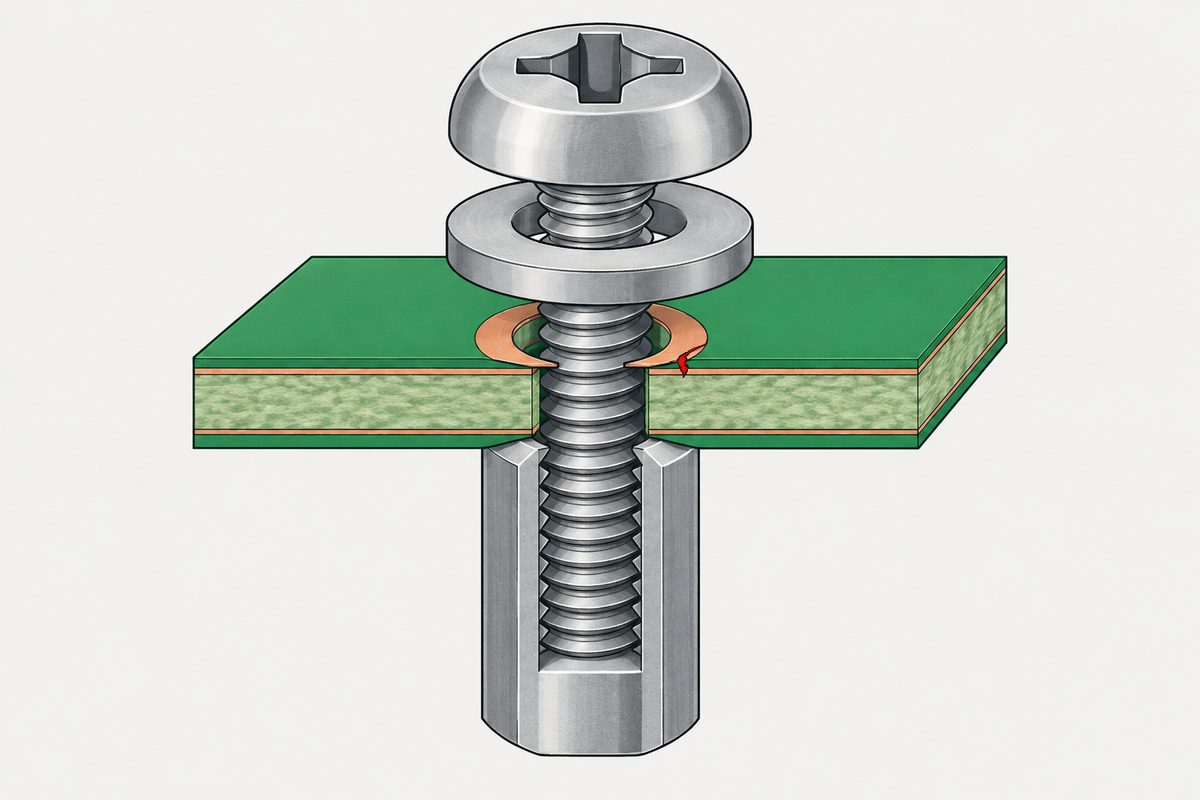
Somebody on r/AskElectronics noticed the ring of copper around the screw holes on a hand-made board and asked whether there was any reason for it when it is not connected to anything. The thread produced a genuine argument. One reply said the copper acts like a protective washer so the screw does not tear into the board. Another said a pad has no thickness and therefore no strength. A third said this is theory losing to practical experience. All three are worth taking seriously, and one of them can be settled with a calculator.
The disagreement, stated fairly
| Claim | What it says |
|---|---|
| It marks the drill | The pad shows where the hole goes, the way a maker marks a board. A manufacturing reason with nothing to do with mechanics |
| It acts as a washer | With the board screwed into a plastic housing, the copper stops the screw tearing into the laminate, especially with cheaper material |
| It cannot | A washer distributes force, and a pad has no thickness, so it has no strength to protect what is under it. Put a real washer on the substrate instead |
The first is a separate reason and it is a good one; nothing below argues with it. The other two look like a contradiction and are not, because they are talking about two different quantities. One of those quantities is arithmetic, so start there.
Load spreading is a stiffness question, and stiffness goes as the cube
A washer spreads load because it is stiff enough in bending to carry force outward from the head before the material under it yields. Bending stiffness per unit width goes as E × t³, and the cube is what decides this argument. Take copper at roughly 117 GPa on a 1,6 mm board at roughly 20 GPa:
| Copper weight | Thickness | Share of the board’s bending stiffness |
|---|---|---|
| Half ounce | 17,5 µm | 0,0008 % |
| One ounce | 35 µm | 0,0061 % |
| Two ounce | 70 µm | 0,0490 % |
Turn it round for the number that lands. For the copper to match the bending stiffness of the board it sits on, it would have to be about 0,9 mm thick. Standard one-ounce foil is 35 micrometres.
So on the specific mechanism named, spreading load the way a washer does, the rebuttal is right, and right by four orders of magnitude. That is not a close call that experience could overturn. It is the cube.
What the observation might be about instead
The person who said the copper helps was not describing an experiment about bending stiffness. Without the pad, the screw head lands on solder mask over cured resin. With it, the head lands on annealed copper. Whether one surface survives a head being tightened onto it better than the other is a contact and surface question, not a load-spreading one, and the two get confused because both end with the words “the board is damaged”.
We found no measurement we were willing to cite either way, so this page will not tell you the pad helps and will not tell you it does not. What it will say is that the argument in the thread was never about the same quantity twice, which is why neither side could convince the other.
The number nobody in the thread reached for
If the worry is the screw damaging the laminate, the quantity to look at is the area the head actually bears on. Using the same method this site uses elsewhere, the standard’s minimum bearing face diameter against an ISO 273 clearance hole:
| M3, medium clearance hole 3,4 mm | Bearing area | Against the bare head |
|---|---|---|
| Head alone, dw min 5,07 mm | 11,11 mm² | — |
| A washer of 7,0 mm outside diameter | 29,4 mm² | 2,6 times |
| Large series, roughly three times nominal | about 54,5 mm² | about 4,9 times |
An entire M3 head bears on about eleven square millimetres. That is the whole contact patch through which the clamp load reaches the board, and it is why a washer changes the situation while a foil cannot.
And the standards already answer the question that was being asked. The plain washer series are three, and the large series exists, in this site’s earlier description of it, for soft materials and oversized holes, running to roughly three times the nominal diameter. A laminate is a soft material. Which washer series to write on the drawing is a decision with an answer, and the answer is not a copper pour.
Two things worth adding before this goes on a board
- If the pad is connected, that is a different design. A metal screw through a grounded pad into a metal standoff is an intentional path, not decoration, and it wants to be drawn that way rather than inherited. What an insulating washer does to the electrical side, and which of the two distances it changes, is creepage, not clearance
- A washer is a joint change, not an accessory. Adding one alters the grip length, the surfaces in the clamp path and the friction, which is the part people skip. The material and hardness class of the washer matter more than its diameter here, because a washer softer than the parts it sits between simply deforms and the area you calculated goes away
The general form of the soft-parent problem, where the limit is the material rather than the fastener, is screws into plastic, and the method used for the bearing areas above is worked through in the head that is smaller than you think.
Which washer you are allowed to reach for is narrower than it looks, and only one of the three plain washer standards says what a washer is for. The widest one is also the softest and is not rated above property class 6.8.
This page covers step 3, the head. The whole order is substrate, thread, head, drive, finish, documentation, and why doing it out of order is rework rather than a tweak is in specifying a screw.
Common questions
Does copper around a screw hole protect the PCB?
Not by spreading load, which is the mechanism usually claimed. Bending stiffness goes as thickness cubed, so 35 micrometres of one-ounce copper on a 1,6 mm board contributes about six thousandths of one per cent of its bending stiffness, and the copper would need to be around 0,9 mm thick to match the board. Whether the head bearing on copper rather than on solder mask over resin makes a difference to surface damage is a separate question, and we found no measurement we were willing to cite on it.
How much area does a small screw head actually bear on?
Less than people expect. Taking the standard minimum bearing face diameter for an M3 head, 5,07 mm, against an ISO 273 medium clearance hole of 3,4 mm, the bearing area is about 11 square millimetres. That is the entire patch through which the clamp force reaches the board, which is why adding a washer changes the picture and adding foil does not.
Which washer should go under a screw on a laminate?
The plain washers come in three outer-diameter series, and the large series exists for soft materials and oversized holes, running to roughly three times the nominal diameter. At M3 that is about five times the bearing area of the bare head. Specify it by standard number rather than by size, and specify the material and hardness class too, because a washer softer than what it sits between deforms and gives the area back.
Is there any good reason to leave the copper then?
Yes, and the most upvoted reply on the source thread gives one that has nothing to do with mechanics: it marks where the hole goes. If the pad is connected to a plane, it is also a deliberate electrical path through the screw and standoff, which is a design decision that should be drawn rather than inherited from a default. Neither of those is the load-spreading claim.
Why did both sides of that argument sound right?
Because they were not arguing about the same quantity. One was talking about spreading load, which is a bending stiffness question and settled by the cube of thickness. The other was talking about what happens at the surface the head touches, which is a contact question. Both end in the sentence the board gets damaged, which is why the disagreement could run without either side being wrong about their own mechanism.
References
- ISO 14579:2011 — hexalobular socket head cap screws; Table 1, which is where the minimum bearing face diameter used above comes from
- r/AskElectronics — the thread this began in, including the washer claim, the rebuttal and the reply about theory against experience
The stiffness comparison is our own arithmetic and can be repeated from two elastic moduli and two thicknesses. Those moduli are typical values rather than standard ones: copper near 117 GPa and a glass-epoxy laminate near 20 GPa in plane, and laminate properties vary considerably by grade, weave and direction. The conclusion is not sensitive to that, because the ratio is four orders of magnitude and the modulus would have to be wrong by a factor of thousands to change it. The copper weights are the trade convention, not a standard. The bearing face diameter of 5,07 mm for M3 is from ISO 14579 Table 1, read from the publicly available preview, and the 3,4 mm clearance hole is ISO 273 medium as tabulated on our earlier page. The large washer series figure is approximate: it comes from the description of that series as roughly three times nominal diameter, not from a tabulated outside diameter, and a drawing should carry the standard number rather than this estimate. No laminate strength, compressive limit or glass transition value is quoted here, because we hold no citable source for them, and for the same reason this page takes no position on whether a pad protects the surface it covers.
Enquiries
If screws are going through a board rather than into metal, say so in the enquiry and say what is on the other side. Head style, washer series and the hardness class of that washer are the three things that decide what the laminate actually sees, and the last of them is the one that is almost never stated.
Request a quotation
Tell us the part and the quantity. We will come back on feasibility, lead time and price.
Or email us directly sales@tigerfasteners.com