 TIGERFASTENERS
Three Plain Washer Standards, and Only One of Them Says What a Washer Is For
The highest voted fastener question on a public engineering site asks why exactly a washer helps distribute stress around a bolt. Twenty four votes, five answers. The mechanics are not ours to settle. What is ours is that three separate ISO standards cover plain washers in three sizes, and reading their opening paragraphs together answers a different and more useful question: what the people who wrote them think a washer is doing, and which washer they think is doing it.
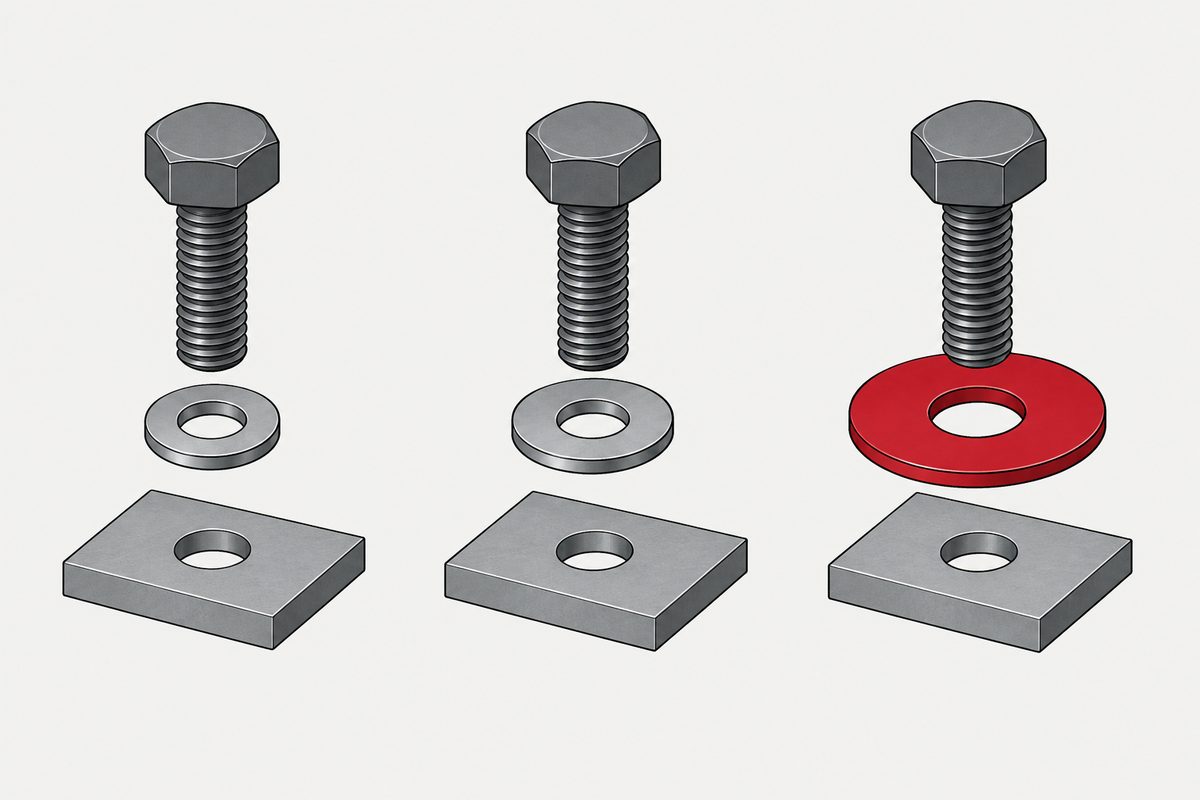
ISO 7093-1, the large series, is the only one of the three that states a purpose. Its washers “are intended for use in cases where soft material pieces are to be clamped or where there are large clearance holes in the workpiece. Nevertheless, in the latter case, the suitability of the washer thickness should be checked.” Not the area. The thickness.
This page does not explain the mechanics of stress distribution, gives no design or selection advice, and names no product. It reads three scopes and one dimension table each. The question came from a public engineering question site through its open interface, because the browser tooling this site normally uses is still unavailable. We read the question and not its answers, and no username appears here.
The normal series hands the question back
Start with the ordinary washer, the one that comes in the box. Its standard opens by saying what it is: normal series, product grade A, in the 200 HV and 300 HV hardness classes, in nominal sizes from 1,6 mm to 64 mm. Then it says which fasteners each hardness class suits. The 200 HV washer for bolts and screws in property classes up to and including 8.8 and nuts up to and including 8. The 300 HV washer for property classes up to and including 10.9 and nuts up to 10.
That is a statement about matching a washer to a fastener, and it is the only functional statement in the document. Then comes the last line of the scope.
“When soft material pieces are clamped, or large clearance holes in the workpiece are used, the user should check the technical suitability of this type of washer.”
Read what those two conditions are. A soft material being clamped. An oversized hole. They are the two situations in which anybody reaches for a washer in the first place, and the standard for the ordinary washer hands both of them straight back with an instruction to go and check.
And the large series picks them up
The next standard along is the same washer with a bigger outside diameter. Its scope has the same hardness classes and the same list of fasteners, and then a sentence the normal series does not have: these washers are intended for use in cases where soft material pieces are to be clamped or where there are large clearance holes in the workpiece.
The same two conditions, in the same order, moved from a warning into a purpose. Between two documents published the same year by the same committee, the two cases a washer is usually reached for are declined by one and claimed by the other.
And then the qualification, which is the part worth slowing down for. “Nevertheless, in the latter case, the suitability of the washer thickness should be checked.” The latter case is the oversized hole. For a hole too big to support the washer under the head, the quantity the standard names is not the outside diameter. It is the thickness, because an unsupported washer over a large hole is being asked to bend rather than to spread.
How much more area you actually get
Take M8 through all three tables. Nominal values, all read from the published dimension tables.
Normal series: hole 8,40, outside 16,00, thickness 1,6
Large series: hole 8,40, outside 24,00, thickness 2
Extra large series: hole 9,00, outside 28,0, thickness 3
The bearing face is the annulus between those two diameters, so its area is π/4 times the difference of the squares. That calculation is ours.
- Normal: 145,6 mm²
- Large: 397,0 mm², which is 2,73 times the normal one
- Extra large: 552,1 mm², which is 3,79 times
Two things fall out of that. The thickness only goes 1,6 to 2 to 3, so the area grows 3,8 times while the thickness grows 1,9 times. And the extra large washer has a bigger hole, 9,00 against 8,40, so six tenths of a millimetre of its extra outside diameter is spent on a looser fit rather than on bearing face.
The biggest washer is the softest one
Now read the third scope, and notice that it is not a bigger version of the first two at all.
“This International Standard specifies the characteristics of extra-large-series, product-grade-C plain washers in the 100 HV hardness class, of nominal sizes ranging from 5 mm to 36 mm inclusive. These washers are suitable for hexagon bolts and screws of product grade C in property classes up to and including 6.8, and hexagon nuts of product grade C in property classes up to and including 6 used in timber structures.”
Put the three hardness classes in a row, which is our comparison rather than anything the documents state side by side. Normal series: 200 HV or 300 HV. Large series: 200 HV or 300 HV. Extra large series: 100 HV. The washer with nearly four times the bearing area is the one made to half the hardness of the softest option in the other two, in the lower product grade, and it names its application in the last three words of its own scope.
The consequence is worth stating plainly, because it inverts the usual instinct. If you want more bearing area under a property class 10.9 bolt, the extra large washer is not the answer the standards give you. It is not rated for that bolt. The largest washer the three documents offer for 10.9 is the large series in 300 HV, which at M8 is the 2,73 times figure above.
None of that says anything about whether any of these washers will protect any particular material, and this page does not try to. Which washer suits a joint is a question about surface pressure limits, and no limit appears in any of the three standards read here.
What the three documents actually contain
Between them, three ISO standards for a flat ring with a hole in it contain: hardness classes, product grades, nominal size ranges, lists of which fastener property classes each hardness class suits, hole and outside diameters, thicknesses, surface roughness, and a set of tolerances handed off to another standard.
What they do not contain is a statement of the mechanics. Nothing about pressure, nothing about how far a load spreads under a head, nothing about the cone people draw. The nearest any of them gets is one sentence in the middle document saying which two situations its washers are intended for, and one in the first saying that in exactly those two situations you should go and check.
This site has taken the same route through washers before, from a different direction: the page on why the copper around a hole is not a washer and the one on the star washer being on a do not use list for electrical bonding. Neither is repeated here.
What to take from it
- The normal series names two situations and tells you to check them yourself: soft material being clamped, and a large clearance hole
- The large series claims those same two as its purpose. Same year, same committee, opposite handling
- For the oversized hole the large series names the thickness, not the outside diameter
- At M8 the bearing areas are 145,6, 397,0 and 552,1 square millimetres, a ratio of 1, 2,73 and 3,79, which is our arithmetic on the published diameters
- Area grows faster than thickness, 3,8 times against 1,9
- The extra large washer has a bigger hole, so part of its extra diameter buys clearance rather than bearing face
- The extra large washer is 100 HV, product grade C, and rated only to property class 6.8, in timber
- So the largest washer available under a 10.9 bolt is the large series at 300 HV, not the extra large one
- No surface pressure limit appears in any of the three, so none of them tells you whether the material under it will survive
The question asked why a washer distributes stress. The three documents that define washers do not answer it, and that is the finding rather than a complaint. They are dimension standards with a hardness class attached, and the only functional sentence in the set is one line about two situations, in the middle one of the three.
They do not say which side it goes on either. The one document that had to settle that is a test standard, and it fixes the washer so that it cannot rotate rather than naming an end of the bolt.
This is not one of the six steps. It shows up across them, or after assembly. Where the decisions that lead here were made is in specifying a screw, which sets out the order and why doing it out of order is rework.
Common questions
Do the plain washer standards say what a washer is for?
Only one of the three does. The large series standard says its washers are intended for use where soft material pieces are to be clamped or where there are large clearance holes in the workpiece. The normal series standard names the same two situations but tells the user to check the technical suitability of that type of washer, and the extra large series standard states an application rather than a function.
How much more bearing area does a large series washer give?
At M8, the normal series is 16,00 mm outside on an 8,40 mm hole and the large series is 24,00 on the same hole. Treating the bearing face as the annulus between them, our arithmetic gives 145,6 and 397,0 square millimetres, so the large series is 2,73 times the normal one. The extra large series, 28,0 on a 9,00 hole, gives 552,1 square millimetres, or 3,79 times.
Why does the large series standard mention thickness?
Because of the second of its two cases. It says that where there are large clearance holes, the suitability of the washer thickness should be checked. A washer bridging a hole too large to support it is being asked to resist bending, and thickness rather than outside diameter is what governs that.
Is the extra large washer just a bigger version of the normal one?
No. It is specified in the 100 HV hardness class and product grade C, against 200 HV and 300 HV in product grade A for the other two. It is suitable for product grade C bolts and screws in property classes up to and including 6.8 and nuts up to and including 6, used in timber structures.
Which washer should go under a property class 10.9 bolt?
This page gives no selection advice. What it can report is that of the three standards read, only the normal and large series list a hardness class suitable up to 10.9, namely 300 HV. The extra large series is rated only up to 6.8, so it is not among the options those documents offer for a 10.9 bolt.
What hardness classes exist for plain washers?
In these three standards, 200 HV and 300 HV for the normal and large series in product grade A, and 100 HV for the extra large series in product grade C. The hardness is Vickers, tested to a separate standard which has not been read for this page.
Do the standards say how much pressure the material under the washer can take?
No. No surface pressure limit appears in any of the three. They give hardness classes, dimensions, thicknesses and surface roughness, and refer tolerances to another document. Whether the clamped material survives is not a question they answer.
Does a thicker washer spread load further?
This page does not make that claim, because none of the three standards does. What the large series standard says is narrower: where the clearance hole is large, check the thickness. That is a statement about which dimension to check, not about how far a load travels.
Why exactly does a washer help distribute stress?
This page does not answer the mechanics and does not try. It reports what the product standards contain, which is dimensions, hardness classes and lists of compatible fastener property classes, and one sentence of stated purpose in the middle document of the three.
References
- ISO 7089:2000, Plain washers, Normal series, Product grade A. Free nine page preview with the scope and the preferred dimensions table
- ISO 7093-1:2000, Plain washers, Large series, Part 1: Product grade A. Free nine page preview with the scope and the preferred dimensions table
- ISO 7094:2000, Plain washers, Extra large series, Product grade C. Free eight page preview with the scope and the preferred dimensions table
- The question, on a public engineering question site. Twenty four votes, five answers
Three free previews were read, one for each series: the normal series, the large series and the extra large series, all published in 2000. In each case the preview carries the full scope and the table of preferred dimensions. Every quoted sentence and every dimension was checked against a rendered image of the page rather than the extracted text. The following are our own arithmetic and comparison, not statements by any of the three documents: the bearing areas of 145,6, 397,0 and 552,1 square millimetres, obtained by treating the bearing face as the annulus between the nominal hole and the nominal outside diameter; the ratios 2,73 and 3,79; the observation that area grows 3,8 times while thickness grows 1,9 times; the note that the extra large series has a larger clearance hole than the other two; and the side by side reading of the three hardness classes. No standard read here places the three series next to each other or draws that comparison. This page does not explain the mechanics of stress distribution, gives no design or selection advice, and makes no claim about whether any washer will protect any material, because no surface pressure limit appears in any of the three. The washer general plan, the tolerance standard for washers and the Vickers hardness test method are all referenced by these documents and none of them has been read here, and the tables of non-preferred dimensions are not used. The question came from a public engineering question site rather than from the forum tooling this site normally uses, which remains unavailable. We read the question and not its answers, and no username appears here.
Enquiries
If a drawing calls for a washer, the useful thing to send is which series and which hardness class, not just the nominal size. Those two decide which of three different parts you get, and the widest one is not the strongest one.
Request a quotation
Tell us the part and the quantity. We will come back on feasibility, lead time and price.
Or email us directly sales@tigerfasteners.com