 TIGERFASTENERS
The Standard That Had To Decide Where a Washer Goes Does Not Answer Nut Side or Bolt Side
Somebody takes an assembly apart, cannot remember which side the single washer was on, and asks whether it generally belongs against the nut or against the bolt head. Ninety seven votes, eight answers. The interesting thing is what happens when you go looking for a document that settles it. The standard defining what a standardized fastener is does not mention washers at all, and the one document that could not avoid deciding turns out to be answering a different question.
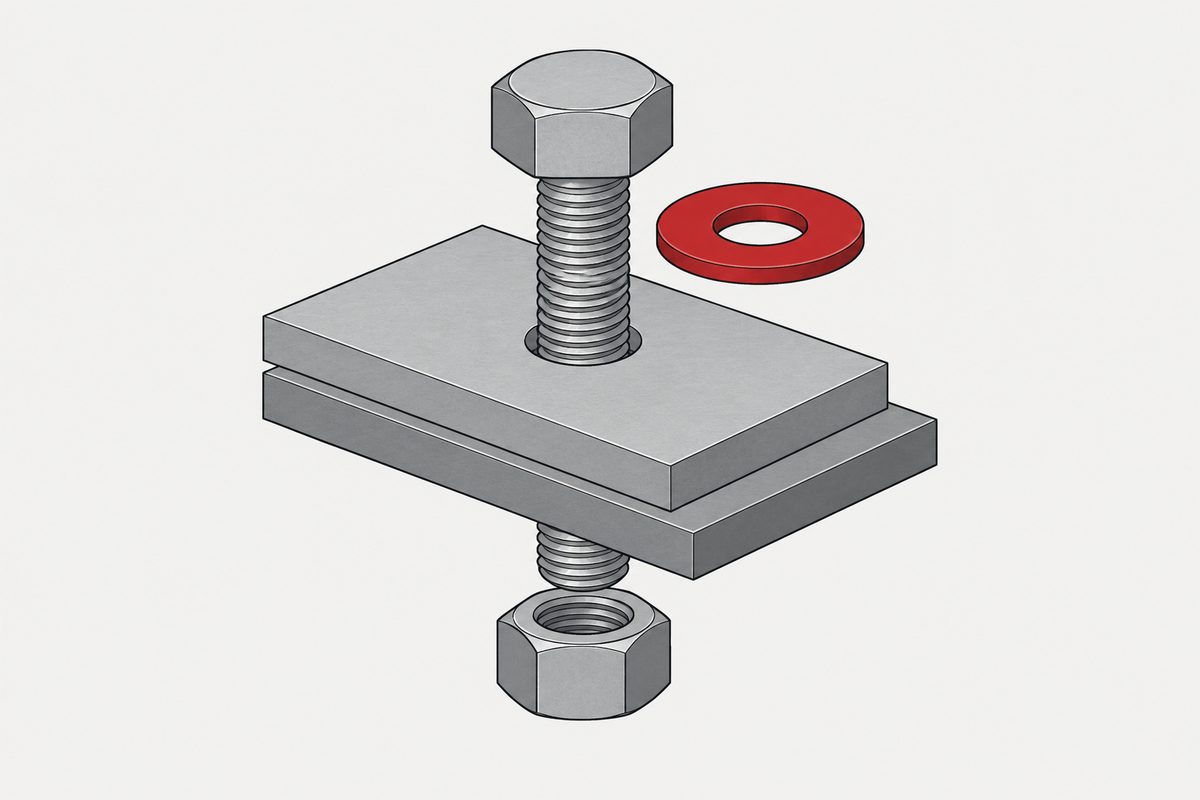
From the notes to the test fixture drawing in the torque and clamp force test standard: “Test-bearing plate or test washer and bolt head or nut shall be fixed by suitable means to prevent rotation and shall be aligned.”
This page does not say which side to put your washer on. No document we read says it, and we are not going to invent one. What can be reported is what the washer is doing in the one place where somebody had to pin it down, and why that turns out to be a different question from the one that was asked. The question came from a public home improvement question site through its open interface, the browser tooling this site normally uses being unavailable again. We read the question and not its answers, and no username appears here.
Where the answer is not
Start with the document whose entire job is to say what a standardized fastener is when nothing else has been agreed. Its title is General requirements for bolts, screws, studs and nuts, and washers are not in that list. By our count the word washer appears in it zero times. Its tables allocate a standard to threads, to driving features, to ends of parts, to surface discontinuities, to coatings and to quality. There is no washer row, because washers are not what that standard is about.
We read that standard closely for a separate question and it is worth being precise here: this is not an omission on its part. It is a boundary. Washers have their own standards, and when we read three of them together we found only one says what a washer is for. None of them says which side it goes on either, which is a large part of why the question has ninety seven votes.
The document that could not avoid it
There is one kind of document that cannot leave the washer unspecified: a test standard for measuring the relationship between tightening torque and the clamp force it produces. You cannot measure that relationship without controlling every surface the torque is spent on, and one of those surfaces is under the head or nut.
ISO 16047:2005 is that standard, covering bolts, screws, studs and nuts of carbon and alloy steel with ISO metric threads from M3 to M39. Its symbol table splits the applied torque into named parts, and two of them matter here: thread torque, and bearing surface friction torque. The washer owns the second one entirely.
By our count the word washer appears eighteen times in the preview. The fixture drawing lists a test-bearing plate, test washer or specified washer as item one, the part being tested as item two or five, and then the note quoted at the top of this page. The washer is fixed so that it cannot rotate. The thing that turns is the nut or the head. The washer is the stationary face it slides against.
What a controlled washer has to be
Because that face carries a measured quantity, the standard specifies it the way you would specify a gauge. Two types are offered, and the choice is left to judgement: “Either a test-bearing plate or a test washer of high (through-hardened, type HH) or low (type HL) hardness shall be used. The supplier shall select the test-bearing plate or test washer and surface condition according to experience, unless otherwise specified by the purchaser at the time of order.”
The high hardness type then gets six properties in a row.
- Hardness 50 HRC to 60 HRC
- Roughness Ra 0,5 plus or minus 0,3
- Clearance hole to the medium series, and it shall neither be chamfered nor have a countersink
- Minimum thickness taken from the large series plain washer standard
- Thickness variation on the same part, and flatness to product grade A of the washer tolerance standard
- Surface condition, either plain uncoated and degreased, or zinc electroplated to a named designation and degreased, and free of burrs
The low hardness type is 200 HV to 300 HV, with a maximum roughness of Ra 1,6 up to three millimetres thick and Ra 3,2 between three and six. Two adjacent subclauses, two different hardness scales, which is our observation rather than a remark by the standard.
Look at that list again and notice what every item has in common. Hardness, roughness, flatness, thickness variation, coating, cleanliness, and a hole with no chamfer. These are the properties that decide how much of your torque disappears into the face rather than into stretching the bolt. Nothing on the list is about which end of the bolt the washer sits at, because from the point of view of the measurement that is not the variable.
Two clearance grades in one fixture
A detail worth recording, because it shows how carefully the two holes are being kept apart. The hole through the washer or bearing part is specified to the medium series. The hole through the test fixture, the clamped member, is specified to the fine series. Two different clearance grades in one rig, which is again our observation.
That makes sense once you see what each hole is for. The fixture hole positions the bolt. The washer hole only has to clear it, and its own outer bearing area is what matters. The two holes are doing different jobs and are toleranced accordingly.
There is also a cleanliness requirement that reads oddly next to how fasteners actually arrive. “All traces of grease, oil or other contaminations shall be removed before testing. The test parts shall be degreased by ultrasonic means…” and if the parties disagree, “the degreasing procedure shall be agreed between the contracting parties.”
The general requirements standard makes the default delivery condition clean and lightly oiled. The test standard begins by removing that. Both are correct; they are describing different moments. It is worth holding both in mind before treating any published friction figure as a property of a part you have in a box.
What this actually answers
Not the question as asked. The reframing is the useful part.
The washer in that fixture is not on the nut side or the bolt side. It is on the turning side. It is held still, the fastener rotates against it, and it is specified in every property that changes the friction of that contact. Read that way, asking whether a washer goes against the nut or against the head is asking about the wrong axis. The distinction the standard draws is between the element that turns and the element that does not.
And a test standard is not an assembly instruction. It describes a rig built to make a measurement repeatable, not a joint built to hold something together. It does not tell the person with a disassembled bracket what to do, and neither do we. What it does establish is that if there is a reason to prefer one side, the reason will be about the surface under the element that moves, and the properties the test standard lists are the ones that would carry it.
One more line from the same standard is a reminder that the turning element is the organising idea throughout. For studs, only the coefficient of friction between the threads is determined, only the nut end is tested, and the metal end of the stud shall be prevented from rotating before testing. Everything is arranged around what is allowed to move.
What this settles and what it does not
- No general fastener standard we read says which side a washer goes on. The general requirements standard for bolts, screws, studs and nuts does not mention washers at all, by our count
- The torque and clamp force test standard fixes the washer so that it cannot rotate, and aligns it, so the washer is the stationary face the turned element bears against
- It specifies that washer by hardness, roughness, clearance hole, thickness, thickness variation, flatness, coating and freedom from burrs, which are the properties that change bearing surface friction
- Applied torque is split into thread torque and bearing surface friction torque, and the washer owns the second
- The washer hole is medium series while the fixture hole is fine series, our own observation from two separate provisions
- Test parts are degreased by ultrasonic means before testing, which is the opposite of the default delivery condition for the fasteners themselves
- This is a test standard, not an assembly instruction, and nothing here tells anyone which side to put a washer on
The person with the bracket in pieces still has to choose. What the documents give is a better question to choose by: not which end, but which face is going to be rubbed by something turning, and whether that face is hard enough, flat enough and clean enough to behave the same way twice.
This page covers step 4, the drive. The whole order is substrate, thread, head, drive, finish, documentation, and why doing it out of order is rework rather than a tweak is in specifying a screw.
Common questions
Does a washer go on the nut side or the bolt side?
No standard we read answers that, and this page does not either. The general requirements standard for bolts, screws, studs and nuts does not mention washers at all by our count, and the plain washer standards do not state which side.
Is there any document that decides where the washer sits?
A test standard has to, because friction under the turned element is part of what it measures. In the torque and clamp force test fixture, the test washer or test-bearing plate and the bolt head or nut are fixed by suitable means to prevent rotation and are aligned. The washer is the stationary face; the fastener turns against it.
What does that standard require of the washer?
For the high hardness type: 50 HRC to 60 HRC, roughness Ra 0,5 plus or minus 0,3, a clearance hole to the medium series that is neither chamfered nor countersunk, a minimum thickness from the large series plain washer standard, specified thickness variation and flatness to product grade A, and a surface either plain uncoated and degreased or zinc electroplated and degreased, free of burrs. The low hardness type is 200 HV to 300 HV with a maximum roughness of Ra 1,6 or Ra 3,2 depending on thickness.
Why does the standard care so much about the washer?
Because the torque applied is split into thread torque and bearing surface friction torque, and the washer face carries the second one. Every property listed for it is a property that changes how much torque is spent there rather than on stretching the bolt.
Can I use those washer requirements on my own assembly?
They are written for a test fixture, not for a joint. The rig exists to make a measurement repeatable. This page gives no assembly or tightening advice.
Does the standard mention which end for studs?
It organises the test around what turns. For studs only the coefficient of friction between the threads is determined, only the nut end is tested, and the metal end of the stud shall be prevented from rotating before testing.
Are the washer hole and the fixture hole the same?
No, and that is our own observation from two separate provisions. The clearance hole in the washer or bearing part is to the medium series; the hole through the test fixture is to the fine series.
Are the test parts oiled or dry?
Dry. All traces of grease, oil or other contamination are removed before testing, and the test parts are degreased by ultrasonic means, with the procedure to be agreed between the parties in case of dispute. That is the opposite of the default delivery condition for fasteners, which is clean and lightly oiled unless something else has been agreed.
So how should I decide?
This page does not decide for you. What it offers is the axis the documents actually use: not nut end against bolt end, but the face that something turns against, and whether that face is hard, flat and clean enough to behave consistently.
References
- ISO 16047:2005, Fasteners, Torque/clamp force testing. Free preview, eleven pages, covering the scope, symbols, principle of test, the fixture drawing and clause 7 on test parts
- ISO 8992:2005, Fasteners, General requirements for bolts, screws, studs and nuts, the standard in which the word washer does not appear
- The question, on a public home improvement question site. Ninety seven votes, eight answers
The test standard preview was downloaded complete and clause 7 with the fixture notes was checked against rendered page images. This site has referred to that standard on eleven earlier pages, so this is the twelfth use, but none of those pages used clause 7.2 on test-bearing plates and test washers, which is where everything new here comes from. No friction coefficient or torque coefficient value from the standard appears on this page, because the tables carrying them were not read. This is the second use of the general requirements standard, after an earlier page on its delivery condition, and nothing from that page is repeated. The following are our own counts and observations, not statements by either standard: that the word washer appears zero times in the general requirements standard and eighteen times in the test standard preview; that the washer hole is specified to the medium series while the fixture hole is specified to the fine series; and that the two washer types are given in two different hardness scales. The three plain washer standards were read for an earlier page and are not re-examined here. This page does not say which side a washer should go on, gives no assembly or tightening advice, and names no brand. A test standard describes a fixture built to make a measurement repeatable and is not an assembly instruction. The question came from a public home improvement question site rather than the forum tooling this site normally uses, which remains unavailable. We read the question and not its answers, and no username appears here.
Enquiries
If a drawing calls for a washer without saying which face it protects or what it has to be made of, that gap tends to surface later as a friction argument. Send the callout as written and we will tell you what we can supply against it and what would have to be added to make the part reproducible.
Request a quotation
Tell us the part and the quantity. We will come back on feasibility, lead time and price.
Or email us directly sales@tigerfasteners.com