 TIGERFASTENERS
The Standard Says the Bolt Arrives Oiled, and Then Says Nothing About How Much
Someone asked how much to adjust a factory torque figure for lubricated threads, and wrote the assumption out honestly: that the published figures are for dry threads, as used in a factory where no oils or grease are present. There is an ISO standard whose whole job is to say what a standardized bolt is when nothing else has been agreed. It contains one sentence about how the bolt arrives, and that sentence is not dry.
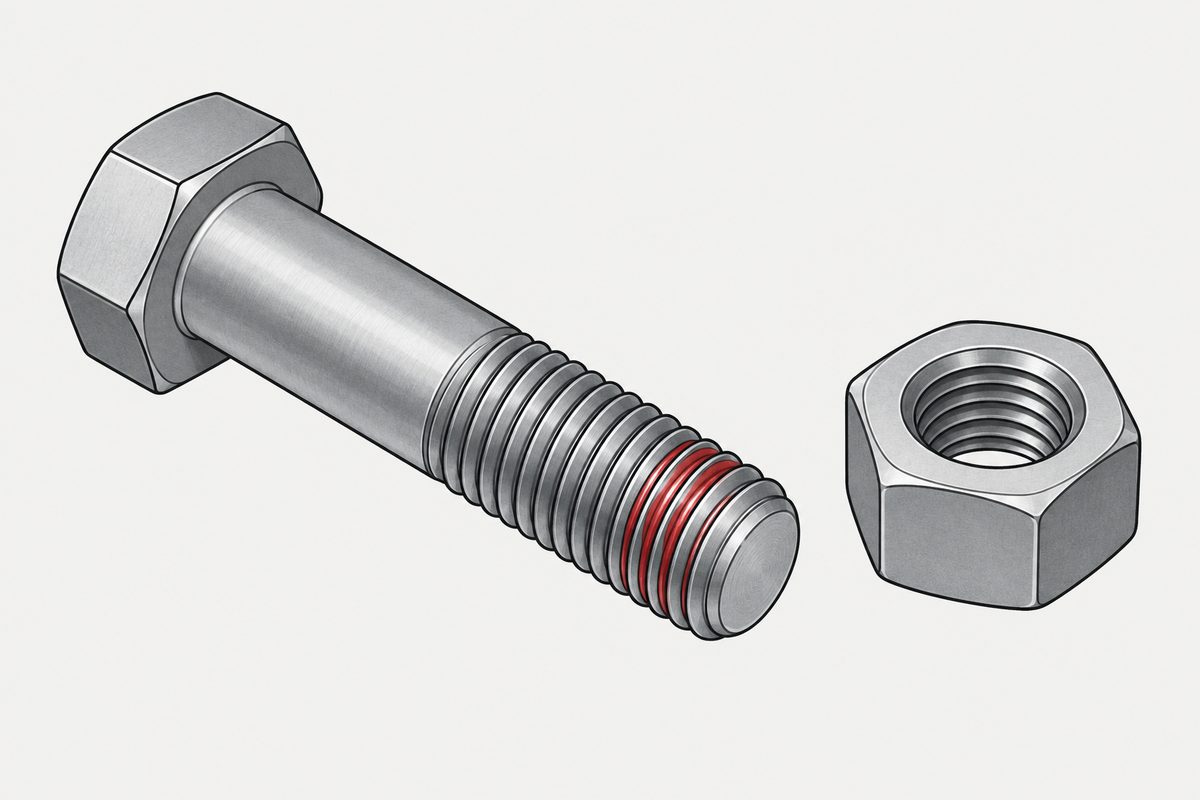
The last line of the general requirements, identical in the 1986 and 2005 editions: “Bolts, screws, studs and nuts shall be delivered in a clean condition and lightly oiled, if no other conditions have been agreed.”
This page gives no tightening advice, no torque correction factor and no lubrication recommendation. It reports what one document says and what it does not say. The question came from a public engineering question site through its open interface, the browser tooling this site normally uses being unavailable again. We read the question and not its answers, and no username appears here.
The document that says what a bolt is
ISO 8992 is called Fasteners, General requirements for bolts, screws, studs and nuts. The current edition is the second, dated 15 April 2005, and it replaced a first edition from 1 December 1986. Both are short. Both are free to read in preview form, and in both cases the preview happens to carry the entire technical content, because the entire technical content is about a page.
Its scope sentence tells you the shape of it. The standard specifies the general requirements for standardized fasteners, and is “intended to be used with reference to the related International Standards on tolerances, mechanical and performance characteristics, geometrical features, surface discontinuities, surface finishes and quality aspects.” That is a document whose main function is to point at other documents.
By our count the 2005 normative reference list holds forty numbered entries drawn from twenty seven distinct ISO documents. The 1986 list held seven. The requirements clause itself barely moved: our word count puts it at about 233 words in 2005 and about 231 in 1986. The number of documents it defers to grew by nearly four times while the number of things it says for itself stayed where it was.
Five elements, and one of them was added
Clause 4 opens by saying that standardized bolts, screws, studs and nuts are defined by the following elements, and then lists them. In 2005 there are five:
- Mechanical properties, given as property class and material
- Product grade, given as tolerances
- Standardized geometrical features, if any
- Surface coatings, if required
- Special requirements, if agreed
In 1986 there were four. The geometrical features line did not exist, and the first line read simply mechanical properties (material) with no mention of a property class. Three of the five carry a condition. Only the first two are unconditional, which is a compact way of saying that a fastener with no stated coating and no stated special requirement is still a fully defined product.
The tolerance half of that list is the subject of ISO 4759-1, and what a product grade does and does not promise is a separate question this site has already worked through. What matters here is that ISO 8992 treats it as one of the two things you always have.
The sentence about oil
The clause ends with two defaults, one for finish and one for delivery. The finish default is conditional on nothing having been agreed: “Unless a surface coating is agreed, the surface finish of the products shall be… as processed for steel products, or… plain for products made of stainless steel or non-ferrous metal.”
Then the last line, quoted at the top of this page, sets the delivery condition: clean and lightly oiled, if nothing else has been agreed. It is worth being precise about what that does and does not establish. It is a statement about the condition a standardized fastener is supposed to leave in. It is not a statement about what any vehicle manual, any torque table or any assembly instruction assumed when it was written. Those are different documents with different authors and this one does not speak for them.
But the assumption in the question was specifically about the fastener: that it would be dry, because a factory has no oils present. On the fastener side of that assumption, the standard says the opposite. Oiled is the state you get when nobody asked for anything.
What the standard does not contain
Having established a lubricated default, the document then declines to characterise it. We counted the words in the 2005 preview.
- friction: zero
- lubricant, lubricated, lubrication: zero
- coefficient: zero
- dry: zero
- oil: once, in the sentence quoted above
- torque: twice, and both times inside the title of a different standard, one on torsional tests and one on prevailing torque nuts. Never once in a requirement. In the 1986 edition the word does not appear at all
There is no oil specified, no quantity, no viscosity, no coverage, no test for it and no resulting coefficient. The word doing all the work is lightly. So the standard is enough to show that the dry premise has no support in it, and it is not enough to give you a number in place of that premise. Those are two different findings and only the first one is a correction.
How much a surface treatment moves the friction is a real and separately documented question, and one where the compound changes what the published figure was even measured against. ISO 8992 does not enter that territory. It sets a delivery condition and stops.
The black default that was deleted
The finish default is where the two editions visibly part. The 1986 clause had three bullets, not two:
- “as processed for steel products not quenched and tempered”
- “in general, black oxide for quenched and tempered steel products”
- “plain for products made of stainless steel or non-ferrous metal”
The 2005 edition merges the first two into as processed for steel products and drops the black oxide line entirely. A quenched and tempered steel fastener, which is to say the heat treated end of the property class range, used to have a black default written into the general requirements. It no longer does. Nothing was put in its place; the category simply stopped having a colour.
That is a change in a default, not in a rule, so it never had to be announced anywhere. The foreword records only that the second edition “cancels and replaces the first edition (ISO 8992:1986), which has been technically revised.” What black oxide is and is not specified to be is a question this site has taken up through the coating standard itself, which turns out not to define blackness either.
Burrs, and the one line the standard will not move
The middle of clause 4 is about surfaces, and it is unusually relaxed for a standard. The product must have intact surfaces and edges and be free of burrs consistent with the manufacturing methods used, and then: “It is not generally required that small burrs due to operations such as slotting, or resulting from forging, pressing or trimming, be removed.” Only a burr that influences performance or would be a safety hazard when handled has to go.
One place is absolute, and the sentence is identical in both editions: “Trimming burrs beyond the bearing face of bolts and screws is not permissible.” Everywhere else the test is whether it matters. Under the head, it is simply not allowed. That is the surface that carries the load into the joint, and it is the one the standard refuses to negotiate about.
Sitting alongside it, unchanged since 1986, is the line that sets the whole document's posture: “All information relates to fully manufactured products. Specific manufacturing processes are not required, except where they have been laid down in the individual standards or have been agreed between customer and supplier.” The document that defines a fastener declines to say how one is made.
What the table stopped covering
Clause 3 is a table of which standard covers what, by material. Two changes are worth recording.
The 1986 table opened with a row headed Dimensions, whose entire content was “See product standards.” In 2005 that row is gone, and in its place sits Geometrical features broken into thread, driving features, ends of parts, countersunk head and others, each with real document numbers against it. A pointer became a list.
The second change runs the other way. In 1986 the surface discontinuities row spanned all three material columns, carbon and alloy steel, stainless and non ferrous alike, all covered by the three parts of ISO 6157. In the 2005 table the stainless steel and non-ferrous columns of that row each contain a dash. The parts of ISO 6157 are listed only under carbon and alloy steel. A stainless fastener has a tolerance standard, a mechanical properties standard, a thread standard and a passivation standard named for it, and no named standard for cracks, laps and seams.
The 2005 edition also adds a second table for tapping screw threads, a whole class of fastener the 1986 edition did not address at all.
What this settles and what it does not
- The default delivery condition is clean and lightly oiled, in both the 1986 and the 2005 editions, when no other condition has been agreed
- The standard gives no oil, no quantity and no friction figure. By our count it contains the word friction zero times, lubricant zero times and coefficient zero times
- Torque appears twice, both times inside the title of another standard, and never in a requirement
- A fastener is defined by five elements in 2005 and was defined by four in 1986, the added one being standardized geometrical features
- The black oxide default for quenched and tempered steel was deleted in 2005 and nothing replaced it
- Small burrs may generally stay, but trimming burrs beyond the bearing face are not permissible, in both editions
- Surface discontinuity coverage narrowed, from all three material groups in 1986 to carbon and alloy steel only in 2005
The question was how much to adjust for lubricated threads. This document cannot answer that, and reading it changes the question: the adjustment was being measured from a starting point the fastener standard does not describe. What the standard offers instead is one adverb, and an honest reader has to notice that lightly is not a specification.
The test standard for torque and clamp force starts from the opposite condition: test parts are degreased by ultrasonic means before testing. Both are correct, and they describe different moments.
A fundamental standard read later says exactly this about the phrase: that unless otherwise specified is the recognizable marker of a default.
This is not one of the six steps. It shows up across them, or after assembly. Where the decisions that lead here were made is in specifying a screw, which sets out the order and why doing it out of order is rework.
Common questions
Do bolts come oiled from the factory?
The general requirements standard for standardized fasteners says they shall be delivered in a clean condition and lightly oiled, if no other conditions have been agreed. That wording is identical in the 1986 first edition and the 2005 second edition. It describes a default, so a different agreed condition overrides it.
How much oil does the standard require?
It does not say. There is no oil type, no quantity, no viscosity, no coverage and no test. The single qualifying word is lightly. By our count the word friction appears zero times in the document, lubricant zero times and coefficient zero times.
So are published torque figures for dry or oiled threads?
This standard does not answer that, and it would be a mistake to make it. It sets the condition a standardized fastener leaves in. What any particular torque table assumed is a property of that table and its author, not of this document.
What is ISO 8992?
Fasteners, General requirements for bolts, screws, studs and nuts. Second edition dated 15 April 2005, replacing a first edition of 1 December 1986. It is largely an index: by our count its normative reference list holds forty entries drawn from twenty seven distinct ISO documents, while the requirements clause itself is about 233 words.
What defines a standardized fastener according to it?
Five elements in the 2005 edition: mechanical properties given as property class and material, product grade given as tolerances, standardized geometrical features if any, surface coatings if required, and special requirements if agreed. The 1986 edition listed four, without the geometrical features line and without the words property class.
Did the default finish change between editions?
Yes. The 1986 edition gave three defaults, the middle one being in general, black oxide for quenched and tempered steel products. The 2005 edition gives two and the black oxide line is gone. Nothing was put in its place.
Are burrs allowed?
Small burrs from operations such as slotting, or resulting from forging, pressing or trimming, are not generally required to be removed. Any burr that influences the performance of the product or would be a safety hazard when handled shall be removed. One case is absolute in both editions: trimming burrs beyond the bearing face of bolts and screws is not permissible.
Does the standard say how a fastener must be made?
No, and it says so. All information relates to fully manufactured products, and specific manufacturing processes are not required except where an individual standard lays them down or the customer and supplier have agreed them. That sentence is unchanged from 1986.
Does it cover surface discontinuities in stainless steel?
Not in the 2005 table. The three parts of ISO 6157 are listed under carbon and alloy steel only, and the stainless steel and non-ferrous metal columns of that row each carry a dash. In the 1986 table the same row spanned all three material groups.
References
- ISO 8992:2005, Fasteners, General requirements for bolts, screws, studs and nuts, second edition, 15 April 2005. Free preview, nine pages, carrying the complete technical content
- ISO 8992:1986, first edition, 1 December 1986. Free preview, four pages, carrying the complete technical content
- The question, on a public engineering question site. Two votes, one answer
Both editions were downloaded complete and clause 4 and the clause 3 tables were checked against rendered page images in each. This is the first time this site has used ISO 8992. The following are our own counts, not statements by the standard: that the 2005 normative reference list holds forty numbered entries drawn from twenty seven distinct ISO documents while the 1986 list held seven; that clause 4 runs to about 233 words in 2005 and about 231 in 1986; and the word frequencies for friction, lubricant, coefficient, dry, oil and torque. The text extraction rendered ISO 4042 in the 1986 reference table as 4642, and the page image confirms it is 4042, which is why every number quoted here was read from an image rather than from extracted text. No torque correction factor, lubrication recommendation or tightening advice is given here, and no oil, tool or fastener brand is named. ISO 898-1 is referenced by the standard but was not read for this page and none of its values appear. The claim established here is narrow: the fastener standard sets an oiled default, and the same document supplies nothing that would let anyone quantify it. The question came from a public engineering question site rather than the forum tooling this site normally uses, which remains unavailable. We read the question and not its answers, and no username appears here.
Enquiries
If your drawing says nothing about delivery condition, the general requirements standard still says something, and it may not be what your process assumes. Send us the fastener line as written and we will tell you which condition we would ship under by default and what it would take to agree a different one in writing.
Request a quotation
Tell us the part and the quantity. We will come back on feasibility, lead time and price.
Or email us directly sales@tigerfasteners.com