 TIGERFASTENERS
The Standard Never Says How Black
Someone on r/Machinists picked black oxide for a sheet metal product because they liked how it looked, then found every source saying it does not stop rust. Another posted photographs of blotchy patches coming off their own line and guessed at cleaning, or at the time the parts spend moving from the acid bath to the salt bath. A third wrote that a batch of fixtures took a couple of tries before they came out right. Nobody in any of those threads reached for the specification, and there is a reason the specification rarely gets opened: on the question everybody is actually arguing about, it declines to answer, and it says so on purpose.
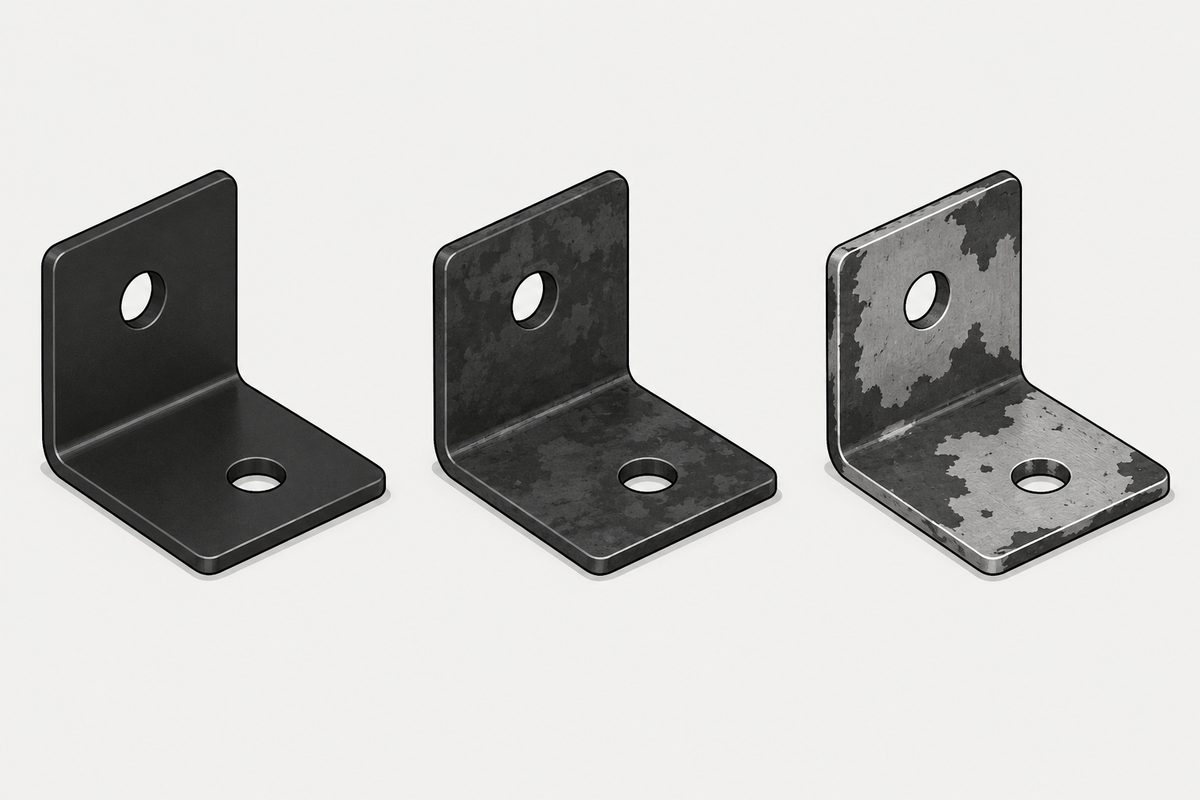
ISO 11408 contains no measure of blackness. No shade, no gloss value, no colour coordinate, no grade. What it does contain is a line telling the buyer to send a sample, a short list of defects that make a coating rejectable, a bench test whose pass mark is three photographs, and a caution about cracking that almost nobody quotes.
The standard is ISO 11408:1999, Chemical conversion coatings, Black oxide coating on iron and steel, Specification and test methods. It runs to five pages, it is still listed as under review, and the free preview is the whole of it. That length is the first thing worth noticing. A finish bought largely for appearance is described in five pages because most of what people argue about is not in the document at all.
Five things the standard asks you to send, and the fifth is the one people skip
Clause 4.1 lists what the purchaser has to provide when ordering. It is short:
| Essential information | What it means in practice |
|---|---|
| The number of the standard | Write ISO 11408 on the order. Without it none of the rest applies |
| The significant surface | Which faces the coating is essential on, shown on a drawing or by marked samples |
| The substrate and its condition | Which steel, and how the surface arrives |
| The sampling procedure | How the lot will be judged, under ISO 4519 |
| The appearance of the coating | In the standard’s own words, by the provision of a suitably marked sample |
The last row is the whole of what ISO 11408 says about how black a black oxide coating should be. Appearance is not specified, it is transferred. The document hands the definition back to the buyer and asks for it as a physical object.
That reframes an argument that happens constantly. When parts come back and somebody says they are not black enough, the usual next move is to look for the clause that settles it. There is no clause. There was supposed to be a sample, and when there is no sample the sentence this is not what I wanted has nothing to be checked against, in either direction. The supplier cannot show conformity and the buyer cannot show a breach, because the thing being disputed was never written down by anybody.
What the standard will reject, and it is not darkness
Clause 7.1 is where appearance does become a requirement, and it works entirely by exclusion. The coating shall be free of spots of red oxide and shall not be an overall reddish-brown colour. Then there is a test anyone can run in a minute: wipe the part with a clean Whatman 40 filter paper, or an equivalent, before any supplementary preservative treatment is applied, and it shall produce no reddish-brown or green smut.
Those are rust and unconverted process residue. Read as a set, the clause says the coating must not be rusty and must not come off on your fingers. It says nothing about depth of colour.
A note under the same clause goes further and permits variation outright. Non-uniformity of colour and haze is permissible on parts that are locally hardened, welded, cemented, riveted or submitted to other kinds of mechanical treatment. A part with a welded boss or a hardened wear face is expected to come back patchy in those places, and that is written into the standard rather than being a concession from the plater.
Clause 5 removes another common complaint by name. The surface roughness of the coating depends on the initial roughness of the substrate, and this shall therefore not be cause for rejection. Black oxide is a conversion coating grown out of the steel, not a layer laid over it, so it copies what is underneath. Parts that arrive tumbled, blasted or scaled come back looking like that in black. Two batches that look different can both conform, and the difference can be sitting entirely in the incoming material.
The test you can actually run, and the fact that its pass mark is a photograph
Clause 7.2 gives a procedure short enough to quote in full and cheap enough to do on a bench. Dissolve 50 g of oxalic acid in one litre of distilled or de-ionised water. Place three drops, about 0,2 ml, on a flat spot of the coated surface at ambient temperature. The reaction should occur after 30 seconds and within 8 minutes. After 8 minutes, rinse and dry the surface, and compare it with Figures 1 to 3.
Two details in that carry more weight than they look. The first is the lower bound. A reaction that starts immediately is a fail as surely as one that never arrives, because the test is reading how much converted coating stands between the acid and the steel. The second is that it has to be done before oil or wax goes on, for the same reason the filter paper wipe does. Once a preservative film is present you are testing the film.
And then the acceptance criterion. The three figures the result is compared against are captioned Poor quality coating, Borderline quality coating and Good quality coating. That is the pass mark. Not a time, not a diameter of attack, not a rating scale. The standard settles its own visual test the same way it settles appearance, by comparison against something you hold up next to the part. It is consistent, and it is worth sitting with, because a specification that resolves quality by photograph is telling you what kind of property this is.
Nine things you did not buy unless you asked for them
Clause 4.2 is a list of additional information the purchaser may provide. Read from the other end it is a list of properties that are absent from an ordinary black oxide order:
| Optional under clause 4.2 | If you did not ask |
|---|---|
| Neutral surface reaction | Not tested |
| Porosity and continuity | Not tested |
| Supplementary preservative treatment, and humidity testing after it | Oil, wax or lacquer is not a given, and neither is any humidity figure |
| Heat treatment before or after black oxidizing | Not specified, and see below |
| Oxalic acid resistance | The bench test above is not run |
| Wear resistance and its measurement | No figure exists |
| Coefficient of friction and its measurement | No figure exists |
| Resistance to neutral salt spray | No hours attached to the parts |
| Adhesion with thicker coatings | Not specified |
The friction row is the one that reaches furthest, because a torque figure is a friction figure wearing different units, and that argument is already worked through in what changes when a coated bolt meets a black oxide nut. The corrosion side of black oxide is settled on that page too, from the same standard, so it is not repeated here.
One row does deserve a correction of a number that circulates. Clause 7.3 is the only salt spray requirement in ISO 11408, and it reads: austenitic stainless steels, the significant surface, without any supplementary preservative coating, shall withstand 96 hours to ISO 9227 without traces of corrosion. That is a clause about stainless steel. Quoting 96 hours for a black oxide carbon steel screw is quoting a requirement written for a different material, and if you want hours on carbon steel you are back in clause 4.2 asking for them. What a salt spray number does and does not carry in general is a separate problem of its own.
The caution in clause 6 that gets left out
Black oxide is often chosen for high strength parts on the reasoning that it involves no electroplating, so it cannot charge hydrogen into the steel. The first half of that is true. The standard does not let the second half stand.
Clause 6.1 carries a caution in its own right: high strength steel of tensile strength Rm ⋝ 1 000 MPa may be subjected to caustic embrittlement that could lead to spontaneous cracking under internal or applied stress during the black oxidizing process. The bath is hot and alkaline, and the standard names that as a mechanism of its own rather than borrowing the electroplating one.
The clause is a caution, not a prohibition, and the wording is may be subjected to. What follows it is procedural: pre-treatment under ISO 9587, carried out before any aqueous cleaning or preparation begins, and post-coating treatment under ISO 9588, with surface-hardened parts held at 190 °C to 220 °C for not less than 2 hours. That temperature window is the same one this site quotes from ISO 4042 for relief after electroplating, where the conditions run 8 to 10 hours. Same oven, different clause, different duration, and the two are not interchangeable.
The practical reading is narrow and worth stating plainly. Above roughly class 10.9, the delayed fracture problem does not disappear when the finish stops being electrolytic. It changes which clause you have to put on the order.
Which brings us back to the sample
We have been on the receiving end of this. A customer came to us because their previous supplier could not get black oxide black enough, and the answer they had been given was that this was as far as it goes. The owner’s account of it is that some sales people hear a request like that and say straight away that it is impossible. We took it to a specialist chemical partner and it was solved.
That is testimony rather than a measurement, and this page will not put a number on it, because there is no number to put. Blackness in this coating depends on the bath chemistry, the temperature, how clean the parts were before they went in, and what goes on afterwards. It is a process outcome, which is exactly why this is as good as it gets is unfalsifiable when there is no agreed sample in the room. Nobody can be shown to be wrong.
With a sample it becomes an ordinary question with an ordinary answer, and it is the question clause 4.1 was written to make possible. So the useful move on a black oxide order is not to look for a tighter specification. It is to do the one thing the specification actually asks of you, which costs a padded envelope: agree a marked sample, keep a counter-sample, and write on the order that appearance is judged against it. Everything else on this page follows from that one line being present or absent.
A black default also used to sit in the general requirements standard for fasteners, applying to quenched and tempered steel products. The 2005 edition deleted it and put nothing in its place.
This page covers step 5, the finish. The whole order is substrate, thread, head, drive, finish, documentation, and why doing it out of order is rework rather than a tweak is in specifying a screw.
Common questions
How black should black oxide be?
The standard does not say. ISO 11408 contains no shade, gloss value or colour grade. Its clause on information the purchaser supplies to the supplier asks for the appearance of the coating to be given by the provision of a suitably marked sample. Appearance is not specified in the document, it is handed back to the buyer, which is why a dispute about darkness has nothing to appeal to unless a sample was agreed first.
On what grounds can I reject a black oxide batch?
On the ones the standard names. The coating must be free of spots of red oxide and must not be an overall reddish-brown colour, and wiping it with a clean Whatman 40 filter paper before any oil or wax is applied must produce no reddish-brown or green smut. Beyond that, colour non-uniformity and haze are permitted on parts that are locally hardened, welded, cemented or riveted, and surface roughness inherited from the substrate is stated not to be cause for rejection at all.
Why do two batches of the same part come out different shades?
Often because the parts going in were different. Black oxide is a conversion coating grown out of the steel rather than a layer applied over it, so the roughness of the result follows the roughness of what arrived, and the standard says so and rules that out as a rejection ground. Bath chemistry, temperature and pre-cleaning also move the result. That is why the standard settles appearance by comparison with a sample instead of by a number.
Is there a quick test for whether black oxide was done properly?
Yes, and it is in the standard. Dissolve 50 g of oxalic acid in a litre of distilled or de-ionised water, put three drops, about 0,2 ml, on a flat area at room temperature, and watch. The reaction should occur after 30 seconds and within 8 minutes, so an immediate reaction fails as well as no reaction. After 8 minutes rinse, dry and compare against the three figures in the standard, captioned poor, borderline and good. It has to be done before any preservative oil or wax goes on.
Does black oxide have 96 hours of salt spray resistance?
That number belongs to a different clause than the one people usually mean. The only salt spray requirement in ISO 11408 applies to austenitic stainless steels, on the significant surface, without any supplementary preservative coating, and asks for 96 hours to ISO 9227 without traces of rust. It is not a figure for black oxide on carbon steel. Salt spray resistance on carbon steel is one of the optional items a purchaser has to request, so on an ordinary order no such figure is attached to the parts.
Is black oxide safe on high strength fasteners since it is not electroplating?
It avoids the electroplating route into hydrogen embrittlement, but the standard raises a separate one. Its clause on heat treatment carries a caution that high strength steel of tensile strength 1 000 MPa and above may be subjected to caustic embrittlement leading to spontaneous cracking during the black oxidizing process, and it calls for pre-treatment to ISO 9587 and post-coating treatment to ISO 9588, with surface-hardened parts held between 190 and 220 degrees Celsius for not less than two hours.
References
- ISO 11408:1999 — Chemical conversion coatings, black oxide coating on iron and steel, specification and test methods. Clauses 4.1, 4.2, 5, 6, 7.1, 7.2 and 7.3 as cited above
- r/Machinists — choosing black oxide for its appearance and running into the corrosion literature
- r/Machinists — blotchy patches on a black oxide run, with the poster working through possible causes
ISO 11408:1999 was read from the publicly available preview, which for this standard is the full five pages, and every clause reference above was taken from that text rather than from a secondary description of it. The catalogue number was confirmed separately on the ISO site, where the entry is listed at stage 90.60, under review. No blackness, gloss or colour figure appears anywhere in this page because none appears anywhere in the standard. The 96 hour salt spray requirement is quoted with the material and the condition it is attached to, and should not be carried across to carbon steel. The account of the customer who could not get a dark enough finish elsewhere is the owner’s testimony about a commercial situation, not a measurement, and no result is claimed for it in numbers. No bath chemistry, temperature or process parameter is given here, because the preview carries none and process detail belongs to the plater.
Enquiries
If a part is going out in black oxide, the enquiry should carry three things: the steel and its condition on arrival, whether an oil or wax is wanted afterwards, and a marked sample for appearance with a counter-sample kept on your side. If the strength class is 10.9 or above, say that too, because the heat treatment clauses turn on it.
Request a quotation
Tell us the part and the quantity. We will come back on feasibility, lead time and price.
Or email us directly sales@tigerfasteners.com