 TIGERFASTENERS
Product grade A is a tolerance class, not a quality class
“Product grade A” on a specification looks like it means better. It means tighter dimensional and geometric tolerances, and nothing else — not strength, not material, not coating, not surface defects. And the three grades do not simply widen in order, which is the part that catches people out.
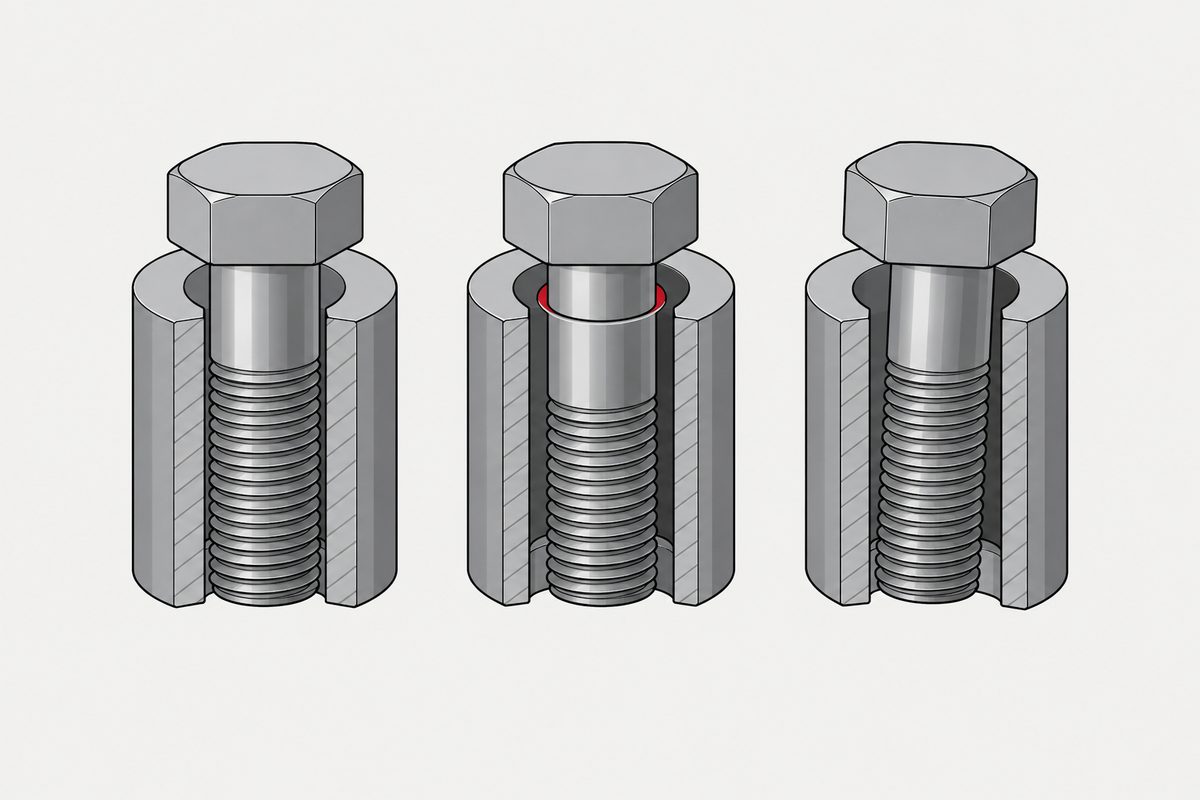
What the grades actually control
ISO 4759-1:2000 (second edition, reconfirmed by ISO in 2022) covers bolts, screws, studs and nuts in product grades A, B and C, with tapping screws at grade A. Clause 1 states the meaning plainly: the product grade denotes the size of the tolerances, A being the most precise and C the least.
What it covers:
- Width across flats of the head or nut, width across corners, wrenching height
- Head height, shank diameter, overall length, thread length
- Bearing face dimensions
- Straightness, position, coaxiality and total run-out
- And the thread tolerance class to be used — see below
What it does not cover: tensile or yield strength, material grade, heat treatment quality, corrosion resistance, coating quality, surface discontinuities such as cracks, laps or decarburisation, and factory quality assurance or lot acceptance rates. Those live in ISO 898-1, the ISO 6157 series, ISO 4042 and ISO 3269 respectively — see property class numbers and why five pieces.
The surface discontinuity part of that list is worth opening, because it does not work the way an inspector expects. ISO 6157-1 sorts marks by how they were made rather than by how big they are, so one kind of crack is banned at any size and another is permitted up to a whole thread diameter.
The grades do not widen in order
This is the part worth knowing, and it is the assumption we had wrong. The arrangement in clause 3.1.1 is not a uniform scaling:
| Feature group | A | B | C |
|---|---|---|---|
| Shank and bearing face | close | close | wide |
| Other features | close | wide | wide |
Put actual numbers against it. Taking a hexagon head fastener at M10, nominal width across flats s = 16, nominal head height k = 6.4, nominal length l = 50:
| Feature | A | B | C |
|---|---|---|---|
| Width across flats, s = 16 | h13: 16.00 / 15.73 | h14: 16.00 / 15.57 | h14: 16.00 / 15.57 |
| Head height, k = 6.4 | js14: 6.22–6.58 | js15: 6.11–6.69 | js16: 5.95–6.85 |
| Length, l = 50 | js15: 49.50–50.50 | js17: 48.75–51.25 | js17: 48.75–51.25 |
| Bearing face total run-out | 0.21 | 0.21 | 0.42 |
Read the bold cells. Width across flats is the same for B and C. Length is the same for B and C. Bearing face run-out is the same for A and B. Only head height widens through all three. A product grade is a whole configuration of tolerances, not a multiplier applied to every dimension.
A note on wording: that last row is the total run-out of the bearing face relative to the thread axis. Calling it “perpendicularity” helps a beginner, but in GD&T they are not the same control.
Those figures cross-check against the current product standards: ISO 4014:2022 gives M10 grade A as s = 16.00/15.73 and k = 6.22–6.58, while ISO 4016:2022 gives M10 grade C as s = 16.00/15.57 and k = 5.95–6.85.
It does reach the thread
The tidy summary is that ISO 965 governs the thread and ISO 4759 governs everything else. That is a workable simplification and it is not quite right. Clause 3.1.2 of ISO 4759-1 assigns the external thread tolerance class directly:
| Product grade | External thread tolerance class |
|---|---|
| A | 6g |
| B | 6g |
| C | Normally 8g — but 6g at property class 8.8 and above |
That exception is the reason the two axes are better described as different than as independent. A grade C fastener at 8.8 does not carry the loose thread class its grade would otherwise imply. Product and coating standards may specify other classes again — what a coating does to the pitch diameter is in plating and thread tolerance.
There is no default grade
“If the drawing does not say, it is grade A” is not a rule. There is no universal default across fasteners. The order of determination is:
- The product standard called up by the drawing or the order — ISO 4762, ISO 4014, ISO 4016 and so on
- The product grade that standard specifies
- The corresponding tolerances it takes from ISO 4759-1
- And where the product standard and ISO 4759-1 disagree, clause 1 gives precedence to the product standard
So a drawing showing a non-standard M6 with no product standard and no tolerance specification cannot be assumed to be grade A. It has no grade at all until somebody states one.
Which grade each common standard carries:
| Standard | Covers | Grade |
|---|---|---|
| ISO 4762:2004 | Hexagon socket head cap screws, M1.6–M64 | A |
| ISO 4014:2022 | Hexagon head bolts, M1.6–M64 | A and B |
| ISO 4017:2022 | Hexagon head screws, M1.6–M64 | A and B |
| ISO 4016:2022 | Hexagon head bolts, steel, M5–M64 | C |
| ISO 4018:2022 | Hexagon head screws, steel, M5–M64 | C |
In ISO 4014 and ISO 4017, A applies at d = M1.6 to M24 with nominal length not exceeding 10d or 150 mm, whichever is shorter; B applies beyond that.
That M24 boundary is a rule of those product standards, not of ISO 4759-1. We had it the other way round. ISO 4762 is grade A all the way to M64. So “grade A stops at M24” is true of hexagon head bolts and false as a general statement.
Four things people get wrong
- “A is stronger.” No. Strength is ISO 898-1, where 8.8 means a nominal tensile strength of 800 MPa and a nominal yield ratio of 0.8, giving 640 MPa nominal yield. Product grade does not appear in that system at all.
- “Tighter is better, so specify A.” A only means smaller tolerance bands. The engineering choice is a product standard adequate for assembly, wrenching, location and load — not the tightest available. Costs of over-specifying include items that are not stocked, suppliers needing to tool up or sort or add measurement, long and large sizes with no grade A standard stock, and a specification incompatible with a product standard turning the part into a non-standard special.
- “A costs more.” There is no citable general percentage, and the direction can reverse: a high-volume standard grade A part can be cheaper than an unusual grade C one, because stock and production volume can outweigh the tolerance class itself.
- “C is a reject grade.” No. It is a legitimate class with its own standards — ISO 4016 and ISO 4018 are grade C by definition, not by failure. Structural and general engineering work uses it deliberately.
One more that we nearly wrote: a head too large to fit a counterbore is not a typical consequence of choosing grade C. Width across flats uses an h tolerance, so it deviates towards the negative. Interference is more often a wrong head style, a wrong product standard, a DIN-versus-ISO difference in width across flats, or a counterbore designed without checking the maximum envelope — see two callout systems.
What that width across flats actually is, and why it cannot be worked out from the thread, is a table rather than a formula: the ratio to the thread reverses direction between M5 and M6, and the across-corners minimum sits below what a sharp hexagon would give.
The rest of the family
ISO 4759-3:2016 (fourth edition) covers washers in product grades A, C and F, for nominal diameters 1 to 150 mm. Its wording is clearer than Part 1's: a product grade is a specified tolerance range relating to dimensional and geometric characteristics, with F meaning fine, A precise and C large tolerances.
ISO 4759-2:1979 covered bolts, screws and nuts from 1 to 3 mm in product grade F for fine mechanics. It was withdrawn on 14 January 1999, and ISO's lifecycle page lists no replacement — so it should be described as withdrawn without an ISO-designated successor, not as superseded by Part 1.
What to put on the drawing
- Call up the product standard by number and year. That carries the grade with it, and it is what takes precedence.
- Do not specify a grade that contradicts the standard you called up. ISO 4016 is grade C; asking for “ISO 4016 grade A” creates a special, not a better part.
- Check the boundary before assuming A. For hexagon head bolts and screws, A stops at M24 or 10d, whichever comes first.
- If a geometric characteristic actually matters, state it. Bearing face run-out at grade C is double that of A and B on an M10 — if that matters to your joint, it is worth calling out rather than inferring.
- Keep strength separate. The property class is a different line on the drawing and does not follow from the product grade.
Where this connects
How to read the rest of a designation is in what a designation contains; what the strength numbers mean is in property class numbers; and how several dimensional tolerances land on the same joint is in tolerance stack-up.
References
- ISO 4759-1:2000, second edition (reconfirmed 2022) — clause 1 (meaning of the grades, precedence of the product standard), 3.1.1 (the feature-group arrangement), 3.1.2 (thread tolerance classes), 3.1.3 and 3.1.4 with the associated figures, 3.2.2.3 (bearing face total run-out), Annex A Tables A.1 and A.2 (IT and js values)
- ISO 4759-3:2016, fourth edition — washers, product grades A, C and F, 1 to 150 mm
- ISO 4759-2:1979 — withdrawn 14 January 1999; no replacement listed by ISO
- ISO 4762:2004 (grade A, M1.6–M64); ISO 4014:2022 and ISO 4017:2022 (grades A and B); ISO 4016:2022 and ISO 4018:2022 (grade C, M5–M64)
- ISO 965-1:2026, ISO 965-2:2024, ISO 965-3:2021 — the thread tolerance system itself
- ISO 898-1:2013 clause 5 and Table 1 — the property class designation system
- ISO 6157 series (surface discontinuities); ISO 4042 (coatings); ISO 3269 (acceptance inspection)
Acceptance for any particular order is governed by the product standard your drawing invokes.
Product grade is also one of the elements the general requirements standard uses to define a standardized fastener, and one of only two on that list that carry no condition. What else is on the list, and what the same standard sets as the default delivery condition, is a separate page.
See also how a JIS declares its degree of correspondence, IDT or MOD.
⚠️ One thing that sits next to this and is easy to collide with it. A product grade does not describe strength — but a product standard can still decide which pairings of grade and property class it standardises. In JIS B 1180, grade C is limited to 4.6 and 4.8 and grades A and B to the higher classes, and JSA has published a ruling that a footnote pointing at another standard does not widen that. The footnote was not permission.
This page covers step 6, the documentation. The whole order is substrate, thread, head, drive, finish, documentation, and why doing it out of order is rework rather than a tweak is in specifying a screw.
Common questions
Does product grade A mean better quality?
It means tighter tolerances on dimensions and geometry, and nothing more. ISO 4759-1 states that the product grade denotes the size of the tolerances, with A the most precise and C the least. It says nothing about tensile strength, material grade, heat treatment, corrosion resistance, coating quality, surface discontinuities such as cracks or laps, or lot acceptance rates. Those are governed by ISO 898-1, the ISO 6157 series, ISO 4042 and ISO 3269 respectively.
Do the tolerances simply get wider from A to B to C?
No, and this is where the assumption breaks. The arrangement in clause 3.1.1 is that the shank and bearing face are close for A and B and wide for C, while other features are close for A and wide for B and C. On an M10 hexagon head fastener, width across flats is identical for B and C, length is identical for B and C, and bearing face total run-out is identical for A and B. Only head height widens through all three grades. A product grade is a whole configuration rather than a multiplier.
Does the product grade affect the thread tolerance?
Yes, which is why the common summary that ISO 965 governs the thread and ISO 4759 governs everything else is only an approximation. Clause 3.1.2 of ISO 4759-1 assigns external thread tolerance classes: 6g for grades A and B, and normally 8g for grade C — except that grade C fasteners at property class 8.8 and above use 6g. Product and coating standards may specify other classes again.
If the drawing does not state a product grade, is it grade A by default?
There is no such default across fasteners. The determination runs from the product standard the drawing calls up, to the grade that standard specifies, to the corresponding tolerances in ISO 4759-1 — and where the product standard and ISO 4759-1 disagree, clause 1 gives precedence to the product standard. A drawing of a non-standard screw with no product standard and no tolerance specification has no grade until somebody states one.
Is grade A always limited to M24?
That limit belongs to particular product standards rather than to ISO 4759-1. In ISO 4014 and ISO 4017 for hexagon head bolts and screws, grade A applies from M1.6 to M24 with nominal length not exceeding ten diameters or 150 millimetres, whichever is shorter, and grade B applies beyond. ISO 4762 hexagon socket head cap screws are grade A all the way to M64, so the statement is true of hexagon head bolts and false as a generalisation.
Is grade C a lower-quality product?
No. It is a legitimate class with its own product standards: ISO 4016 and ISO 4018 are grade C by definition rather than by failing to meet something tighter, and structural and general engineering work specifies it deliberately. Nor does grade A necessarily cost more — there is no citable general percentage, and a high-volume standard grade A part can be cheaper than an unusual grade C one because stock and production volume can outweigh the tolerance class.
Enquiries
When you send a specification, call up the product standard with its year rather than a grade letter on its own. The standard carries the grade, and where the two disagree the standard is what governs.
Request a quotation
Tell us the part and the quantity. We will come back on feasibility, lead time and price.
Or email us directly sales@tigerfasteners.com