 TIGERFASTENERS
The Number on the Spanner Is Across Flats, and It Is a Table
Somebody on r/AskEngineers asked a clean question: when a nut driver says 5 mm, is that flat to flat, corner to corner, or the length of one flat? The top answer, at 201 points, said flat to flat and stopped there, which is correct and is about a fifth of what the standard has to say. One reply got further and guessed that nuts probably measure a little small in practice. He was right, and there is a number for it, and there is a second column he did not mention that matters more than people expect.
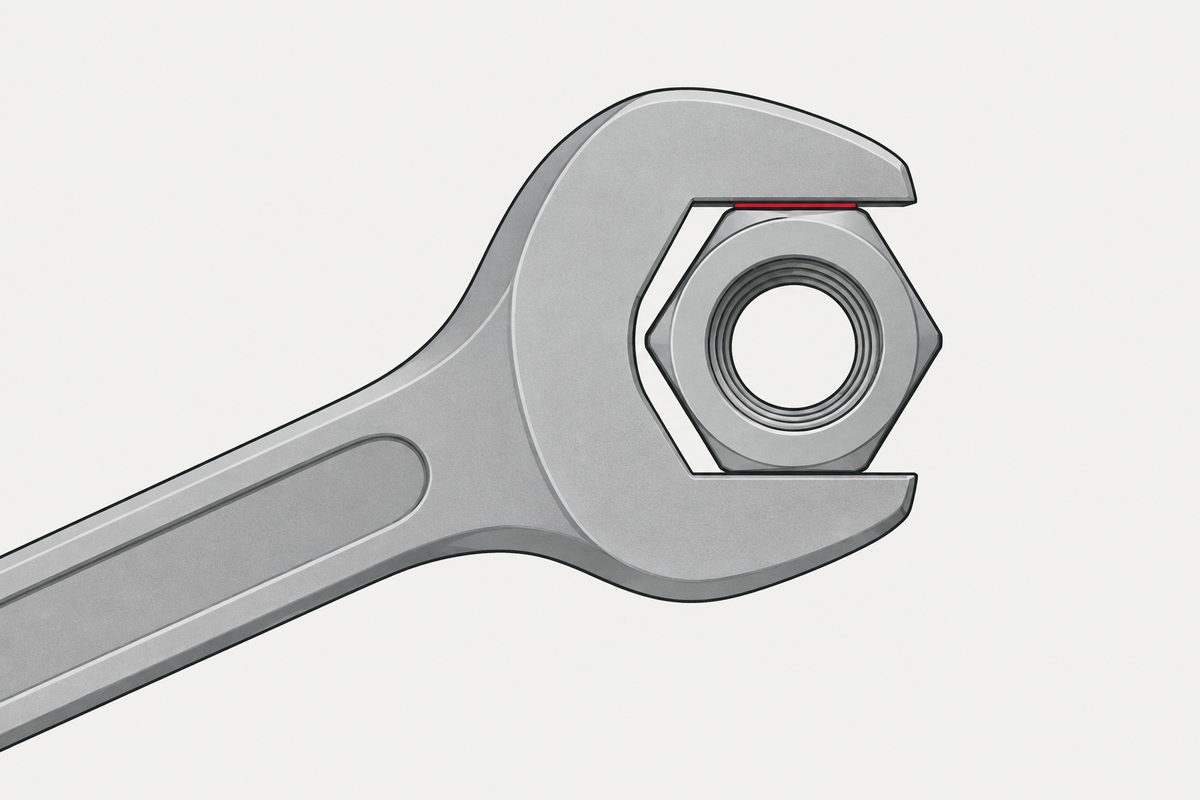
It is across flats, and the standard calls it s. An M10 nut takes 16 mm, which is neither the thread size nor anything you can compute from it. The ratio between the two runs from 2,00 at the small end down to 1,50, and it does not fall smoothly: it goes back up between M5 and M6. Whatever else the spanner series is, it is not a formula.
The document is ISO 4032, Hexagon nuts, style 1, covering M1,6 to M64 in product grade A up to M16 and grade B above it. We read three editions, 1979, 1999 and 2012, and the width across flats row is identical in all three, which is worth saying out loud because it settles one thing straight away: if a nut in your hand does not fit the ISO spanner, ISO did not change its mind about the size.
What the table actually gives you
| Thread | s, across flats, nominal = max | s min | e, across corners, min |
|---|---|---|---|
| M1,6 | 3,20 | 3,02 | 3,41 |
| M2 | 4,00 | 3,82 | 4,32 |
| M2,5 | 5,00 | 4,82 | 5,45 |
| M3 | 5,50 | 5,32 | 6,01 |
| M4 | 7,00 | 6,78 | 7,66 |
| M5 | 8,00 | 7,78 | 8,79 |
| M6 | 10,00 | 9,78 | 11,05 |
| M8 | 13,00 | 12,73 | 14,38 |
| M10 | 16,00 | 15,73 | 17,77 |
| M12 | 18,00 | 17,73 | 20,03 |
| M16 | 24,00 | 23,67 | 26,75 |
| M20 | 30,00 | 29,16 | 32,95 |
| M24 | 36 | 35 | 39,55 |
| M30 | 46 | 45 | 50,85 |
| M36 | 55,0 | 53,8 | 60,79 |
Three columns, and the reply on that thread only touched the first. The rest of this page is what the other two are for.
It does not come from the thread, and the proof is between M5 and M6
People reach for a rule of thumb here, usually something like one and a half times the thread. Divide the first column by the thread size and the ratio does this:
| Thread | s ÷ d | Thread | s ÷ d |
|---|---|---|---|
| M1,6 to M2,5 | 2,00 | M8 | 1,63 |
| M3 | 1,83 | M10 | 1,60 |
| M4 | 1,75 | M12 to M24 | 1,50 |
| M5 | 1,60 | M30, M36 | 1,53 |
| M6 | 1,67 |
The ratio falls from 2,00, and then it goes back up between M5 and M6, and later it goes up again between M24 and M30. A quantity that reverses direction twice is not being generated by a formula, and any rule of thumb built on the large sizes will be wrong at M5 in one direction and wrong at M6 in the other. The series is a table because somebody chose the values, and looking them up is the whole method.
The rule of thumb is older than the table, and we have found it in the wild. Minutes of a Philadelphia meeting in 1864 record a firm whose drawings put the width across flats at one and a half times the bolt diameter, which is the same evening the 60 degree thread was proposed. The ratio survived into the middle of the modern range and was abandoned at both ends.
That is worth pairing with what this site has said elsewhere about how a fastener is called out. A designation such as Hexagon nut ISO 4032 − M12 − 8 names the thread and the property class and says nothing about the spanner, because the standard number carries it. Change the standard and the spanner can change with it, which is the same problem in a different coat as a drawing that mixes two callout systems.
The second column, and why the standard bothers
An open spanner grips two flats. A ring spanner or a socket surrounds the whole hexagon, which is why the standard tabulates e, the width across corners, as a minimum in its own right. It is the dimension that decides whether a nut is big enough for what the tool is built to close around, and it is the larger of the two numbers, so it is also the one that has to clear a counterbore.
Now do the arithmetic the standard leaves to you. A perfect regular hexagon has an across-corners dimension of s ÷ cos 30°, which is 2 over the square root of 3, or 1,1547 times the flats. Take the tabulated e minimum and divide it by the tabulated s minimum on the same row, and the answer is not 1,1547. It is 1,13, and it is 1,13 on every one of the fifteen rows above:
| Thread | 1,13 × s min | e min in the table |
|---|---|---|
| M6 | 1,13 × 9,78 = 11,051 | 11,05 |
| M10 | 1,13 × 15,73 = 17,775 | 17,77 |
| M16 | 1,13 × 23,67 = 26,747 | 26,75 |
| M24 | 1,13 × 35 = 39,55 | 39,55 |
| M36 | 1,13 × 53,8 = 60,794 | 60,79 |
Fifteen rows, one constant, and the standard never prints it. Against the geometric 1,1547 the tabulated figure is short by about 2,1 per cent. Read plainly, the standard is declining to promise you a perfect corner: it guarantees the flats and then guarantees rather less across the diagonal than a sharp hexagon would give. It does not print a reason next to the number, so that reading is ours rather than the document’s, and this page will not tell you what takes the 2,1 per cent.
And the number on the tool is a maximum
The first column is headed nominal = max. At M10 that is 16,00, and the minimum on the same row is 15,73. So a nut that is entirely within specification can be a quarter of a millimetre under the number on the spanner, before the tool’s own opening tolerance is considered at all, and we hold no hand tool dimensional standard so this page puts no figure on that half.
The reply on that thread that guessed nuts probably measure a bit small was therefore right, and right for a structural reason rather than as a comment on manufacturing quality. A dimension published as nominal-equals-maximum can only deviate one way. Where the accumulated slack ends up mattering is the same place it always does, in the margin between the tool and the corner it is turning, which is the general problem of what bounds a drive.
So why does a nut sometimes not fit the spanner you expected
Not because the size moved. The width across flats row is the same in the 1979, 1999 and 2012 editions we read, so a mismatch is not ISO having revised the number under anybody’s feet.
The honest remaining answer is that hexagon nuts exist under more than one product standard, and different families of standard have not always agreed on the width for a given thread. Our page on what a product grade actually controls lists that disagreement as one of the ordinary causes of a head fouling a counterbore. We hold only the ISO documents, so no figure from any other standards family appears on this page, and the practical instruction is the one that does not require the comparison: put the standard number on the drawing, not just the thread, and check the width across flats against that standard before designing anything around the head.
Four sentences to take away
- The number is across flats, called s, and for an M10 nut it is 16 mm
- It is a table, not a formula. The ratio to the thread reverses direction between M5 and M6, so no rule of thumb survives the whole range
- Across corners is a separate tabulated minimum, and it is 1,13 times the across-flats minimum rather than the 1,1547 a sharp hexagon would give
- The number on the tool is the maximum of the nut. At M10 the nut may legitimately be 15,73
That last rule is older than the metric table. A 1928 American report says the same thing, and gives the reason: nut tolerances minus only, wrench opening tolerances plus only.
This is not one of the six steps. It shows up across them, or after assembly. Where the decisions that lead here were made is in specifying a screw, which sets out the order and why doing it out of order is rework.
Common questions
Does a 5 mm nut driver mean 5 mm across the flats or across the corners?
Across the flats. The standard calls that dimension s and publishes it as nominal equals maximum, so a nut within specification can measure slightly under the number on the tool. Across corners is a separate dimension in the same table, called e, published as a minimum, and it is the larger of the two.
What size spanner does an M10 nut take?
Sixteen millimetres under ISO 4032. That figure is identical in the 1979, 1999 and 2012 editions we read. Note that it is not derivable from the thread: the same table gives 8 mm for M5, 10 for M6, 13 for M8, 18 for M12 and 24 for M16.
Is there a formula from thread size to spanner size?
No, and the table rules one out rather than merely lacking one. Dividing the width across flats by the thread diameter gives 2,00 at the smallest sizes, 1,60 at M5, then 1,67 at M6, then down through 1,63 and 1,60 to 1,50 from M12 to M24, then back up to 1,53 at M30. A ratio that reverses direction twice is not being produced by a formula, so the values have to be looked up.
Why does the standard tabulate across corners separately?
Because an open spanner grips two flats while a ring spanner or socket has to close around the whole hexagon, and because the corners are what has to clear a counterbore. The figure is given as a minimum, e, and it is not simply the trigonometric result: on every row we checked, e minimum equals 1,13 times s minimum, where a sharp regular hexagon would give 1,1547 times. The standard prints no reason for the difference.
Can a nut be smaller than the spanner size printed on the tool?
Yes, and legitimately. The width across flats is published as nominal equals maximum, so it can only deviate downward. At M10 the nominal is 16,00 and the minimum is 15,73, a spread of 0,27 mm on the nut alone, before any tolerance on the tool opening is considered.
My nut does not fit the spanner the ISO table says. What happened?
Not a revision: the width across flats row is unchanged across the 1979, 1999 and 2012 editions. Hexagon nuts exist under more than one product standard, and different families have not always agreed on the width for a given thread, which is one of the ordinary causes of a head or nut fouling a counterbore. The reliable fix is to put the standard number on the drawing rather than the thread alone, and to read the width from that standard.
References
- ISO 4032:1999 — Hexagon nuts, style 1, product grades A and B. Scope, Table 1 and the designation example, read from the public preview
- ISO 4032:2012 — the later edition, read to confirm the width across flats row is unchanged
- r/AskEngineers — the thread this began in, including the reply that guessed nuts measure a little small
Three editions of ISO 4032 were read from their public previews, 1979, 1999 and 2012, and the dimensions above are from the 1999 table with the width across flats row checked against the other two. The relation that the across-corners minimum equals 1,13 times the across-flats minimum is our own arithmetic on two printed columns, not a sentence in the standard, and the standard prints no explanation of why that figure sits below the geometric 1,1547, so the reading offered here is ours. Sizes above M36 are not used in that check because we could read the across-corners minimum but not the across-flats minimum for them, and they are not quoted. No dimension from any non-ISO standards family appears on this page: we hold only the ISO documents, and the observation that different families have disagreed on width across flats is stated without numbers for that reason. No tolerance is given for a spanner or socket opening, because no hand tool dimensional standard was read for this page. The claim that a twelve-point tool contacts any particular part of the hexagon is not made here, for want of a source.
Enquiries
If a nut or a hexagon head has to fit inside something, send the standard number rather than the thread on its own, and say whether a socket has to get around it or only a spanner onto the flats. Those are two different clearances, and the second column of that table is the one people find out about late.
Request a quotation
Tell us the part and the quantity. We will come back on feasibility, lead time and price.
Or email us directly sales@tigerfasteners.com