 TIGERFASTENERS
The Thread Angle Was Set at Sixty Degrees Because It Was Easier to Check
The threads on your desk have flanks at sixty degrees to each other. Every metric fastener does. It is one of those numbers that feels like it must come from a stress calculation, and the document that first argued for it is free to read, so we went and read it. In April 1864 William Sellers stood up at the Franklin Institute in Philadelphia and proposed a thread with a sixty degree angle and flat crests. His reason for the sixty is one sentence long, and it is not about strength.
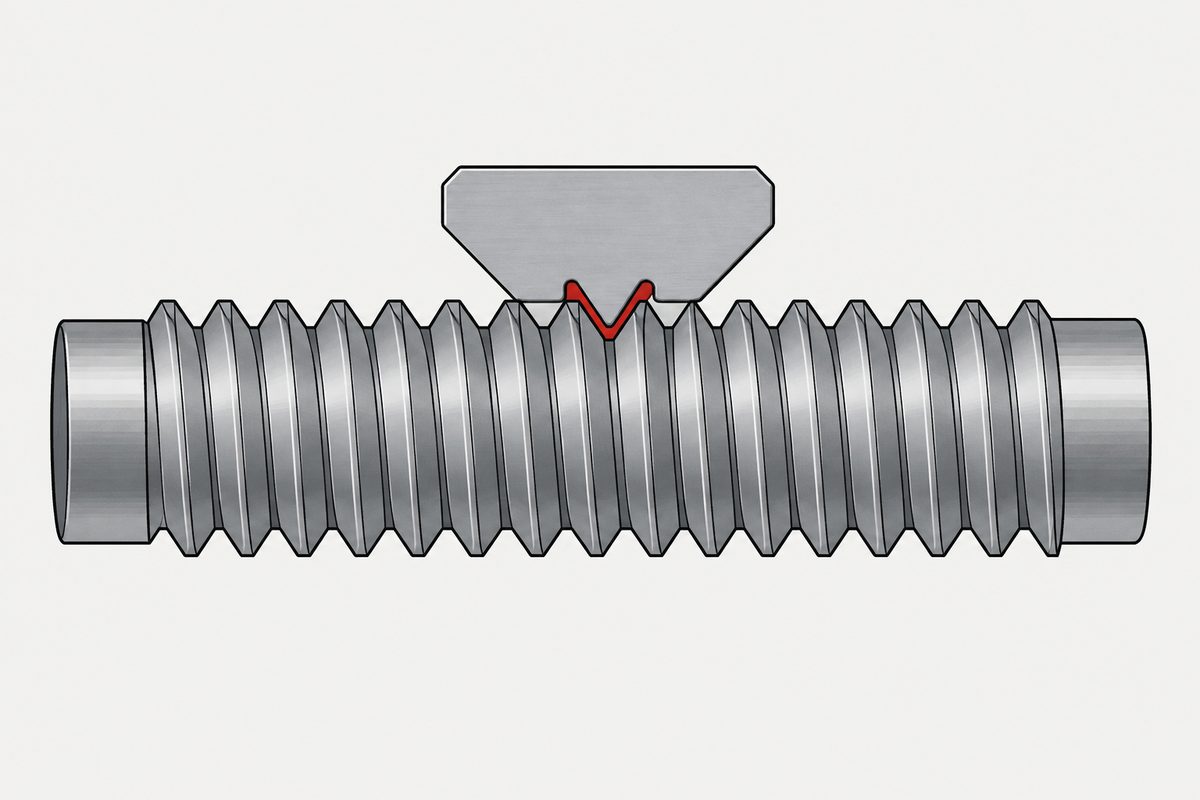
“The angle of the proposed thread is fixed at 60°, the same as the sharp thread, it being more readily obtained than 55°, and more in accordance with the general practice in this country.” That is the whole justification, in the paper that proposed it. More readily obtained. The three objections he raised against the British thread run the same way: every one of them is about making the thing or checking it, and not one is about how the joint behaves under load.
The source is the paper as printed in the Journal of the Franklin Institute, Volume XLVII, Number 5, May 1864, in the proceedings of the April meeting. The volume is digitised and unrestricted, so what follows is quoted from the text rather than from anybody’s account of it.
He opens by conceding
The first thing the paper does is give the argument away. Sellers describes the American situation without flattering it: in this country no organized attempt has as yet been made to establish any system, each manufacturer having adopted whatever his judgment may have dictated as the best, or as most convenient for himself. Then he points at England, where the engineers had agreed by mutual agreement on proportions then in universal use.
And then the sentence that sets the terms of the whole paper. Our standard of length being the same as theirs, he writes, it would seem desirable that the system they have adopted should also be employed here, unless grave objections can be urged against it and a better one substituted.
That is a man putting the burden of proof on himself in public, before he has said anything in his own favour. He also credits the British thread before he attacks it: its advantages over a sharp thread, he writes, are increased strength from the absence of acute corners, and greater security from accidental injury given by the rounded top.
Three objections, and what they are all about
| Objection | What kind of problem it is |
|---|---|
| The angle of 55° is a difficult one to verify. No gauges to that angle, made independently and without special tools, would correspond with sufficient accuracy | Metrology |
| The curve at the top and bottom of the screw thread will not fit the corresponding curve in the nut, so the wearing surface is reduced to the straight sides | Manufacture |
| The cutting tool must have at least three cutting sides. British practice on small work needed three kinds of cutter and two lathes to do what American practice did with one cutter and one lathe | Tooling and cost |
Read the right-hand column. Not one of these is a claim about clamp force, fatigue, stripping or stress. All three are about whether an ordinary shop can make the thing and tell whether it made it correctly.
The second objection also shows a habit of mind worth pointing out, because it is rarer than it should be. Having said the curves will not fit, Sellers immediately limits himself: it is not to be inferred that these curves cannot be made to fit, only that the difficulties are so increased by the form that in practice it will not be accomplished. He is distinguishing what is impossible from what will not actually happen, in 1864, in a paper arguing for his own proposal.
The proposal, and the eighth
Having settled the angle, the geometry is short. Divide the pitch, which he notes is the same thing as the side of the thread, into eight equal parts; take one part off the top and fill one part in at the bottom. The flat top and bottom then equal one eighth of the pitch, and the wearing surface is three quarters of it. He notes that this gives a thread depth almost precisely the same as the English one.
He also claims the arrangement gives 36 per cent more wearing surface than the English thread, on the reasoning that the contact is practically confined to the flat sides in both cases. That figure is his, in 1864, and this page reports it rather than confirms it.
What matters more is why the flat was available to him at all. The sharp top had to go, he argues, because it is vulnerable on large bolts, and American shops were already putting a small flat on large threads without any agreed proportion for it. Given that the flanks must be straight, the choice is between a rounded top and a flat one, and the flat wins on tooling: the sides are the same shape as a sharp thread, so the same tool serves, and to give this form requires only that the point of the cutting tool shall be taken off.
He brought the gauge with him
This is the part that turns the paper from an opinion into a proposal. His first objection to 55 degrees was that it could not be reliably verified. So the paper does not only specify a thread; it includes a drawing of an instrument for measuring the flat on the chasing tool.
The gauge has a 60 degree angle cut into the edge of its frame, a second angle with the apex cut away, and a graduated wedge that slides through the second one. Bring a mark on the wedge to a fixed mark on the frame and its edge stands the correct distance above the apex, which tells the toolmaker how much to take off the point of a chaser that has first been fitted to the first angle. There is even an instruction for setting the tool in the lathe against a face of the gauge, which, he writes, will insure the thread when cut being perpendicular to the surface.
The minutes of the same evening make the point again without meaning to. After the paper and the discussion, a Mr. Longstreth exhibited an instrument for setting the tools of screw-cutting lathes, and then a second instrument for testing the correctness of screw threads. Two more measuring devices, in one meeting. The problem in the room was never what shape to agree on. It was how anybody would prove they had hit it.
The better answer he declined to adopt
One passage deserves more attention than it usually gets. Sellers fitted a formula to the English pitch series to see whether it followed a rule, and found that it very nearly did: he gives the constants he used, 2,09 and 16,64, and notes that the English threads do not depart from the rule until they reach four and a half inches, and then only slightly.
Then he sets his own result aside. The pitches given by the formula, he writes, would be found an improvement, but not sufficiently so to warrant us in adopting them, if the rest of the English system were otherwise acceptable.
A man proposing a national standard, holding a demonstrably tidier series, deciding that tidier is not worth incompatibility. That judgement gets made in standards committees every year and it is almost never written down as plainly as this.
And a rule of thumb, caught in the wild in 1864
The minutes record two firms bringing evidence to the meeting. Merrick and Sons submitted actual screws, bolts and nuts from six inches down to three eighths, and the secretary notes their pitches were almost identical with those Sellers proposed. Bement and Dougherty submitted drawings, and theirs matched Whitworth except at the half inch. Their drawings also carried a house rule: the width across the flats of finished heads and nuts was one and a half times the diameter of the bolt, and the thickness of the nut equalled the diameter.
That first number is still in circulation. It is the rule of thumb people reach for when they guess a spanner size, and the modern table only agrees with it over part of the range: the ratio in ISO 4032 is 1,50 from M12 to M24 but 2,00 at the small end, and it reverses direction twice on the way. So the rule was somebody ’s house practice in Philadelphia in 1864, and the standard that eventually arrived kept it in the middle and abandoned it at both ends.
What this page is not claiming
The threads in use today have a sixty degree flank angle, and the reason Sellers gave for choosing sixty in 1864 was that it was more readily obtained than fifty-five and matched the practice around him. This page does not claim a line of descent between those two facts, because we have not read a document that records one, and a resemblance is not a lineage.
Nor does it say the British thread was worse. Sellers credited it first, and his three objections were about tools and gauges rather than performance. And it does not follow the story forward: the meeting resolved to circulate the paper to other societies if they shall approve of the same, and appointed a committee of nine to investigate and recommend. What that committee concluded is not in the document we read, and this page stops where the document does.
What it does leave you with is the shape of the decision. A number that looks like physics turns out, in the paper that proposed it, to have been chosen because an ordinary shop could check it with a gauge somebody could make. That is not a lesser reason. On the evidence of that evening it was the only reason that mattered.
The angle Sellers was arguing against has since been read from its own paper: fifty-five degrees was the measured average of English practice, chosen by survey rather than by calculation. And the committee appointed that evening did report, eight months later: nine were appointed and ten signed.
The same shape turns up again fifty-six years later, in the report of the federal commission that named Sellers as its predecessor: its thread tolerances were sized so that the taps already for sale would work.
This page covers step 2, the thread. The whole order is substrate, thread, head, drive, finish, documentation, and why doing it out of order is rework rather than a tweak is in specifying a screw.
Common questions
Why is the thread angle 60 degrees?
The paper that proposed it gives one reason. In April 1864 William Sellers told the Franklin Institute that the angle of the proposed thread was fixed at 60 degrees, the same as the sharp thread, it being more readily obtained than 55 degrees and more in accordance with the general practice in that country. The justification is about how easily the angle can be produced and verified, not about how the joint performs under load.
What was wrong with the 55 degree British thread?
Sellers raised three objections and credited the design before he did. His objections were that 55 degrees is difficult to verify, so gauges made independently would not agree closely enough; that the rounded crest and root of the screw will not fit the matching curves in the nut, leaving the flanks to do the work; and that the cutting tool needs at least three cutting sides, with British practice on small work using three kinds of cutter and two lathes where American practice used one of each. All three concern manufacture and measurement.
Where does the flat on a thread crest come from?
From the same 1864 proposal. Sellers divides the pitch into eight equal parts, takes one off the top and fills one in at the bottom, which makes the flat crest and root each one eighth of the pitch and leaves three quarters as wearing surface. His argument for the flat over the British rounded form is tooling: the flanks are the same shape as a sharp thread, so the same tool cuts them, and producing the flat requires only that the point of the tool be taken off.
Did Sellers propose new thread pitches too?
He worked out that he could, and then decided not to. He fitted a formula to the English pitch series, quoting the constants 2,09 and 16,64, and observed that the English threads followed it closely until about four and a half inches. He then wrote that the pitches given by the formula would be found an improvement but not sufficiently so to warrant adopting them. A better series, set aside because the improvement did not justify the incompatibility.
Is the 1.5 times diameter rule for spanner sizes old?
At least as old as that meeting. The minutes record a Philadelphia firm submitting drawings in which the width across the flats of finished heads and nuts was one and a half times the bolt diameter and the nut thickness equalled the diameter. The modern ISO table keeps that ratio from M12 to M24 and departs from it at the small sizes, where it runs to 2,00, so the rule of thumb was a house practice that the standard later kept only in part.
Does today’s metric thread descend from this paper?
Threads in use today have a 60 degree flank angle, and this 1864 paper argued for 60 degrees on the grounds of gaugeability. This page does not assert a line of descent between the two, because we have not read a document that records one. What we can say is what the paper says: when somebody first had to justify the number, the justification was that the angle could be obtained and checked.
References
- Journal of the Franklin Institute, Vol. XLVII No. 5, May 1864 — the proceedings of the April meeting, containing the paper on a system of screw threads and nuts read by William Sellers, the discussion, and the resolutions. Digitised and unrestricted
- ISO 4032:1999 — hexagon nuts, style 1, for the modern width across flats compared with the 1864 house rule
The 1864 paper was read from the digitised full text of the May 1864 issue on the Internet Archive, which carries no lending restriction, and every quotation above is from that text rather than from a later account of it. It is an optical character recognition transcript, so the mathematical expressions and tables contain corrupted characters; no formula and no table from the paper is reproduced here, and the pitch formula is described only by the two constants Sellers names and by his conclusion about it. The 36 per cent greater wearing surface is Sellers’ claim in 1864, reported rather than verified. Whitworth’s own 1841 paper has since been read for a separate page and no reasoning from it is imported here; the account of the British thread on this page is Sellers’ account of it, including the advantages he credits it with. No line of descent is claimed between the 1864 proposal and the angle used in modern standards, because we hold no document recording one. The nine-man committee appointed that evening is named in the minutes and what it concluded is not in the document we read, so this page does not follow the story past the meeting; the committee’s report was later found in the January 1865 issue and is covered on its own page. No proportion from ISO 68-1 is quoted, that standard not having been read for this page.
Enquiries
None of this changes what goes on a drawing today, and that is rather the point. If a thread has to be verified rather than merely specified, the question Sellers asked in 1864 is still the useful one: what will the person checking it actually be holding, and can two of those instruments, made separately, be made to agree.
Request a quotation
Tell us the part and the quantity. We will come back on feasibility, lead time and price.
Or email us directly sales@tigerfasteners.com