 TIGERFASTENERS
Fifty-Five Degrees Was the Average of What Was Already There
Our page on the Sellers paper of 1864 carried an admission in its notes: we had not read Whitworth’s own paper, so no reasoning was attributed to him. That paper turns out to be free to read, sixteen pages long, and far blunter than anything written about it since. It opens by stating that a rule for screw threads cannot be deduced from mechanical principles or from any number of experiments. Then it describes how the number was actually obtained, which was by collecting bolts from workshops across England and taking the average.
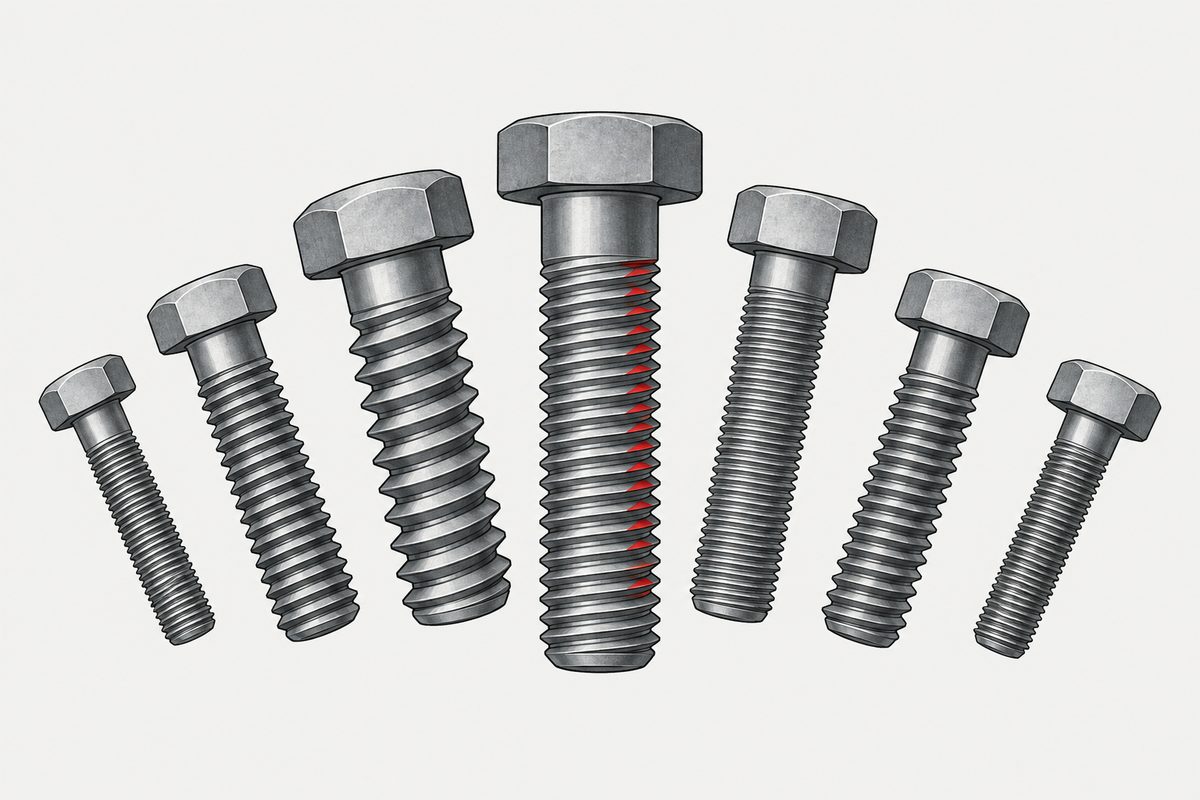
“Any standard must be, to a great extent, arbitrary. It is impossible to deduce a precise rule for the threads of screws from mechanical principles, or from any number of experiments.” That is Joseph Whitworth in 1841, on the second page of the paper that gave the English-speaking world its first thread system. He follows it immediately with the other half: mere approximation would be unimportant, absolute identity of thread for a given diameter being indispensable. The number does not matter. Everyone having the same number is the whole point.
The source is A Paper on an Uniform System of Screw Threads, read at the Institution of Civil Engineers in 1841, reprinted in Whitworth’s collected Miscellaneous Papers on Mechanical Subjects of 1858. It is out of copyright and scanned in full on the Internet Archive. The optical character recognition mangles the digits, so every number quoted below was checked against the page images.
The problem was the repair shop
The paper is not about strength. It is about spares. Great inconvenience arises from the variety of threads adopted by different manufacturers, and the difficulty of ascertaining the exact pitch of a particular thread, especially when it is not a multiple or submultiple of the inch, occasions extreme embarrassment.
Then the example that makes it concrete. Take the refitting shop of a railway or steam packet company. The variety of apparatus made necessary by the want of uniformity corresponds to the number of different manufacturers who supplied the engines, whereas if the same thread system were common to those engines, a single set of screwing tackle would suffice. He adds that uniformity would also prevent the waste of bolts and nuts which is now unavoidable.
An engineering firm in 1841 is describing the same thing a maintenance department describes today: too many part numbers, and a tool crib sized to the worst supplier rather than to the work.
Why he says the number cannot be calculated
Before choosing anything, Whitworth spends four pages arguing that the choice is not available to calculation. A thread has three essential characters, pitch, depth and form, each of which can be modified independently, each of which affects power, strength and durability, and no definite rule can be given for determining any one of them.
The conditions also fight each other. Increase of power is necessarily attended with diminution of strength. A fine thread loses in strength while it gains mechanically. Deep threads are more durable than shallow, and materially detract from the strength of the bolt. It may be obvious that a particular thread is too coarse or too fine, but there are intermediate degrees within which the choice is arbitrary, and must be guided rather by discretion than by calculation.
No exact data of any kind can be obtained for calculation, he writes, and the problem is capable only of approximate solution. This is the founding document of thread standardisation telling the reader, at length, that the thing it is about to specify cannot be derived.
So he measured England
The method follows from the argument. The only mode with any probability of success would be a sort of compromise, all parties consenting to adopt a medium for the sake of common advantage. The average pitch and depth of the various threads used by the leading engineers would thus become the common standard, which would both conciliate general concurrence and probably land nearer the true standard for practical purposes than any other.
And then he says what his firm did. An extensive collection was made of screw bolts from the principal workshops throughout England, and the average thread was carefully observed for different diameters. The quarter inch, half inch, one inch and one and a half inch were taken as the fixed points of a scale, and the intermediate sizes regulated by them. The only deviation from the average was such as might be necessary to avoid the great inconvenience of small fractional parts in the number of threads to the inch. The scale was later extended to six inches.
So the Whitworth pitches are a survey with the fractions rounded out of them. Not a derivation, not an optimum. A measurement of what English workshops were already doing, tidied so the numbers would be sayable.
And the angle is a survey result too
This is the part that had not reached our site before. The variation in depth among the different specimens was found to be greater proportionally than in pitch, and the angle between the sides of the thread is a convenient way to express depth. So he measured that as well.
“The mean of the variations of this angle in 1-inch screws was found to be about 55°, and this was also pretty nearly the mean of the angle in screws of different diameters. As it is for various reasons desirable that the angle should be constant, more especially with reference to general uniformity of system, the angle of 55° has been adopted throughout the entire scale.”
Fifty-five degrees is a measured mean. It is the average of the angles that English shops were already cutting on one-inch screws, rounded to a constant because a constant is easier to standardise on. Nothing about load, nothing about friction, nothing about an optimum.
Put that beside what this site has already read. Sellers chose sixty degrees in 1864 because sixty was easier to obtain than fifty-five and closer to American practice. And the 1920 commission sized its tolerance bands so that commercial taps already on sale would produce work inside them. Three foundational documents, read in full, and all three pick the geometry by looking at what the shops were already able to do. The numbers on a modern drawing descend from three separate surveys of the state of the trade.
The rounded crest, and its stated reason
Whitworth’s thread is rounded top and bottom, and the paper gives both the amount and the reason. The deduction for the quantity rounded off amounts to one-third of the whole depth, one-sixth from the top and one-sixth from the bottom. With that deduction, the 55 degree angle leaves an actual depth of rather more than three-fifths and less than two-thirds of the pitch.
The reason is not strength, and not stress concentration, which is what a modern reader expects. It is to prevent the injury which the thread of the screw, and that of the taps and dies, might sustain from accident. The corners are taken off so that the tooling and the parts survive being knocked about. A handling decision, written into the profile in 1841 and still in the profile.
The pitch scale is bounded by the human arm
One more thing the paper says out loud that later standards leave implicit. The ratio of pitch to diameter is not constant across the scale. The pitch of the quarter inch is one-fifth of the diameter, the half inch one-sixth, the one inch one-eighth, the four inch one-twelfth, the six inch one-fifteenth.
He then explains why the variation is smaller than a power calculation would give. The power required must be determined in relation to the muscular force of the human arm, aided by the leverage of the screw key. On small screws there is a considerable excess of force available. On large ones there is a deficiency, because with all the leverage that can generally be applied, it requires the force of several men to fix a bolt of six inches diameter. So at both ends of the scale, power stops being the governing consideration and something else takes over.
At the small end, two things take over. A coarser thread would need more depth and would too much weaken the centre part of the screw. And coarse threads would render small screws apt to work loose for want of sufficient hold to prevent the effect of jarring. That is vibration loosening, named as a design constraint on the pitch series, in 1841. Our page on the two different failures that share the word loosening is describing something this paper had already put in writing.
| What set the pitch | Where in the scale |
|---|---|
| Depth would weaken the core | Small sizes |
| Loosening under jarring | Small sizes |
| Power available from an arm and a key | Middle of the scale |
| Several men on a six inch bolt | Large sizes |
| Cast iron as well as wrought, making the whole scale coarser | Throughout |
| Avoiding fractional threads per inch | Throughout |
Two of those deserve a note. The threads averaged were used in cast iron as well as wrought, and that circumstance rendered them coarser than they would have been if restricted to wrought iron. And above one inch the same pitch serves two diameters, which could not have been avoided without fractional parts, and which the paper notes also promoted the economy of screwing apparatus by repetition of the thread. Fewer taps.
What he thought would go wrong
The paper ends on accuracy rather than on adoption. It is mainly for want of accuracy that screw bolts so frequently fail. Unless the threads of the screw and nut correspond in every part and coalesce throughout their whole length and depth, their mutual action is completely deranged, power and strength are both sacrificed, and friction is proportionally increased.
He also expected resistance, and named it precisely: the inconvenience to existing establishments that any change would involve, and the fact that general co-operation could not reasonably be expected without a certain prospect of success. Anyone who has tried to consolidate a fastener list will recognise the argument.
When the paper was reprinted in 1858, Whitworth added a footnote to it. Since 1841, when this was written, the system of screws here recommended has been universally adopted. The preface to the same volume puts it a little more carefully: generally adopted in this country, and becoming extensively used in America and other countries. Six years later, in Philadelphia, somebody proposed a different angle.
What a reader can take from it
- Fifty-five degrees is a measured average, taken from one-inch screws already in use in English workshops, and adopted as a constant for the sake of uniformity rather than for a mechanical reason
- The pitch series is a survey with the fractions removed. The only stated deviation from the measured average was to avoid awkward numbers of threads per inch
- The rounding at crest and root is a handling allowance, adopted to stop the screw, the taps and the dies being damaged by accident
- The ratio of pitch to diameter was never meant to be constant, and the paper names what bounds it at each end, including how many people can pull on a spanner
- The argument for standardising was spares and tooling, not performance. That is the argument in the paper, made first and made longest
The useful habit here is Whitworth’s own. He separates the question of what the number should be, which he says cannot be answered, from the question of whether everyone uses the same one, which he says is indispensable. Most arguments about fastener standards are the first question in disguise, and most of the value is in the second.
Sixteen years later he came back to the other half of the problem, measurement, and defined what a good fit is: a tight fit is not necessarily a good one.
Both threads are still named in the ISO vocabulary standard for fasteners, as Whitworth thread and Whitworth pipe thread, sitting on the same list as the metric entries. That standard has its own problem: it prints six languages per entry and says three of them are not ISO terms.
An inch thread can also survive for reasons that have nothing to do with strength: a UN vehicle regulation carries exactly one imperial dimension, and it is an anchorage thread.
This page covers step 2, the thread. The whole order is substrate, thread, head, drive, finish, documentation, and why doing it out of order is rework rather than a tweak is in specifying a screw.
Common questions
Why is the Whitworth thread angle 55 degrees?
Because that was the measured average. Whitworth’s 1841 paper states that the mean of the variations of this angle in one-inch screws was found to be about 55 degrees, that this was also pretty nearly the mean for screws of different diameters, and that since it is desirable for the angle to be constant with reference to general uniformity of system, 55 degrees was adopted throughout the entire scale.
How were the Whitworth pitches decided?
By survey and averaging. The paper says an extensive collection was made of screw bolts from the principal workshops throughout England and the average thread was carefully observed for different diameters. The quarter inch, half inch, one inch and one and a half inch were taken as fixed points of a scale, and the only deviation from the average was what was needed to avoid small fractional parts in the number of threads to the inch.
Did Whitworth think the thread form could be calculated?
No, and he says so at length. The paper states that any standard must be to a great extent arbitrary, that it is impossible to deduce a precise rule for the threads of screws from mechanical principles or from any number of experiments, and that no exact data of any kind can be obtained for calculation. He argues that pitch, depth and form each vary independently and that no definite rule can be given for determining any one of them.
Why is the Whitworth thread rounded at the crest and root?
The paper gives a handling reason rather than a strength one. One third of the whole depth is rounded off, one sixth from the top and one sixth from the bottom, and the stated precaution is to prevent the injury which the thread of the screw, and that of the taps and dies, might sustain from accident.
Why is the pitch not a constant fraction of the diameter?
The paper explains this directly. The pitch is one fifth of the diameter at a quarter inch, one sixth at half an inch, one eighth at one inch, one twelfth at four inches and one fifteenth at six inches. Whitworth attributes the shape of the variation to the fact that the power required must be determined in relation to the muscular force of the human arm aided by the leverage of the screw key, with a considerable excess of force on small screws and a deficiency on large ones, since it takes several men to fix a six inch bolt.
What problem was thread standardisation meant to solve in 1841?
Repairs and tooling. The paper describes the refitting shop of a railway or steam packet company needing as many sets of screwing apparatus as it has engine suppliers, and says that with a common thread system a single set of screwing tackle would suffice. It also mentions preventing the waste of bolts and nuts, and the extreme embarrassment of trying to establish the exact pitch of an unfamiliar thread.
Did Whitworth and Sellers disagree about the angle?
They chose different angles for reasons that were both about the workshop rather than about mechanics. Whitworth took 55 degrees as the measured average of English practice in 1841. Sellers proposed 60 degrees in 1864 on the grounds that it was more readily obtained than 55 and more in accordance with general practice in the United States. Neither paper argues that its angle carries load better.
References
- Joseph Whitworth, “A Paper on an Uniform System of Screw Threads”, read at the Institution of Civil Engineers in 1841, in Miscellaneous Papers on Mechanical Subjects, 1858, pages 21 to 36. Full scan and text on the Internet Archive
- Sellers, 1864, read from the Journal of the Franklin Institute, the American paper that proposed a different angle
- Progress Report of the National Screw Thread Commission, 1921, which names both Whitworth and Sellers as its predecessors
The paper is out of copyright and was read from the scanned text of the Internet Archive copy of the 1858 collected volume, identifier miscellaneouspa03whitgoog, which is not access restricted. The optical character recognition on this scan corrupts digits, rendering 55 degrees as 65 and 66 in places, so every numeral quoted above was checked against the page images themselves, specifically the images of printed pages 32, 33 and 34. No value from the paper’s table of pitches is quoted here, because that table is badly garbled in the text layer; the pitch to diameter ratios given above are the ones Whitworth spells out in words in the prose, and those were verified from the page image. This page does not trace the Whitworth system forward into later British or imperial standards, none of which was read for it; the only statement about its adoption is the footnote Whitworth added himself in 1858 and the preface to that volume. The comparison with the 1864 Sellers paper and the 1921 commission report uses only what this site has read in full from those two documents. Our earlier page on the Sellers paper stated that Whitworth’s own paper had not been read and that no reasoning was attributed to him; that gap is what this page closes.
Enquiries
There is nothing to order here. The paper is on the site because the oldest argument for standardising a fastener was written down in public, it was about spares and tooling rather than performance, and its author began by saying the number could not be calculated.
Request a quotation
Tell us the part and the quantity. We will come back on feasibility, lead time and price.
Or email us directly sales@tigerfasteners.com