 TIGERFASTENERS
A UN Vehicle Regulation Contains Exactly One Imperial Dimension, and It Is a Thread
Every seat belt in every car bolts into a hole, and an international regulation says what that hole is. It is not metric. In a document of a hundred and seven thousand characters that measures everything else in millimetres and decanewtons, there is a single inch, and it is the thread in the anchorage. What makes it interesting is the paragraph immediately after, which says when the requirement does not apply.
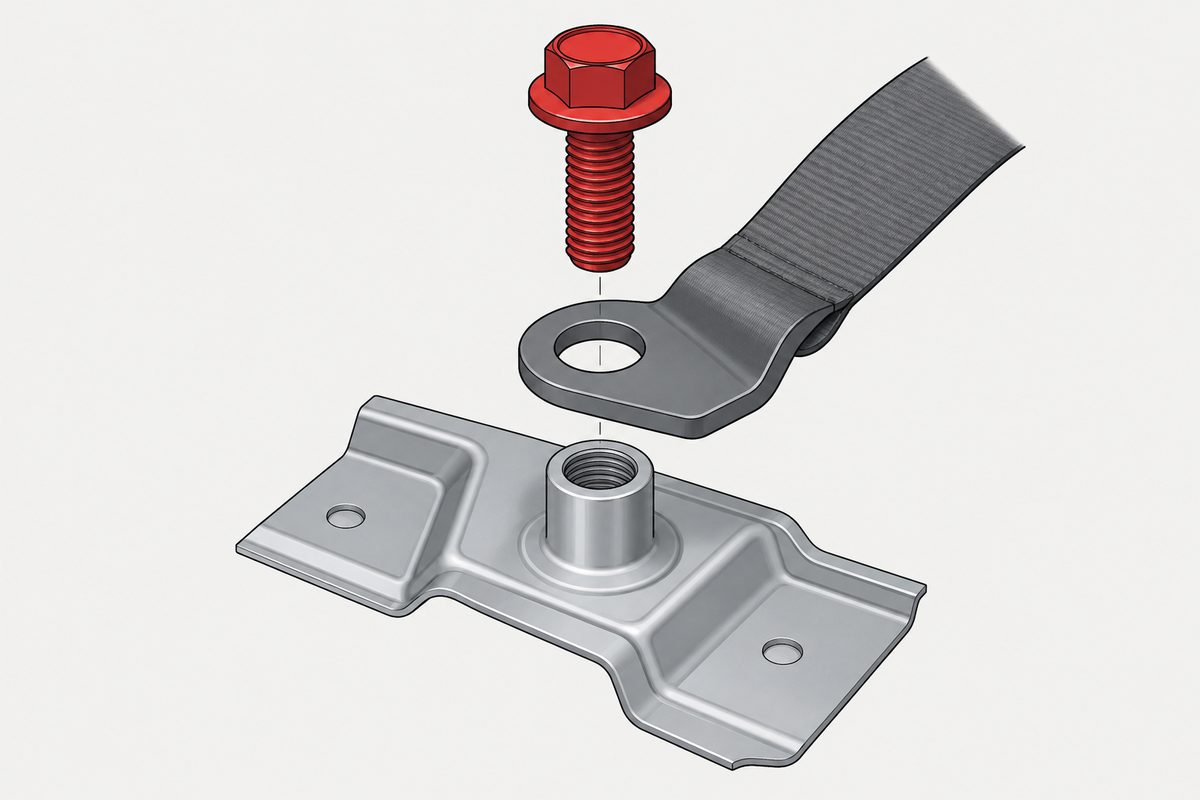
Paragraph 5.5.1, in one sentence: “An anchorage shall have a threaded hole of 7/16 inch (20 UNF 2B).” By our count that is the only appearance of the words inch and UNF in the whole regulation, against 143 uses of mm and 24 of daN.
This page gives no advice on vehicles, approval, or the installation of belts or anchorages, and this site is not a supplier of certified vehicle parts. It did not come from a forum question; it comes from looking for a whole source family with no coverage at all, which is the method the last article arrived at. The browser tooling we normally use remains unavailable.
Which text we read, and why it is a republication
The document is UN Regulation No 14, on the approval of vehicles with regard to safety-belt anchorages and related systems. It states on its face that it incorporates all valid text up to Supplement 5 to the 07 series of amendments, with a date of entry into force of 10 June 2014. This is the first time this site has used a United Nations vehicle regulation.
We did not read it on the issuing body’s own site, because that site refuses us. The regulation PDF there returns a 403 to this site. What we read instead is the text as republished in the Official Journal of the European Union, dated 19 August 2015.
That republication carries a warning about itself, and it belongs at the top of this page rather than buried in a footnote: “Only the original UN/ECE texts have legal effect under international public law.” It also says the status and date of entry into force should be checked against the issuing body’s current status document. So this page reports what a republished text says, and does not claim it is the version in force today.
We read paragraph 5.5 and its surroundings, the title material, and word counts across the whole document. We did not read the test clauses, the inspection clauses, or any annex, and nothing here describes the requirements for the child seat anchorage systems the same regulation covers.
One inch, and everything else in millimetres
The regulation is thoroughly metric. Distances are in millimetres, forces in decanewtons, and there are a hundred and forty three of the former and twenty four of the latter by our count.
Then there is one seven sixteenths of an inch. It is the thread in the anchorage, and it is the only imperial dimension in the document. The words inch and UNF each appear once, in that one sentence.
The regulation does not say where the size came from, and we are not going to reconstruct it. What can be said is that a thread specification survived into an international instrument that measures everything else the other way, which is usually a sign that changing it would cost more than living with it.
And then the paragraph that takes it back
The next paragraph is the reason this is worth a page. If the vehicle is fitted by the manufacturer with safety-belts attached to all the anchorages prescribed for the seat in question, those anchorages need not have the 7/16 inch thread at all, provided they comply with everything else. A second exemption covers certain additional anchorages.
So the thread is required where the anchorage might be used by something that is not already bolted to it, and not required where it is.
That is our reading, and it needs flagging as one. The regulation gives no purpose for the size and no reasoning for the exemption; it just states both. But taking the two paragraphs together, the thread is behaving like a compatibility requirement rather than a strength requirement. It is not there to make the joint stronger. It is there so that something can be attached to it later.
The third paragraph in the same short clause points the same way: “It shall be possible to remove the safety-belt without damaging the anchorage.” Removability is a requirement, not a convenience. An anchorage that could only be unbolted once would not comply.
The hole is specified and the bolt is not
One more thing follows from the counts. The regulation specifies the female thread and never mentions the male part that goes into it.
The word screw does not appear in the document. The word torque does not appear. The word bolt appears exactly once, and it is not about the anchorage at all: it is in a description of a test rig, permitting the addition of land edges or bolts to stop the strap slipping off during a pull test.
That division is worth carrying. The regulated feature is the hole in the vehicle. What is screwed into it, at what tightness, is somebody else’s document. A thread size in a rule like this is an interface, and an interface only has to be agreed, not optimised.
What this settles and what it does not
- An anchorage shall have a threaded hole of 7/16 inch, 20 UNF 2B
- By our count that is the only imperial dimension in the whole document, which uses mm 143 times and daN 24 times
- The requirement does not apply where the manufacturer has fitted belts to all the anchorages prescribed for that seat, provided the other provisions are met, nor to certain additional anchorages
- Reading the thread as a compatibility requirement rather than a strength one is ours; the regulation states the size and the exemption without giving a reason for either
- It shall be possible to remove the safety-belt without damaging the anchorage
- By our count the words screw and torque do not appear, and bolt appears once, in a description of a test rig
- We read a republication, not the original, because the issuing body refuses requests from this site, and that republication states that only the original texts have legal effect
- The text states that it incorporates all valid text up to Supplement 5 to the 07 series of amendments, with entry into force on 10 June 2014; this page does not claim it is the version in force now
- We did not read the test clauses, the inspection clauses or any annex, and nothing here describes the child seat anchorage systems the same regulation covers
- No advice on vehicles, approval or installation is given, and no conversion or substitution between imperial and metric threads is offered
The habit worth taking is telling interfaces apart from requirements. A dimension that exists so two parties can meet does not have to be the best dimension available, and arguing that a metric thread would be better misses what the clause is for. When a size looks arbitrary, the question to ask is not whether it is optimal but who else has to fit it.
This page covers step 2, the thread. The whole order is substrate, thread, head, drive, finish, documentation, and why doing it out of order is rework rather than a tweak is in specifying a screw.
Common questions
What thread does a safety-belt anchorage have?
The regulation says an anchorage shall have a threaded hole of 7/16 inch, 20 UNF 2B.
Is that the only imperial dimension in the regulation?
By our count, yes. The words inch and UNF each appear once, in that sentence. Elsewhere the document uses mm 143 times and daN 24 times.
Does every anchorage need that thread?
No. The regulation says the requirement does not apply where the vehicle is fitted by the manufacturer with safety-belts attached to all anchorages prescribed for the seat in question, provided the other provisions are complied with, and it does not apply to certain additional anchorages either.
Why is the thread required only in that case?
The regulation does not say. Reading it as a compatibility requirement rather than a strength one is our reading, based on putting the two paragraphs side by side.
Does the regulation say anything about the bolt?
By our count, no. Screw and torque do not appear in the document at all, and bolt appears once, in a description of a test rig rather than of an anchorage. The regulation specifies the threaded hole.
Can the belt be removed?
The regulation says it shall be possible to remove the safety-belt without damaging the anchorage.
Is this the current version of the regulation?
This page does not say. The text we read states that it incorporates all valid text up to Supplement 5 to the 07 series of amendments with entry into force on 10 June 2014, and the republication we read from says the status and entry into force should be checked against the issuing body current status document.
Why did you read a republication?
The issuing body website returns a 403 to this site, so the regulation was read as republished in the Official Journal of the European Union. That republication states that only the original texts have legal effect under international public law.
Is this guidance for a vehicle or a part?
No. No advice on vehicles, approval or installation is given, and this site is not a supplier of certified vehicle parts.
References
We did not read this regulation on the issuing body’s own site, because that site returns a 403 to this site; the text was read as republished in the Official Journal of the European Union. That republication states on its face that only the original UN/ECE texts have legal effect under international public law, and that the status and date of entry into force should be checked against the issuing body’s current status document. This page therefore reports what a republished text says and does not claim to give the version in force today. The text states that it incorporates all valid text up to Supplement 5 to the 07 series of amendments, with entry into force on 10 June 2014. We read paragraph 5.5 and its surroundings, the title material, and word counts across the whole document; we did not read the test clauses, the inspection clauses or any annex, and nothing here describes the child seat anchorage systems the same regulation covers. This is the first time this site has used a United Nations vehicle regulation. The following are our own counts and reading, not statements in the regulation: that the thread is the only imperial dimension in the document, against 143 uses of mm and 24 of daN; that screw and torque do not appear and bolt appears once in a test rig description; and that the thread behaves as a compatibility requirement rather than a strength requirement. The regulation gives no purpose for the size and no reasoning for the exemption, and this page does not reconstruct where the size came from. No conversion or substitution between imperial and metric threads is offered. This article did not come from a forum question; it comes from searching for a source family with no coverage at all. No advice on vehicles, approval or installation is given, this site is not a supplier of certified vehicle parts, and no brand is named. The browser tooling this site normally uses remains unavailable.
Enquiries
If a thread on your drawing exists so that somebody else’s part can attach to it, that is an interface rather than a strength decision, and it is worth saying so when you ask. Tell us what has to mate with it and we will tell you what we can evidence.
Request a quotation
Tell us the part and the quantity. We will come back on feasibility, lead time and price.
Or email us directly sales@tigerfasteners.com