 TIGERFASTENERS
What bounds the drive before you choose it
The short version: a recess is a torque interface, and how much torque it can pass depends largely on how deep the driver can engage. That depth is not a free choice — head geometry, the section left beneath the recess and the forming process all press on it, and they were mostly settled before the drive came up. Which is why the decision order puts the drive after the head, and why “we’ll use Torx, it is stronger” is a sentence that sometimes cannot be honoured at the size you are working at.
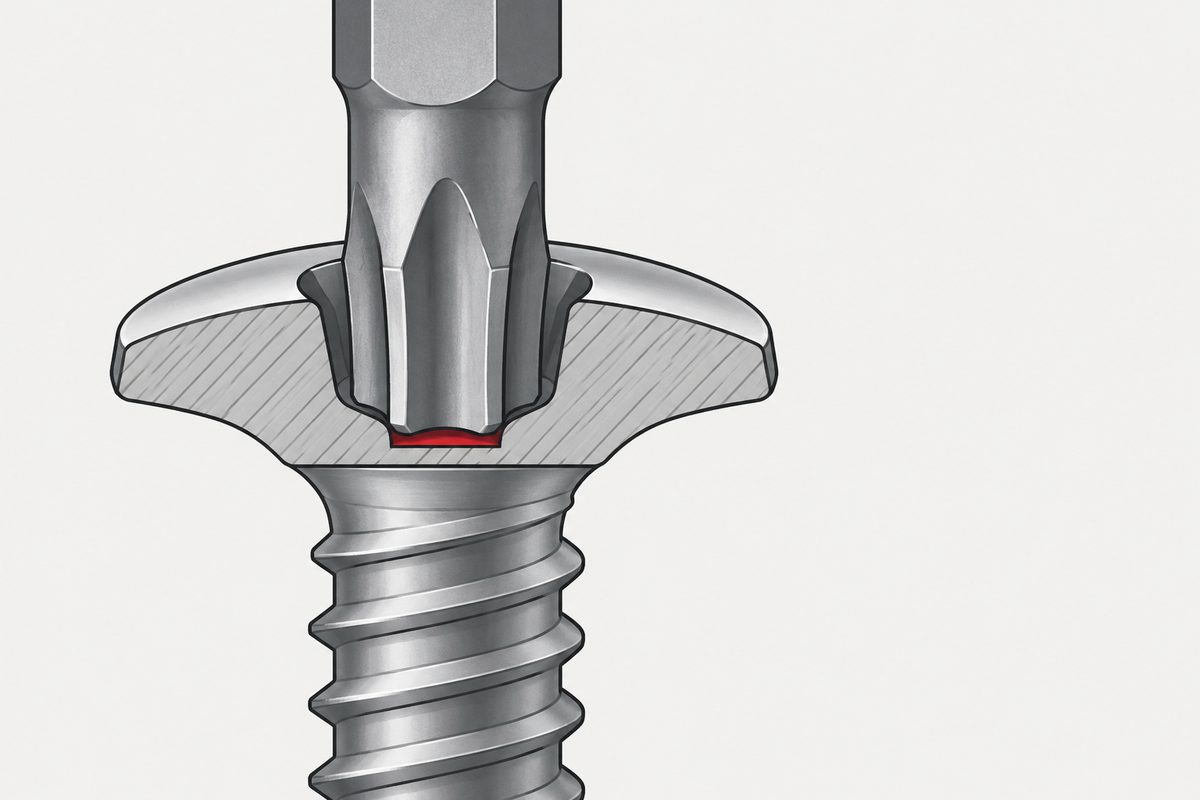
What a recess is actually doing
It is the joint between a machine and a screw. Torque arrives through a bit, crosses into the recess through whatever contact area exists between them, and leaves as rotation. Everything that makes one recess better than another at a given size comes back to that contact: how much of it there is, what angle it sits at, and how deep the bit can reach before it runs out of recess.
So the failure to design against is the interface giving up before the thread does. A rounded recess says the connection between tool and screw failed first; it does not say which side was out of specification, and either can be — what actually happens under torque is not the thing most people have been told.
Three things take their share before you get to choose
- Head geometry. The recess is a cavity in the head, and on many head styles its depth is limited by how tall the head is. Not all of them: on countersunk screws to ISO 7046 and the profiles in ISO 7721-2 the recess floor extends past the head into the shank region, which is how a flat head carries a usable recess at all. Either way the geometry constrains it — opening the included angle buys head diameter at the same head height, and a thinner head has less to give
- The section left beneath it. A deeper recess leaves less material between its floor and the load path from bearing face to shank. What can be said without hand-waving is narrow but useful: depth reduces the effective section, and past a threshold that depends on the geometry it raises head stress and can move where the head fails. Where that threshold sits is a question for the supplier and for testing, not for a rule of thumb
- How it gets made. Recess volume is one of the things that decides how many blows the head needs — stage count depends on head height, profile, recess volume and support, not on diameter alone. Whether a particular recess adds a stage at a particular size is a question to put to the supplier; if it does, that is tooling and lead time rather than a drawing change
None of the three is a decision about which recess to use, and in practice they are not settled in a tidy sequence either — head style, recess, the torque the joint needs and the forming route converge together. The point is only that by the time the drive is written on the drawing, most of the room it had has already been allocated.
On a button head the head height takes its share first, and the standard derates the whole part for it: marked 08.8.
Why there are so many recesses
Some of it is commercial — Torx is a proprietary system with licensed manufacturers and controlled tooling, and patents and compatibility have shaped which recesses spread. But each of the common ones also suits a different way of driving, and that is the part worth carrying into a specification:
There is a third reason, and it is not about driving at all. On an assembly line a recess can be chosen so that the wrong preset tool physically will not engage, which is why two drive families end up side by side on one cover.
The oldest of these arguments is on record. The two patents behind the cross recess argue almost entirely about how to form it, and neither of them mentions cam-out.
| Recess | Assumes | Costs |
|---|---|---|
| Slotted | A hand holding the driver on axis | No self-centring, the bit walks, and automated driving is harder than with a recessed drive |
| Cross recess | Self-centring matters more than torque capacity | Tapered flanks generate an axial component under load |
| Hex socket | Depth is available, and access is along the axis | Needs head height; corners round if the key is worn or undersized |
| Torx and similar lobed | High torque wanted without deep tapered flanks | Bit and recess tolerances matter more; an adjacent size can often be forced in far enough to do damage |
The three cross recesses that look identical and are not are a separate problem, and the more common one in practice.
Except at the small end, where the order reverses
The head usually bounds the drive, but not always, and it is worth naming the cases where the drive is fixed first:
- An existing line. If the assembly cells are tooled and the bits are stocked, changing recess is a capital decision, not a drawing decision
- Automated feeding. Whether the screw stays on the bit depends on the recess, but not on the recess alone — magnetic and vacuum bits change the answer, and so does the screw material. A drive a person can use is not automatically one a feeder can
- Field service. A recess that needs a specific bit is a recess that will be attacked with the wrong one, so what a technician carries is a real constraint
- Security or tamper requirements, where what the recess excludes may outrank torque capacity in the choice — though it still has to pass the installation and removal torque
When the drive is fixed first, the head has to absorb it. That is a legitimate design, and it is worth saying out loud in the review, because otherwise the head gets specified as though it were free and the conflict surfaces at the sample stage.
What to settle before the recess goes on the drawing
- What is the head height, and how much of it is available? The recess is competing with head strength for the same material
- Manual, powered or automated? Each asks something different of the recess, and whether the screw has to stay on the bit is one of the things that changes
- Is the drive already fixed by the line? If so, say it before the head is chosen, not after
- Does the recess add a forming stage at this size? Worth asking the supplier, because this is the point in the order where a late change is still cheap
- Which tool will actually go in? The driver tip has its own dimensional standard, and its tolerance band is the same 0,05 mm at every size, with conformance defined by an inspection gauge rather than by a measurement
This page covers step 4, the drive. The whole order is substrate, thread, head, drive, finish, documentation, and why doing it out of order is rework rather than a tweak is in specifying a screw.
Common questions
Why does the head limit the drive?
Because the recess is a cavity in the head and competes with it for material. On many head styles its depth is limited by head height, though not all — countersunk recesses to ISO 7046 extend past the head into the shank region. Depth also reduces the section beneath the recess, and past a geometry-dependent threshold that raises head stress and can move where the head fails. Recess volume is one of the inputs to how many forming blows the head needs, so whether a given recess adds a stage at a given size is worth asking the supplier. None of that is decided by choosing the drive, which is why the order puts the drive after the head.
Is Torx always stronger than a cross recess?
It is designed to transmit higher torque without relying on deep tapered flanks, which is why it appears where head height is tight. But the comparison is only meaningful at a given size and head style, and it brings its own sensitivities: bit and recess tolerances matter more, and an adjacent-size bit can often be forced in far enough to damage the recess. The useful question is not which recess is stronger in general but which one the head can carry at the size you are working at.
Why are there so many different recesses?
Partly commercial history — Torx is a licensed proprietary system — and partly that each suits a different way of driving. A slot suits a hand keeping the driver on axis. A cross recess assumes self-centring matters more than torque capacity. A hex socket assumes depth is available and access is along the axis. A lobed recess assumes high torque is wanted from a shallow one. They answer different assembly conditions, which is the part that matters when choosing one.
When is the drive chosen before the head?
When something outside the drawing fixes it. An existing assembly line with tooled cells and stocked bits makes a recess change a capital decision. Automated feeding depends on whether the screw stays on the bit, which the recess affects along with the bit type and the screw material. Field service depends on what a technician carries. Security fasteners weigh what the recess excludes against the torque it still has to pass. In those cases the head has to absorb the constraint, which is fine, but it should be said before the head is specified rather than discovered at sample stage.
What does a rounded recess actually mean?
That the connection between tool and screw failed before the thread did. It does not say which side was at fault — bit fit, bit wear, misalignment and a recess too shallow for the torque asked of it are all candidates, and the recess and the bit can each be out of specification. Treating it as normal wear hides a controllable process problem.
References
Enquiries
Heads rounding on the line, or unsure whether a recess is realistic at your size? Send the head style, the size, and how it is driven — by hand, by a powered driver, or by an automated cell. Rounding is usually the interface failing before the thread does, and which of the three constraints is binding decides whether the answer is a different bit, a different head, or a different screw.
Request a quotation
Tell us the part and the quantity. We will come back on feasibility, lead time and price.
Or email us directly sales@tigerfasteners.com