 TIGERFASTENERS
Why Two Different Drives Sit Side by Side on the Same Cover
An engineer on r/AskEngineers had been annoyed for years that the caliper on his GTI took a Torx bit and the caliper bracket behind it took a triple square. He assumed it was a quirk until he watched an Audi engine come apart and found the two drives on the same timing cover, next to each other. The best answer in the thread is not about tooling cost, and it changes what a recess is for.
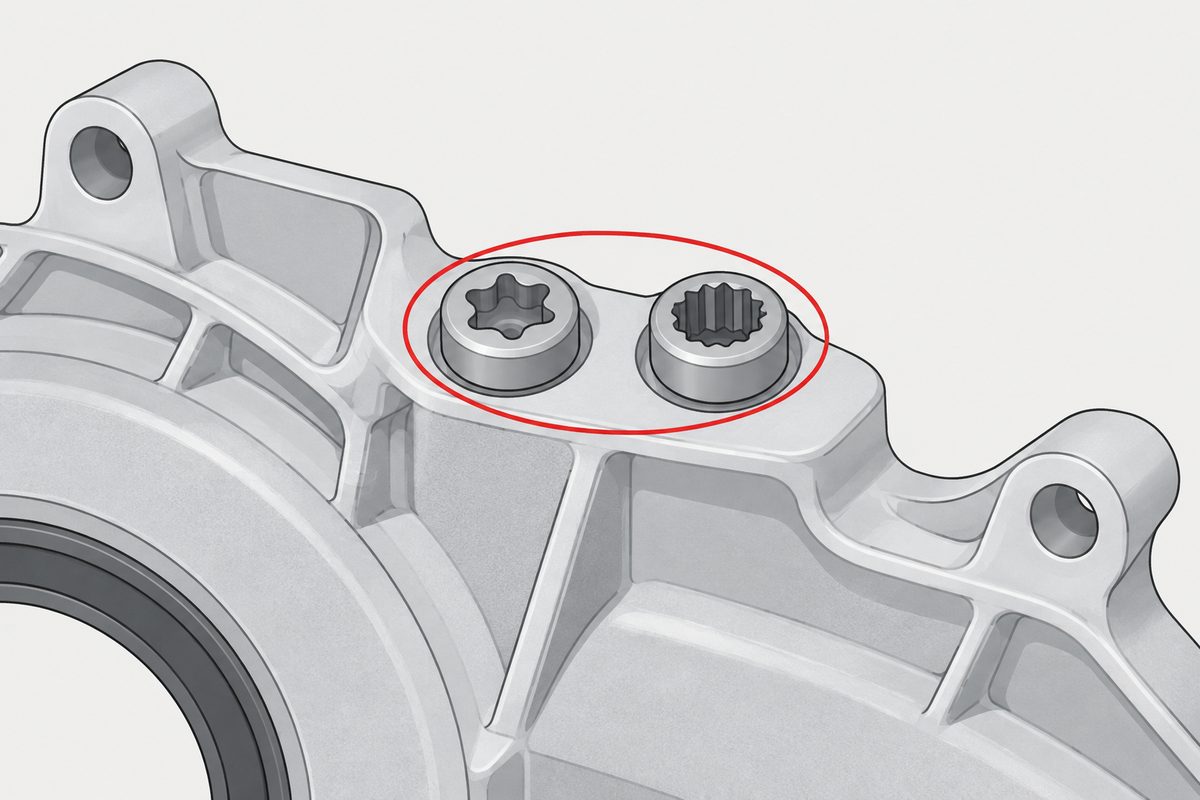
The two answers, and why the second one is the interesting one
The top reply is the honest one and worth keeping. There are many reasons, it says, and few of them are engineering: the cost of the fastener, commonality with other parts from the same vendor, what is available in the region where the component is made. It closes with a line anyone who has taken a car apart will recognise, that ease of disassembly is one of the last things considered, if it is considered at all.
The second reply is the one that explains the timing cover. Different drives get used for different torque values even where any of them would carry the maximum torque, and the reason is not the fastener at all:
It is not good to have an assembler with four preset torque guns that all take the same bit. Too easy to mix them up, or to mix up which bolts get which torque.
Read that as a design statement rather than a complaint. The recess has been given a second job. It is not only transmitting torque, it is keying the tool to the joint, so that the gun set to the wrong value physically will not engage. That is error-proofing done with geometry, and the person it protects never reads a drawing.
Why the recess is available to carry a message at all
This only works because of an asymmetry in how the standards are written, and it is visible in one table. ISO 14579 covers hexalobular socket head cap screws from M2 to M20, and for every thread size it names one socket number:
| Thread | M2 | M3 | M4 | M5 | M6 | M8 | M10 | M12 | M16 | M20 |
|---|---|---|---|---|---|---|---|---|---|---|
| Socket no. | 6 | 10 | 20 | 25 | 30 | 45 | 50 | 55 | 70 | 90 |
One row, no alternatives. Inside a drive family the recess size is not a free variable, it is a function of the thread. You cannot put two different hexalobular sizes on two M8 screws and stay inside the standard, so you cannot use recess size to tell an assembler anything.
Across families, nothing is fixed at all. Two M8 screws, one with a no. 45 hexalobular recess and one with a triple square, break no standard, sit in the same table of thread sizes and carry the same property class. The drive family is the one field on that screw that no standard has claimed, and a field nobody has claimed is a field you can write on.
What the recess standard does and does not promise
One thing worth knowing before leaning on a recess as a key. ISO 10664 governs the shape, basic dimensions, profile curvature and gauging of the recess in the screw, and ISO states it is intended for recess inspection rather than as a manufacturing standard. It says nothing about the driver. We went looking for a general-purpose hexalobular driver-tip standard and did not find one, which is worked through in the recess is standardised and the bit is not.
So the keying works in the direction that matters on a production line, where the tools are chosen and controlled, and it works much less well in a workshop, where the bit in the drawer is whatever a tool vendor decided it should be. Which is roughly the complaint the original poster started with.
The drive he could not buy a socket for
Triple square is where this gets uncomfortable to write about honestly, because we could not find a published standard for it. Searching turns up tool vendors rather than standards bodies, describing twelve equally spaced protrusions each ending in a 90° internal angle, as against the 60° of a conventional twelve-point, and noting that it is common on cylinder head bolts and drivetrain parts from BMW, Opel, Mercedes and the Volkswagen group. That is a vendor-level description, not a clause, and this page treats it as one.
Which is the ending, not a gap in the research. A drive family you cannot cite a standard number for is a bad thing to put on a drawing and a good thing to use as a key, and those are the same fact. The keying value of a recess comes from other people not having the tool. Standardise it and stock it everywhere, and it stops keying anything.
The site has one other case of a drive family where the assumption that a name identifies a shape fails outright: two different Y drives. And what actually limits how much torque a recess can carry, which is a separate question from which family it belongs to, is what bounds the drive.
What to settle before a second drive family goes on the drawing
- Whether the second family is carrying information. If it is there to key a torque value, that intention exists only in somebody’s head unless it is written down. The part does not say why it is different
- Who has the tool. Assembly is controlled, service usually is not, and the population that has to remove the fastener is larger and less equipped than the one that fits it
- Whether a standard can be cited. If not, the drawing has to carry the geometry or a named part, because a family name alone is not a specification
- Whether the recess is near its limit anyway. Keying is free only if the recess you switched to still carries the torque, and at small sizes the drive stops being the free choice first. See the order reverses below a certain size
And the caution from the top reply is the right one to end on. Many of these decisions are not engineering decisions at all, and even the ones that are were not made with the person holding the socket set in mind.
This page covers step 4, the drive. The whole order is substrate, thread, head, drive, finish, documentation, and why doing it out of order is rework rather than a tweak is in specifying a screw.
Common questions
Why would one assembly use two different drive types?
The best explanation offered on the source thread is error-proofing. Different drives are used for different torque values even where any of them would carry the maximum, so that an assembler with several preset torque guns cannot fit the wrong gun to the wrong bolt. The recess is doing a second job as a key. The same thread also lists reasons that are not engineering at all: fastener cost, commonality with parts from the same vendor, and what is available where the component is made.
Can I use two different recess sizes to distinguish two torque values?
Not inside one drive family. ISO 14579 gives each thread size a single hexalobular socket number, so an M8 takes a no. 45 and there is no second option to choose. Recess size is a function of the thread rather than a variable you control. What is unconstrained is the drive family, since nothing stops two M8 screws carrying different families, and that is why the family rather than the size is what ends up carrying the message.
Is there a published standard for triple square, or XZN?
We could not find one. Searching returns tool vendors rather than standards bodies, describing twelve equally spaced protrusions each ending in a 90 degree internal angle, against 60 degrees on a conventional twelve-point, and associating it with German cylinder head and drivetrain fasteners. That is a vendor-level description and this page does not raise it to the status of a clause. If a drawing depends on the geometry, the drawing needs to carry it or name a specific part.
Does a standardised recess mean my bit will fit?
No. ISO 10664 covers the recess in the screw, its shape, basic dimensions, profile curvature and gauging, and ISO states it is intended for recess inspection rather than as a manufacturing standard. It does not govern the driver, and we could not find a general-purpose hexalobular driver-tip standard at all. That is why the keying works on a line where the tools are controlled and works much less well in a workshop.
Is the drive family really free, or does something constrain it?
No standard binds it, but the joint does. A recess can only key a torque value if the family you switch to still carries that torque, and how much a recess can carry is set by its own geometry and by the head it sits in rather than by the thread. Below about M3 that constraint arrives first and the drive stops being the free choice.
References
- ISO 14579:2011 — hexalobular socket head cap screws; clause 1 scope and Table 1, which gives the socket number for every thread size from M2 to M20
- ISO 10664:2014 — hexalobular internal driving feature for bolts and screws; the recess, not the driver
- r/AskEngineers — the thread this began in, including the error-proofing answer and the caution above it
ISO 14579:2011 was read from the publicly available preview PDF, which carries clause 1 and Table 1 in full; the socket numbers quoted here come from that table, and M14 and M18 appear there in brackets as non-preferred sizes. The ISO 10664 material is from our earlier page, which read that standard the same way. Triple square is reported at vendor level and nothing more: we searched for an ISO or DIN number and found tool sellers rather than standards bodies, so the twelve protrusions, the 90 degree internal angle and the association with German engine and drivetrain fasteners are described here as vendor descriptions rather than quoted as requirements. The error-proofing explanation is the best answer given on the source thread by an engineer, not a statement from any vehicle manufacturer, and this page does not claim to know why Volkswagen made the choices it made. We found no published measurement of whether keying by drive family actually reduces mis-torqued joints, so no such claim is made. The ISO catalogue number was taken from the preview URL path and confirmed against a second source.
Enquiries
If two drive families appear on one assembly, tell us which is which and why when you send the enquiry. If the second family is there to key a torque value, that is worth knowing before we quote tooling, and it is the kind of intention that lives in one engineer’s head until somebody writes it on the drawing.
Request a quotation
Tell us the part and the quantity. We will come back on feasibility, lead time and price.
Or email us directly sales@tigerfasteners.com