 TIGERFASTENERS
Two different drives are both called Y
If you are holding a screw with three slots and looking for a bit, the first thing to settle is which of two unrelated drives you have. Tri-Wing has offset slots and an aerospace standard behind it. Tri-point is centred and symmetric and has no public standard at all. They are not designed to be interchangeable, and the names in the shops will not reliably tell you which is which.
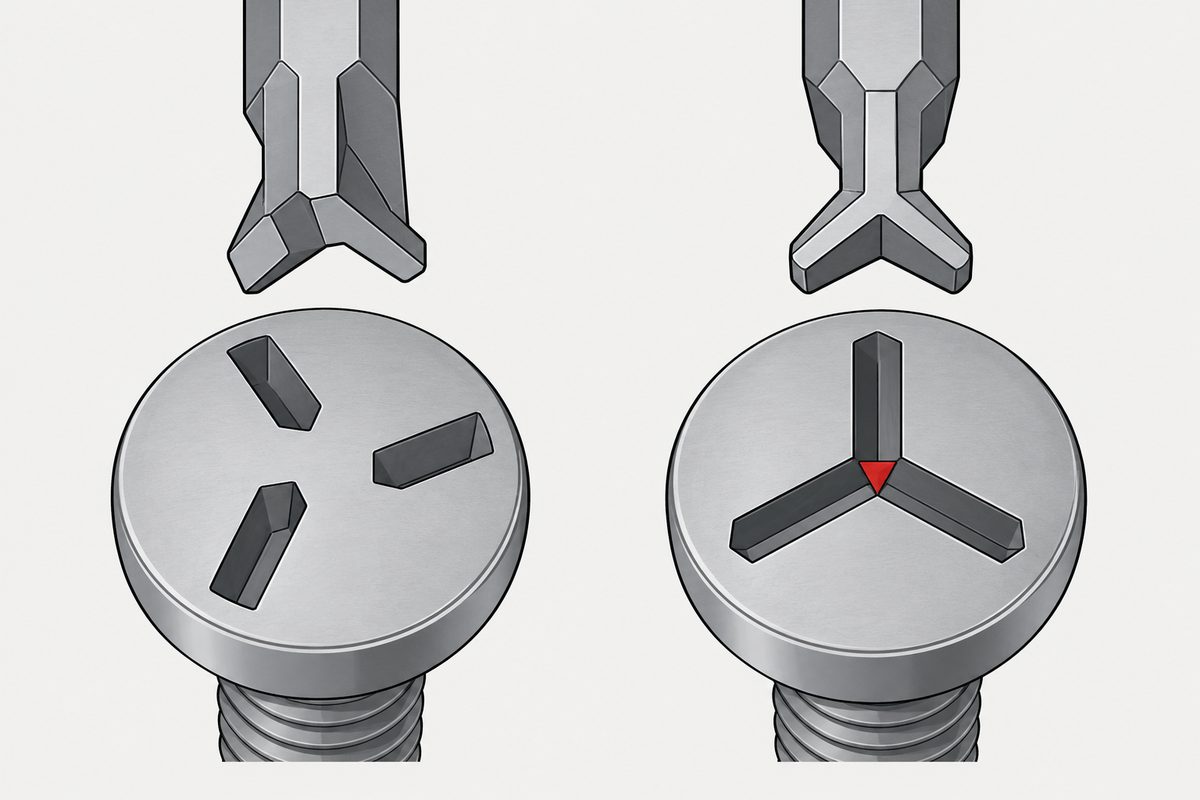
The geometric difference, which is the only reliable one
Both drives present three slots. The difference is whether those slots pass through the centre.
| Tri-Wing | Tri-point | |
|---|---|---|
| Slots | Offset from the radius, not meeting at the centre | Pass through the centre at about 120° |
| Look | Like a pinwheel; a small triangular area usually remains in the middle | A true Y outline |
| Working faces | Asymmetric | Symmetric |
Phillips Screw Company describes Tri-Wing as a tri-slot shape, and Wera describes its three working faces as an asymmetric arrangement. The centred Y is what iFixit and Apple's own documentation call tri-point.
One has a standard. The other has none.
This is the part that surprised us, and it is the practical difference between the two.
- Tri-Wing is standardised. NAS 4000, “Recess, Tri-Slot, Dimensions of Recess and Gages”, defines the recess and its gauges, with recess dash numbers running 0–15 plus 4J. Gauge makers still supply penetration and go/no-go gauges to it, and a long list of NAS part standards call it up.
- Tri-point has no public standard we could find — not ISO, not ANSI/ASME, not NAS, not JIS. The Y000, Y00, Y0 and Y1 sizes are a repair-tool market convention, not a published specification. iFixit describes its own tri-point bit as a custom drive style made to fit Apple screws, and Japanese toolmaker ANEX labels its Y bits by millimetre instead.
What that means when you buy. For Tri-Wing you can specify a recess number and a gauge. For tri-point you cannot — sizes are not safely interchangeable across brands, so the size has to come from the repair documentation for that specific product, or from fitting the actual screw.
Two limits on the above. Tri-Wing® is a registered trademark of the Phillips Screw Company, so the generic geometric description is the tri-slot recess. And while several NAS part standards that use the recess are marked inactive for new design after 1 January 1986, we could not confirm from public sources whether NAS 4000 itself is active, inactive or withdrawn, so we are not asserting it.
Neither is in ISO or ASME — which is itself worth knowing
If you are used to reaching for an ISO number, there is not one here.
| Standard | Covers |
|---|---|
| ISO 4757 | Cross recesses, types H and Z only |
| ISO 10664 | Hexalobular internal driving feature |
| ASME B18.6.3 | Recess types I, IA, III, VI and their gauges |
None of them lists either Y form. So a drawing that just says “Y drive” has not specified anything a supplier can work from.
Where Tri-Wing came from, and what the claim about torque actually says
Tri-Wing is an aerospace drive, and there is a first-hand record of why. A NASA fastener study from 1970 notes that three major aircraft manufacturers were then proposing the Tri-Wing recess as an aviation standard, citing its larger driving surface as an advantage when removing seized or corroded fasteners.
We had intended to extend that into a tidier claim: three contact faces means more torque and less cam-out at small sizes. Checking it found no evidence for that as a general rule, and some evidence against.
- No public comparison exists that controls head diameter, material, recess depth and end load across micro Tri-Wing, tri-point and cross recesses.
- A Phillips-related patent notes that three-slot versions can show driver rock-out or spin-out at smaller sizes — the opposite of “smaller means naturally more secure”.
- The same NASA report still treats these recesses as needing axial force and correct alignment, and does not claim cam-out is eliminated.
- For tri-point the available material points the other way: its tapered profile is described as relatively prone to pushing the driver out, and the tiny screws it appears on are tightened to very low torque anyway.
So the defensible statement is narrower. Tri-Wing's straight working walls and larger driving surface were meant partly to transmit torque, particularly for removal, and the drive also has the effect of limiting what non-dedicated tools can do. But you cannot get from the number three to a general claim about every Y-shaped screw.
There is a formal way to measure this, if a supplier ever quotes numbers at you: NASM 1312-25, the driving recess torque quality conformance test. It is a procedure, not a published comparison between drives.
Can you use the wrong one anyway
We wanted to write “the wrong bit will round the recess”. That is too absolute, but the conclusion under it holds.
The two are not designed to be interchangeable. Because one set of slots is offset and the other passes through the centre, the wing positions, the central profile, the side-wall contact points and the insertion depth are all different. The wrong driver typically will not bottom out, and contacts only at the wing tips or part of a side wall. Where real loosening torque is needed, that localised loading plus cam-out is what rounds the recess.
A low-torque, loose or already worn screw can sometimes be turned with the wrong bit. That is not the same as the two being compatible, and we found no published failure-rate test for using one on the other, so treat the risk as a mechanism rather than a measured number.
The confusions worth knowing about
The most common one runs in a specific direction: tri-point screws sold or documented as Tri-Wing. iFixit maintains an identification page for Nintendo hardware precisely because the two names have been mixed up in the market for years.
| Drive | What it actually is |
|---|---|
| Tri-angle / TP3 | A triangular or rounded-triangular hole |
| Tri-groove | Three short slots around the outside of the head, not meeting at the centre — a centred Y bit is no use |
| Torq-Set | Four offset slots. In aerospace work it is more often mistaken for a skewed cross recess than for a Y |
| Torx / hexalobular | Six lobes |
| Pentalobe | Five lobes |
Where tri-point actually turns up is consistent enough to be useful: Apple Watch and newer iPhones use Y000, Apple Pencil uses Y00, some MacBook Pro batteries use Y1, and Nintendo Switch and Joy-Con hardware uses it too.
What to write on a drawing
“Y drive” is not a specification. For Tri-Wing, name the recess and its number. For a tri-point screw, the drive has to be defined by reference to the actual part, because there is no published standard to point at.
Where the drive sits among the other decisions a screw needs is in specifying a screw; why a recess cams out at all is in why the driver slips; and what actually sets the limit on a drive is in what bounds the drive.
References
- NAS 4000 — Recess, Tri-Slot, Dimensions of Recess and Gages
- NASA MCR-69-410 (1970) — fastener study recording the aerospace proposal and the larger driving surface rationale
- US 4,187,892 — notes rock-out and spin-out behaviour in three-slot recesses at smaller sizes
- NASM 1312-25 — driving recess torque quality conformance test
- ISO 4757 (cross recesses H and Z); ISO 10664 (hexalobular); ASME B18.6.3 (recess types I, IA, III, VI)
- Phillips Screw Company, Tri-Wing® drive system; Wera Tri-Wing technical pages; iFixit drive identification and bit data
- “What is this Y-shaped screwdriver bit, and what is its purpose?”, DIY Stack Exchange
Tri-Wing® is a registered trademark of the Phillips Screw Company. This page describes drive geometry and what the cited standards contain; acceptance for any particular part is governed by your drawing.
This page covers step 4, the drive. The whole order is substrate, thread, head, drive, finish, documentation, and why doing it out of order is rework rather than a tweak is in specifying a screw.
Common questions
What is the Y-shaped screwdriver bit called?
It depends which of two drives you have. If the three slots are offset and do not meet at the centre, it is Tri-Wing, a tri-slot recess standardised as NAS 4000. If the three arms pass through the centre at about 120 degrees, it is tri-point, sold as Y000, Y00, Y0 and Y1. They look similar at a glance and are not designed to be interchangeable.
Is Tri-Wing a standard drive?
Yes. NAS 4000, "Recess, Tri-Slot, Dimensions of Recess and Gages", defines the recess and its gauges, with recess dash numbers 0 to 15 plus 4J, and a number of NAS part standards call it up. Tri-Wing is a registered trademark of the Phillips Screw Company, so the generic description is the tri-slot recess. Several NAS part standards using it are marked inactive for new design after 1986, and we could not confirm the current status of NAS 4000 itself from public sources.
Is there a standard for tri-point screws?
We could not find one. Tri-point does not appear in ISO, ANSI/ASME, NAS or JIS. The Y000, Y00, Y0 and Y1 sizes are a repair-tool market convention rather than a published specification, and they are not safely interchangeable between brands, so the size should come from the repair documentation for that product or from fitting the actual screw.
Does a three-slot drive transmit more torque than a cross recess?
Not as a general rule that we can support. Tri-Wing was proposed for aerospace partly because of its larger driving surface, particularly for removing seized fasteners, and that much is documented. But we found no public comparison controlling head diameter, material, recess depth and end load, and a Phillips-related patent notes that three-slot recesses can show driver rock-out or spin-out at smaller sizes. The number three on its own does not settle it.
Can I use a tri-point bit on a Tri-Wing screw?
They are not designed to be interchangeable. One set of slots is offset and the other passes through the centre, so the wing positions, central profile, side-wall contact and insertion depth all differ. The wrong driver usually will not bottom out and contacts only at the wing tips or part of a side wall, which is what rounds a recess when real loosening torque is applied. A loose or low-torque screw can sometimes be turned anyway, but that does not make the two compatible.
Enquiries
If a drawing reaching you says only “Y drive”, send it over with a photograph of the mating part if you have one. Settling which recess is meant before tooling is ordered is much cheaper than settling it afterwards.
Request a quotation
Tell us the part and the quantity. We will come back on feasibility, lead time and price.
Or email us directly sales@tigerfasteners.com