 TIGERFASTENERS
Cam-out: the most repeated fact about the Phillips recess is backwards
The short version: “the Phillips recess was designed to cam out so you cannot overtighten” is the most repeated claim about screw drives, and the patents behind the recess do not mention it at all. We read both of them from the scans. The 1933 filing argues about production cost and head strength, the 1936 one about punching, and the word cam appears in neither. Cam-out came to be seen as a benefit later, when early powered drivers had unreliable torque clutches and slipping was better than snapping. The difference matters, because if you believe the recess is supposed to slip, you will treat a rounded head as normal wear instead of as a controllable process fault.
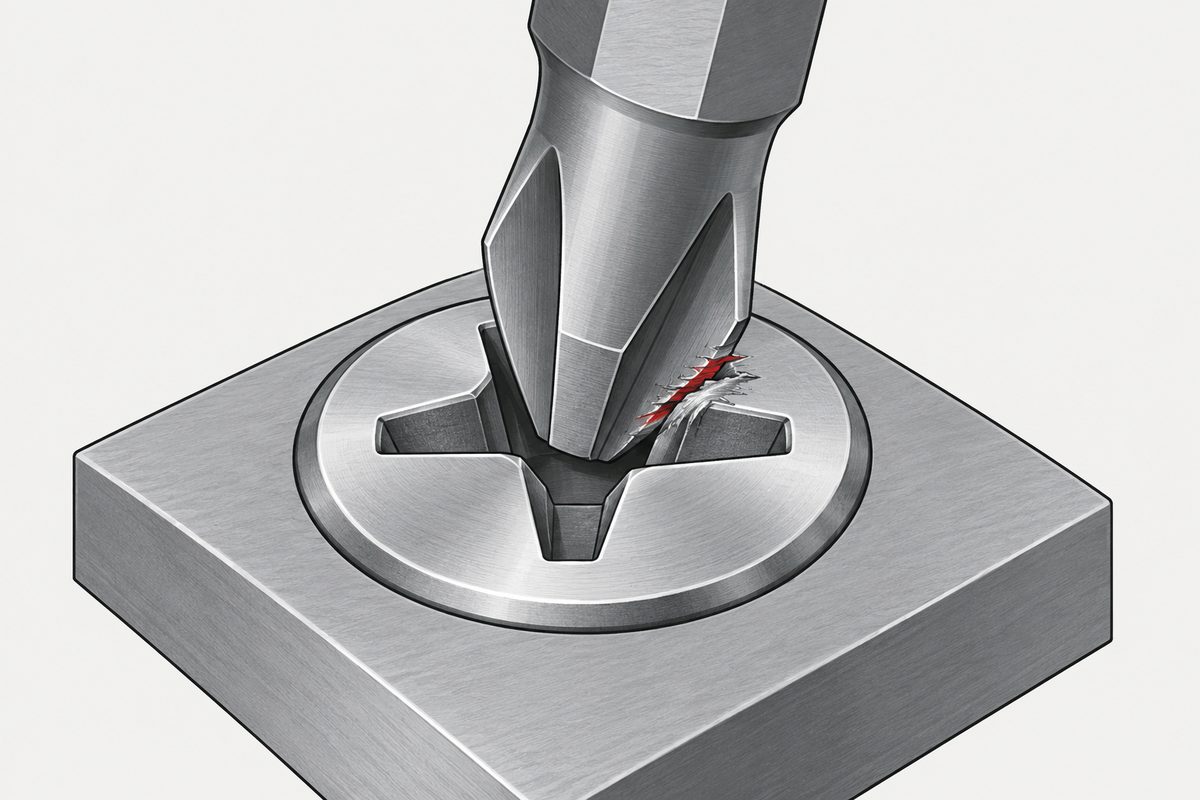
Pushing harder is what everyone does, and it usually works
A driver starts to slip, so you lean on it. That is not a bad instinct: more axial force keeps the bit seated, and most of the time the screw goes in and nobody thinks about it again.
It is also the only lever available to a hand at that moment. And it works — enough aligned down-force does suppress cam-out. What it cannot fix is the part decided before anyone picked up a driver: the recess geometry sets how much of the contact reaction pushes the bit back out, and no amount of force changes that ratio.
The claim in the opening paragraph is not one to make on hearsay, so we pulled both patents from the USPTO and read the scans: what the two cross recess patents actually say, including whose name is on the 1933 one.
So press harder — and that is the only half of it you control
The cross recess has tapered flanks. Turning the driver against resistance resolves part of that torque into an axial force that pushes the bit out of the recess. Three things decide whether it slips:
- The flank angle — the more tapered, the more of the torque becomes ejection force
- The down-force on the driver — the operator or the machine has to supply what the geometry gives away
- How worn the bit is — a rounded bit tip contacts on a smaller, more tapered part of the flank, so it slips earlier, which wears it further
That last one is a feedback loop, and it is why cam-out arrives suddenly. A line runs for months with no complaints, then produces a run of rounded heads over a few days. Nothing changed about the screws. The bit crossed the point where slipping accelerates its own wear.
Phillips, JIS and Pozidriv: identical at a glance, different under load
| Recess | Behaviour under torque | How to identify it |
|---|---|---|
| Phillips | Tapered flanks; slips before very high torque is reached | No identifying mark; rounded transitions at the centre |
| JIS B 1012 | Designed not to slip — so it keeps taking torque until something else gives | Usually a single small dot or dimple beside the cross; squarer corners at the recess wings (recess names in Chinese and English) |
| Pozidriv | Added ribs give a straighter flank contact; resists slipping | Four fine radial ticks between the main wings — the clearest visual tell of the three |
The dangerous pairing is a Phillips bit in a JIS recess. The JIS recess does not shed the torque, so the load stays on and it is the recess that deforms. The result is reported as “soft screws” almost every time — and swapping supplier does not fix it, because the screws were never the variable.
Why this gets worse as the screw gets smaller
- The recess is punched into the head, and the head has limited material. A deeper recess grips better and leaves less wall — below M2 that trade is tight, and it is the same constraint that limits how much head you can form in the first place
- Down-force does not scale down. The force a hand or a fixture applies is roughly constant, and on a small head it is a much larger fraction of what the head can take
- Coating changes the friction in the recess as well as on the threads, so a finish change can alter cam-out behaviour without anybody having changed the screw
Five checks when heads start rounding
- Change the bit first, before anything else. It is the cheapest variable and the most likely one. If it fixes the problem, you have your answer for a few dollars
- Look for a dot beside the cross on a sample. If the screws are JIS and the bits are Phillips, the mismatch is the cause
- Check the down-force, not just the torque. A driver set correctly but pressed lightly will cam out at a torque it would otherwise carry
- Check alignment. A driver entering off-axis loads one wing of the recess, and one wing always fails before four do
- Check whether the coating or supplier changed recently. Friction in the recess is part of the system
Note that four of the five are free and none of them involve the screw. A rounded recess with the joint still clamped is not a thread failure at all, and treating it as one sends the investigation to the wrong supplier.
When to leave the cross recess behind
If the assembly is powered, high volume, or below about M2, an internal-drive recess with near-parallel flanks — hexalobular, hex socket — removes the mechanism rather than managing it. The torque goes into the joint instead of into pushing the bit out.
- What you gain: higher transmissible torque for the same head size, longer bit life, far less operator dependence
- What has to be available first: the head has to be able to carry the recess — depth competes with head strength, and recess volume can add a forming stage
- What you pay: tooling for the recess punch, and every service technician now needs the right driver
- What you must not skip: changing the recess changes underhead friction and therefore the clamp force you get from a given torque — that is a joint change and needs re-verification
The second bullet is the one that decides it in practice. A product that gets serviced in the field by people who own a Phillips driver and nothing else has a real reason to stay with the cross recess — and that reason has nothing to do with engineering.
One family worth knowing before you go shopping: the two drives that are both called Y. They are not interchangeable, and the claim that three slots resist cam-out better turns out not to be supported.
The usual destination is hexalobular — and the mechanism is more specific than “it grips better”: hexalobular is not called T20.
Going the other way — back to a slot — fails differently: sideways, not upwards. See the slotted screw nobody can source.
This page covers step 4, the drive. The whole order is substrate, thread, head, drive, finish, documentation, and why doing it out of order is rework rather than a tweak is in specifying a screw.
Common questions
Was the Phillips screw designed to cam out on purpose?
The popular story says yes, and neither patent supports it. US 1,908,080 of 1933 and US 2,046,343 of 1936 were both read in full, and the word cam does not appear in either; the claims in both are purely geometric and say nothing about torque. The 1933 document argues about production cost against casting and broaching, and about head strength. Cam-out came to be treated as an advantage later, when early powered drivers had unreliable torque-limiting clutches and a slipping bit was preferable to a snapped screw. The behaviour is a consequence of the tapered flank geometry rather than a stated original goal.
What is the difference between Phillips and JIS screws?
They look almost identical, but the JIS recess is shaped so that it does not shed torque by slipping, while the Phillips recess does. A JIS screw is usually marked with a single small dot or dimple beside the cross. Driving a JIS screw with a Phillips bit keeps the load on instead of releasing it, so the recess deforms — a fault that is almost always reported as soft screws, even though the screws were never the variable.
How do you identify a Pozidriv screw?
Pozidriv heads carry four fine radial ticks between the four main wings of the cross. It is the clearest visual identifier among the three common cross recesses. The added ribs give straighter flank contact, so a Pozidriv recess resists cam-out compared with Phillips.
Why do screw heads suddenly start rounding on a line that ran fine for months?
Usually bit wear crossing a threshold. A worn bit contacts a smaller and more tapered part of the recess flank, so it slips earlier, and slipping wears it further — a feedback loop. That is why the failure appears suddenly rather than gradually. Change the bit before investigating anything else; it is the cheapest variable and the most likely cause, and nothing about the screws needs to have changed.
Should small screws use Torx instead of Phillips?
Below about M2, or wherever the assembly is powered and high volume, an internal drive with near-parallel flanks such as hexalobular or hex socket removes the cam-out mechanism instead of managing it, giving higher transmissible torque for the same head size and much longer bit life. The trade-offs are tooling for the recess punch and the fact that every field service technician then needs the correct driver — which is often the deciding factor.
References
- US 1,908,080, “Screw”, John P. Thompson, assignor to H. F. Phillips, granted 9 May 1933
- US 2,046,343, “Screw”, Henry F. Phillips, assignor to Phillips Screw Company, granted 7 July 1936
- List of screw drives — Wikipedia
- ISO 4757:1983 — Cross recesses for screws (types H and Z)
- Japanese Industrial Standards Committee — JIS B 1012, cross recesses for screws
Enquiries
Heads rounding on the line and the screws are getting the blame? Send a photograph of the head recess, one of the driver bit tip, and the recess standard on the drawing. Those three usually establish whether it is bit wear, a Phillips-into-JIS mismatch, or down-force — and in most cases the screw is not the variable that needs changing.
Request a quotation
Tell us the part and the quantity. We will come back on feasibility, lead time and price.
Or email us directly sales@tigerfasteners.com