 TIGERFASTENERS
Everyone can explain the slotted screw. Nobody can source it.
The slot loses on almost every measure people care about, and it has not gone anywhere. Everyone has a reason why. We went looking for the evidence behind the three most common ones: one is simply wrong, and the other two we could not source at all. What we did find was more interesting than the folklore.
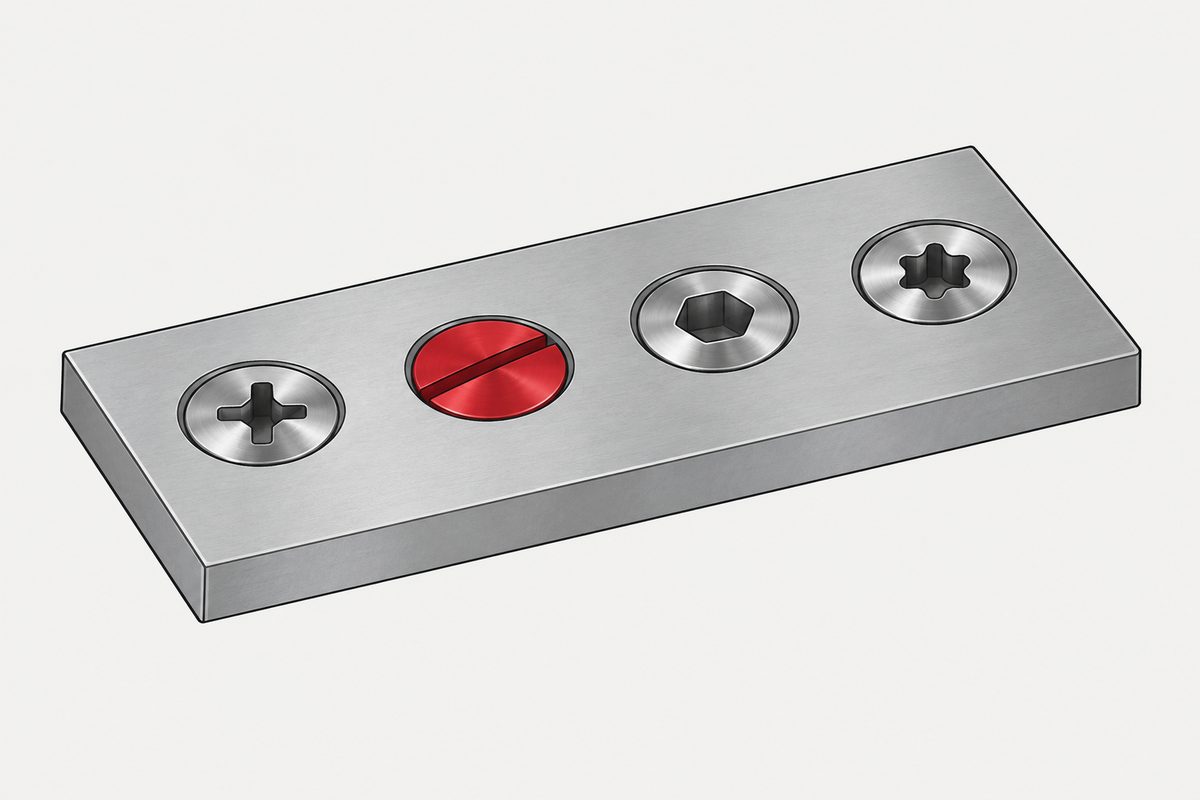
It is not a legacy specification
The first surprise. There is no single general standard for the slot — the geometry lives in each screw product standard's dimension tables. And those standards are current.
| Standard | Head |
|---|---|
| ISO 1207:2011 | Slotted cheese head, product grade A |
| ISO 1580:2011 | Slotted pan head |
| ISO 2009:2011 | Slotted countersunk flat head |
| ISO 2010:2011 | Slotted raised countersunk head |
All four were confirmed in 2026 and carry no obsolescence or “not recommended for new design” marking. The self-tapping equivalents ISO 1481, 1482 and 1483:2011 were confirmed the same year, and ISO 4766:2024 covers slotted set screws with flat point. This is a maintained family, not a survival.
Three standards divide the work, and it is worth knowing which does what: the screw product standard fixes the slot's width and depth; ISO 2380-1:2004 fixes the driver tip shape, dimensions and test torques; ISO 2351-1:2007 covers machine-operated slotted bits and recommends tip-and-bit combinations, referencing ISO 2380-1 Type C tips.
The three explanations, checked
| Claim | Verdict |
|---|---|
| “Electrical terminals require a slot” | Wrong |
| “The slot clears its own dirt and paint” | Unsourced |
| “You can grind a blade to fit” | Partly — but not as a reason it persists |
Electrical terminals. IEC 60999-1:1999 and 60999-2:2003 govern screw-type and screwless clamping units. They require the test screwdriver blade to suit the screw under test, and explicitly handle the hex-head-with-slot case, but nowhere require a terminal screw to be slotted. UL 486A-486B:2025 handles slotted, hex socket and square drives in separate torque tables — slotted is a tested, permitted option, not a mandated form. There is no standard preference to explain, because the preference does not exist in the standards.
Self-clearing. We found no standard, paper or engineering handbook supporting it, and no comparative test of slot against cross recess for contamination or paint fill. Scraping paint out along an open slot is a plausible thing to do; it is not an established property of the drive.
Grinding a blade. This one has real support: US Army tool maintenance instruction covers regrinding or filing a damaged slotted blade so the sides are parallel and the end square, then grinding to the thickness needed. But that supports dressing a blade to a size, not fitting any slotted screw — width, thickness, the hardened layer, material strength and overheating during grinding all constrain it. And we found no standard or study that lists field-grindability as a reason the drive is retained.
The torque comparison does not say what you expect
We looked for the number showing a slot carries less torque than a cross recess. The independent study we found reports no significant difference.
Hickok et al. (2014) compared straight, Phillips and ECX tips across 16 subjects. Applied torque ran about 2.61 to 2.97 N·m with no significant difference between the three; what did differ was that Phillips required lower mean axial force.
Read that carefully. It is a study of what a human can apply, not of what the recess walls can carry before they deform, and 16 subjects is a small sample. A separate study on specialised surgical screws put slotted and cross recess in the same higher-performing group at various off-axis angles, but the specimens were unusual and no general ratio was given. We could not find a torque-capacity ratio or a slip rate that generalises to ordinary ISO machine screws. Figures in circulation from bit or screw makers are vendor claims.
What actually goes wrong, and why the word cam-out misleads
The failure modes are clear even where the statistics are not.
- The blade slides sideways out of the slot end. This gets called cam-out, but it is closer to skating than to the axial climb-out of a cross recess: there is no geometric constraint in the second direction to stop the tip travelling along the slot.
- A blade that is too thin, too narrow, or tapered concentrates contact at the slot edges, which raises burrs, deforms the slot and damages the tip.
Both are why the safety guidance is specific: the Army instruction requires the blade sides to be parallel so the tool is not lifted out of the slot, and Canadian occupational-health guidance requires the blade width to match the slot to reduce slipping and injury. Fitting the blade is not fussiness; it is the drive's main control.
Why a cross recess climbs out instead is in why the driver slips.
Power driving: consistent advice, no prohibition
Technical writing consistently says the slot does not self-centre and the blade escapes under load, which makes power driving difficult. But no standard prohibits it — and ISO 2351-1:2007 is literally the standard for machine-operated slotted bits. So “the standards advise against it” is not a claim you can make.
What can honestly be said
We wanted to end on a clean idea: the slot is the only drive where the tool can be made to fit the screw rather than the screw having to fit an existing tool, which is why it still makes sense where the tooling is uncertain.
Only the first half of that survives. The slot does lack two-axis geometric constraint and does not self-centre, and that is consistent with sideways skating and with the difficulty of high-speed or automated driving. A flat blade is genuinely easier to dress in the field than a complex recess tip.
But we found no evidence it is the only such drive, no basis for “fits any slotted screw”, and nothing showing that this property is the actual reason the drive persists. The geometry is sound; the explanation is folklore that happens to be geometrically plausible.
The useful version. Slotted is a current, maintained standard family whose defining property is that it constrains the tool in one direction only. Everything practical follows from that — blade fit matters more than on any other drive, and automation is harder. Why it is still specified as often as it is, we could not source. If someone tells you, ask where they read it.
Where the drive sits among the other decisions is in specifying a screw; what bounds a drive at all is in what bounds the drive.
References
- ISO 1207:2011, ISO 1580:2011, ISO 2009:2011, ISO 2010:2011 — slotted cheese, pan, countersunk and raised countersunk head screws; confirmed 2026
- ISO 1481:2011, ISO 1482:2011, ISO 1483:2011 — slotted self-tapping screws; ISO 4766:2024 — slotted set screws with flat point
- ISO 2380-1:2004 — driver tips for slotted heads, dimensions and test torques; ISO 2380-2:2004 — blade lengths and marking; ISO 2351-1:2007 — machine-operated slotted bits
- IEC 60999-1:1999 and IEC 60999-2:2003 — clamping units; test blade must suit the screw, no slotted requirement
- UL 486A-486B:2025 — wire connectors; separate torque tables by drive form
- Hickok et al., 2014, DOI 10.1177/1541931214581329 — applied torque by tip type, 16 subjects
- Spencer et al., 2004, DOI 10.1016/j.joms.2003.07.008 — recess performance at off-axis angles, specialised screws
- US Army OD1621, Use and Care of Handtools and Measuring Tools; CCOHS, Hand Tools — Screwdrivers
Acceptance for any particular part is governed by your drawing and the standards it invokes.
This page covers step 4, the drive. The whole order is substrate, thread, head, drive, finish, documentation, and why doing it out of order is rework rather than a tweak is in specifying a screw.
Common questions
Is the slotted screw an obsolete standard?
No. The geometry lives in each screw product standard, and ISO 1207, 1580, 2009 and 2010:2011 for cheese, pan, countersunk and raised countersunk heads were all confirmed in 2026 with no obsolescence or not-recommended-for-new-design marking. The self-tapping equivalents ISO 1481 to 1483:2011 were confirmed the same year and ISO 4766:2024 covers slotted set screws. It is a maintained family.
Do electrical terminals have to use slotted screws?
Not according to the standards we checked. IEC 60999-1:1999 and 60999-2:2003 require the test screwdriver blade to suit the screw under test and explicitly handle hex heads with a slot, but do not require a terminal screw to be slotted. UL 486A-486B:2025 handles slotted, hex socket and square drives in separate torque tables, so slotted is a permitted and tested option rather than a mandated form.
Does a slot carry less torque than a cross recess?
The independent study we found says not significantly. Hickok et al. (2014) compared straight, Phillips and ECX tips across 16 subjects and reported applied torque of about 2.61 to 2.97 newton metres with no significant difference between the three; what differed was that Phillips needed lower mean axial force. That is a study of human applied torque rather than recess wall capacity, and we could not find a torque capacity ratio that generalises to ordinary ISO machine screws.
Why does a slotted screwdriver slip out?
Because the slot constrains the tool in one direction only. The blade slides sideways out of the end of the slot, which is closer to skating than to the axial climb-out of a cross recess. A blade that is too thin, too narrow or tapered also concentrates contact at the slot edges, raising burrs and deforming the slot. This is why safety guidance is specific about parallel blade sides and matching the blade width to the slot.
Can slotted screws be power driven?
There is no standard prohibition, and ISO 2351-1:2007 is specifically the standard for machine-operated slotted bits. Technical writing does consistently note that the slot does not self-centre and the blade escapes under load, which makes power driving harder, but "the standards advise against it" is not something you can claim.
Enquiries
If a design still calls for slotted and you are not sure why, send the drawing. The reason is sometimes a real one — a service requirement, a tool already in the field — and sometimes it is just what the last revision said.
Request a quotation
Tell us the part and the quantity. We will come back on feasibility, lead time and price.
Or email us directly sales@tigerfasteners.com