 TIGERFASTENERS
Stripped threads: which side actually failed
The short version: “stripped” is one word covering three different failures. The thread on the screw sheared, the thread in the hole sheared, or the recess in the head rounded out and no thread failed at all. They have different causes, they sit with different parties, and they need different fixes. The repair most people reach for first — run a bigger screw in — destroys the evidence needed to tell them apart, which is why the same joint tends to fail again.
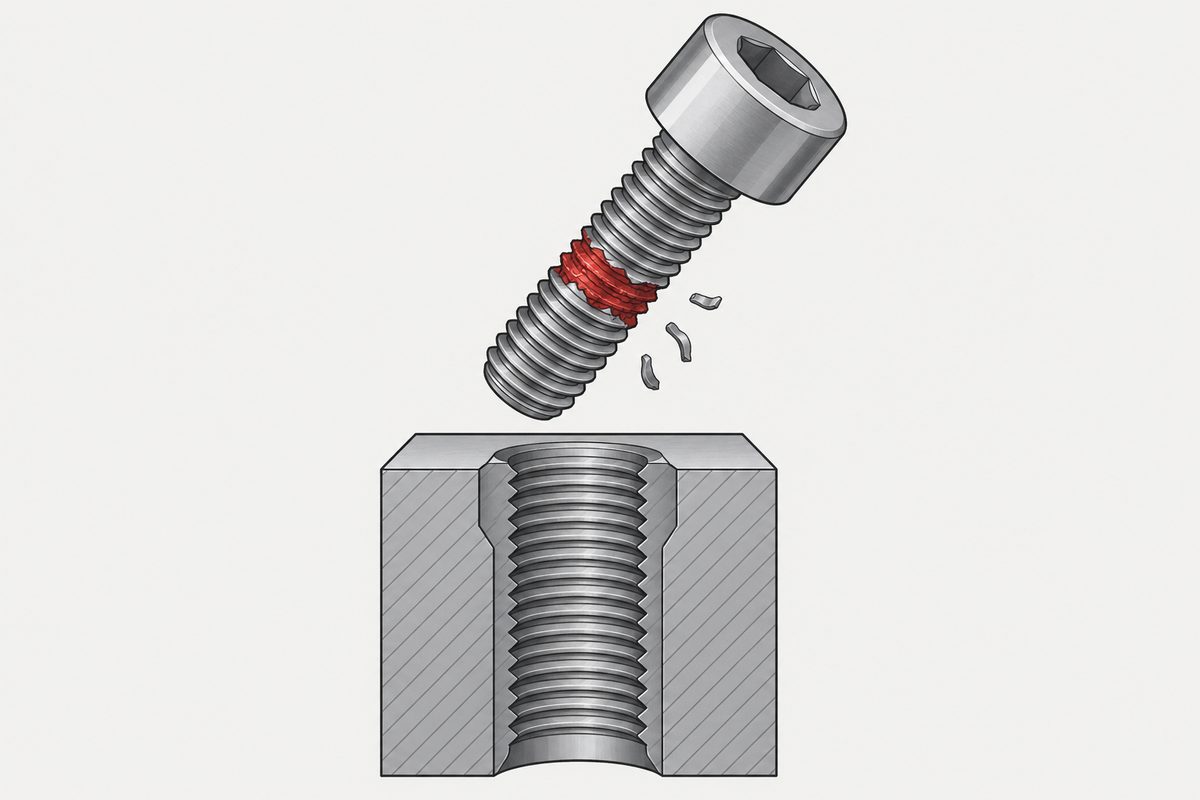
Three failures, one word
| Failure | What you see | Where the cause usually sits |
|---|---|---|
| Screw thread sheared | Threads on the screw flattened or missing over part of the length; hole threads look sharp | Specification — strength class, material pairing, or a hole that was too tight |
| Hole thread sheared | Screw threads intact; screw spins freely and will not pull down | Engagement length or parent material — usually too few threads in something soft |
| Recess rounded (cam-out) | Head recess is rounded; the screw is still tight and still holding | Driver, bit wear, or the wrong recess standard — nothing is wrong with the thread |
The third one is the one most often misfiled. A rounded recess feels like the screw failed, so it gets reported as a screw defect — but the joint is intact and the cause is on the tool side. Phillips and JIS recesses are visually almost identical and behave differently under torque, which produces exactly this complaint. English names the three separately, which is why “stripped” does not translate cleanly in either direction.
Three checks, before anything is repaired
- Back the screw out and look at its threads under magnification. Flattened crests over part of the length means the screw sheared. Sharp, undamaged threads means it did not
- Run a known-good screw into the hole by hand. If it spins in with no resistance and will not pull down, the hole failed
- Look at the recess before you look at anything else. If it is rounded and the screw is still clamping, you are looking at cam-out and the thread is a red herring
Do these before drilling, tapping or fitting an insert, because every one of those removes the surfaces that carry the answer. The five minutes spent here decide whether you fix this joint or fix every joint.
So the hole is the defective part — except that is often the design working
A threaded joint is deliberately designed so that one side is weaker, and the correct weak link is the screw, not the hole — a sheared screw costs a screw, a stripped housing costs the housing. The usual design rule is that the thread shear area should be comfortably greater than the screw’s tensile stress area, with a factor of roughly two, so that overload breaks the cheap part.
- If the hole stripped, that ratio was not achieved. Almost always this is engagement length in a soft parent material, not a bad screw
- Depth is not engagement. A deep hole with a short threaded portion, or a chamfer that eats the first turn, gives fewer working threads than the drawing suggests
- Below M3 the arithmetic gets unforgiving. One diameter of engagement buys fewer threads at a fine pitch, and losing one thread to a chamfer is a much larger proportion of the total
Which of the three possible failures the standard actually wants is set out in the nut has one number.
Four causes, in the order they are usually actually it
- Over-torque. The most common, and the least often measured. A driver set by feel or by an uncalibrated clutch delivers a spread, not a value — and friction decides how much of that torque becomes clamp force in the first place
- Not enough engagement. See above — this is a drawing problem that only appears in production
- Wrong pilot hole. Too tight raises driving torque until the screw shears; too loose leaves too little material to form a thread in. The correct size is a window, not a number
- Repeated disassembly on a self-formed thread. A self-tapping or thread-forming screw makes its thread on the way in. Every reassembly cuts or deforms it again, and each cycle removes material that is not coming back — in plastic this is the normal case rather than the exception
The last one is a design decision misread as a maintenance problem. If a joint will be opened more than a handful of times, a thread formed by the screw itself is the wrong choice — and no amount of torque control fixes that.
Repairs, and what each one costs you
| Repair | What it gives you | What it costs |
|---|---|---|
| Larger screw | Fastest, needs nothing new | Destroys the evidence, changes the part number, and moves the weak link — and changing the screw versus changing the housing has its own cost comparison — the joint is now non-standard and undocumented |
| Wire thread insert | Restores the original thread size, often stronger than the parent thread | Needs the correct drill and tap; most failures of the repair are wrong drill size or an uncleaned hole |
| Solid or moulded-in insert | The real fix for repeated disassembly, especially in plastic | Requires design change and tooling — not a field repair |
| Longer screw, more engagement | Addresses the cause rather than the symptom | Only available if there is depth to use, and it is a change that must be re-verified |
Note that the fastest repair is the only one that makes the next failure harder to diagnose. That is not an argument against ever using it — it is an argument for doing the three checks first, so the decision is made with the information rather than instead of it.
Before any of those, the question most people ask first: is there something you can pour in. Three of the four usual candidates are rated for something other than load.
The question that prevents the next one
How many times will this joint be opened over the product’s life? Once, and a thread formed by the screw is fine. Five times, and it is marginal. Twenty, and an insert was always the right answer and the stripped hole was only a matter of time.
If the screw itself is being changed to solve this, price the re-verification before switching — a different thread form, length or coating changes the friction and therefore the clamp force, which is a joint change rather than a part swap.
This page covers step 2, the thread. The whole order is substrate, thread, head, drive, finish, documentation, and why doing it out of order is rework rather than a tweak is in specifying a screw.
Common questions
How do you tell whether the screw or the hole is stripped?
Back the screw out and look at its threads under magnification. If the crests are flattened or missing over part of the length, the screw sheared. If the screw threads are sharp and undamaged but a known-good screw spins freely in the hole without pulling down, the hole failed. If the head recess is rounded while the screw is still clamping, no thread failed at all — that is cam-out, and the cause is on the driver side.
Why does the hole strip instead of the screw?
A threaded joint is designed so one side is the weak link, and the correct weak link is the screw, because a sheared screw costs a screw while a stripped housing costs the housing. The usual rule is that the thread shear area should exceed the screw tensile stress area by a factor of roughly two. If the hole stripped, that ratio was not achieved — normally because there were too few engaged threads in a soft parent material, not because the screw was faulty.
Is a wire thread insert better than using a larger screw?
For diagnosis and documentation, yes. A wire thread insert restores the original thread size and is often stronger than the parent thread, so the part number and the drawing stay valid. Running a larger screw changes the part, moves the weak link, and destroys the surfaces needed to establish what failed — so the same joint tends to fail again with no record of why.
Why do self-tapping screws strip after a few reassemblies?
A self-tapping or thread-forming screw creates its thread as it is driven. Every reassembly cuts or deforms that thread again, and each cycle removes material that does not come back. If a joint will be opened more than a handful of times over the product life, a thread formed by the screw itself is the wrong choice and a moulded-in or pressed-in insert was always the right one. Torque control does not fix this.
References
- ISO 898-1 — Mechanical properties of fasteners made of carbon steel and alloy steel (property classes and proof loads)
- Roy Mech — Screw thread stress area calculations (tensile stress area and thread shear area)
- Screw thread — Wikipedia
Enquiries
Stripping in production and not sure which side is failing? Send photographs of the backed-out screw, the hole, and the head recess, plus the parent material and the tightening torque. Those three photographs usually separate the three cases — including the common one where nothing is wrong with the screw and the driver setup is what needs to change.
Request a quotation
Tell us the part and the quantity. We will come back on feasibility, lead time and price.
Or email us directly sales@tigerfasteners.com