 TIGERFASTENERS
The nut has one number, and it is not the nut’s strength
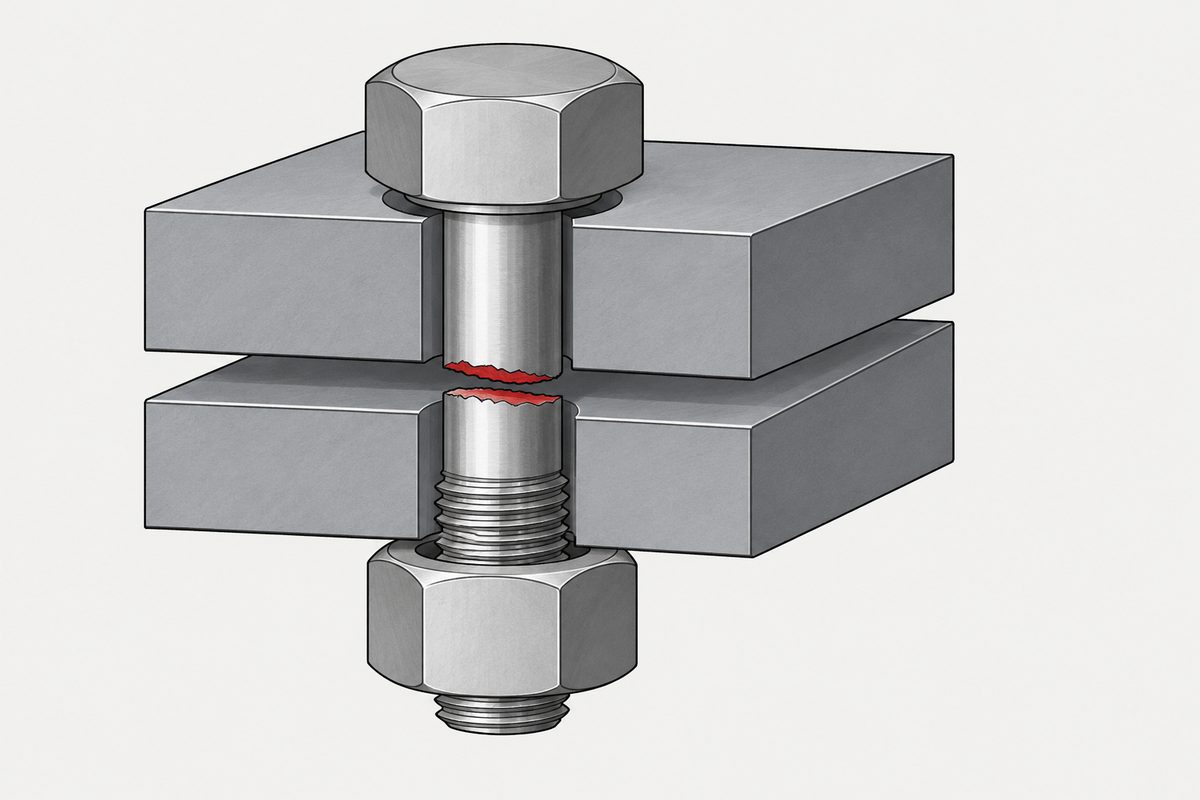
A bolt carries two numbers and the nut that goes with it carries one. That asymmetry is not an abbreviation. The nut's number describes something about the bolt, and behind it sits a design intent the standard states explicitly: when the joint is overloaded, the bolt is supposed to be what breaks.
What each number is actually saying
On a bolt, ISO 898-1 builds the designation from two properties of the material. The left number times 100 is the nominal tensile strength in MPa; the right number divided by 10 is the nominal ratio of yield to tensile. So 8.8 means 800 MPa nominal tensile with a nominal yield ratio of 0.8, giving 640 MPa nominal yield.
The nut's single number is not its own tensile strength. ISO 898-2 clause 5.2.1 makes it the left digit of the highest bolt class the nut may be paired with — one hundredth of that bolt's nominal tensile strength. A class 8 nut goes up to 8.8, a class 10 up to 10.9, a class 12 up to 12.9.
That is why the numbers look like they match. They match because one of them was defined in terms of the other.
| Nut class | Highest bolt class it may pair with |
|---|---|
| 5 | 5.8 |
| 6 | 6.8 |
| 8 | 8.8 |
| 10 | 10.9 |
| 12 | 12.9 |
Full-loadability classes are 5, 6, 8, 10 and 12. There is no class 4 in the current edition. Thin nuts have their own classes, 04 and 05, and that leading zero means the same thing it means on a button head screw — see marked 08.8.
Stainless nuts are a different system again, under ISO 3506-2:2020, marked A2-70 and the like. Those designations do not carry the class 8 / class 10 meaning across.
The standard says which part should fail
ISO 898-2:2022, Annex B.1 sets out three loads competing to be the lowest:
- the load at which the nut's internal thread strips;
- the bolt's ultimate tensile load;
- the load at which the bolt's external thread strips.
The assembly fails at whichever is lowest. And the standard states the intent plainly: fracture of the bolt after elongation in the free threaded length is the expected failure mode when a bolt-and-nut assembly is overloaded. ISO 16224:2026 — which replaced the withdrawn ISO/TR 16224:2012 — keeps the same principle at clause 5.1.
Two limits on how far to take that. Annex B is informative, not a per-part guarantee, and it describes correctly paired, compliant assemblies inside the standard's own range of geometry and material. It does not promise that every real joint fails bolt-first under fatigue, corrosion, hydrogen embrittlement, eccentric loading or incomplete engagement.
Why prefer a broken bolt? ISO 16224 clause 5.1 puts it carefully: fracture after elongation shows the assembly reached its full load capacity, whereas thread stripping that occurred locally during tightening can be difficult to detect and can leave the joint with reduced clamp force or reduced in-service capacity. The older ISO 898-2:2012 Annex A.1 said it more bluntly — fracture of the loaded thread section on over-tightening gives a clear indication that tightening failed.
The equivalent argument for a thread tapped into the parent material, rather than a nut, is in the design target: put the weak link on the screw.
The mechanism is not the one we assumed
The obvious guess is that the standard simply makes the nut's proof load higher than the bolt's ultimate tensile load, so the bolt always loses first. We were going to write that. It is not true.
| Size | Nut proof load | Bolt Fm,min | Ratio |
|---|---|---|---|
| M6, 8 / 8.8 | 17,200 N | 16,100 N | 1.068 |
| M8, 8 / 8.8 | 31,800 N | 29,200 N | 1.089 |
| M10, 8 / 8.8 | 50,500 N | 46,400 N | 1.088 |
| M6, 10 / 10.9 | 20,900 N | 20,900 N | 1.000 |
| M8, 10 / 10.9 | 38,100 N | 38,100 N | 1.000 |
| M10, 10 / 10.9 | 60,300 N | 60,300 N | 1.000 |
| M6, 12 / 12.9 | 23,100 N | 24,500 N | 0.943 |
| M8, 12 / 12.9 | 42,500 N | 44,600 N | 0.953 |
| M10, 12 / 12.9 | 67,300 N | 70,800 N | 0.951 |
At class 10 the two are exactly equal, and at class 12 the nut's proof load is below the bolt's minimum ultimate tensile load. So the ordering of those two numbers cannot be the mechanism.
The reason it still works is that proof load is not the stripping load. It is a non-destructive acceptance threshold: the nut is put on a hardened mandrel — 45 to 50 HRC, thread 5h6g — loaded axially, held for 15 seconds, and must come off by hand afterwards, with at most a half turn by spanner to start it. No significant plastic deformation, stripping, cracking or fracture. The actual load at which the thread would strip is normally higher than that threshold.
What actually controls the failure mode is the combination the standard designs around: nut height, effective engagement, hardness, pitch, diameter and the tolerances — evaluated through the Alexander model in Annex B. The proof load is how you check a delivered nut, not how the outcome is engineered.
A footnote the standard puts in itself
Divide those proof loads by the nominal stress area and you get roughly 856 to 871 MPa for class 8, about 1,040 for class 10, and 1,149 to 1,161 for class 12. But Annex C of the same standard lists different figures for calculation: 860 / 1,040 / 1,150 MPa for M5 to M7, and 885 / 1,040 / 1,180 MPa for M8 to M10.
Annex C says why. In the 2022 revision the normative proof-load table was only updated where the recalculated value differed by more than 5%, so the normative Table 5 and the Annex C calculation stresses do not agree. For purchasing and acceptance, use the newton values in Table 5. If you are calculating, know which of the two you have picked up.
Height, and the third style
ISO 898-2 sorts nuts by height relative to the thread diameter D:
- Style 0, thin nuts: 0.45D ≤ mmin < 0.80D
- Style 1, regular nuts: 0.80D ≤ mmin < 0.89D
- Style 2, high nuts: mmin ≥ 0.89D
| Size | ISO 4032 style 1, mmin | ISO 4033 style 2, mmin | Difference |
|---|---|---|---|
| M6 | 4.90 mm | 5.40 mm | +0.50 |
| M8 | 6.44 mm | 7.14 mm | +0.70 |
| M10 | 8.04 mm | 8.94 mm | +0.90 |
A style 2 nut does not get a higher proof load for the same class — the proof load comes from the same Table 5. The extra height buys effective engagement and thread shear area, which lets some high-class and large-size combinations avoid stripping at lower hardness or under different heat treatment. You can see the consequence in the coverage: in coarse pitch, class 12 in style 1 is listed only to M16, while style 2 reaches M39.
Thin nuts, ISO 4035:2023 style 0, carry classes 04 and 05 — reduced loadability, marked with that leading zero. A thin nut is not a lock nut and not a cheaper regular nut.
Substitution, and the exception
ISO 898-2 clause 6 permits a higher-class nut to be used in place of a lower one. That is the safe direction, and it is written into the standard rather than being folk practice.
The exception is prevailing-torque nuts, which clause 6 excludes explicitly. A prevailing-torque nut must be the corresponding class; you cannot substitute upward. This is the part we would have got wrong — we also assumed prevailing-torque nuts marked their property class differently. They do not. ISO 2320:2015 governs the functional prevailing-torque requirements, while the steel nut's mechanical properties and its class marking still come from ISO 898-2.
Going the other way — a lower-class nut on a higher-class bolt — is not a specified combination under Table 2. The standard does not say it will strip; it says you have left the pairing the design assumption was built on, which raises the risk that a thread rather than the bolt becomes the lowest of the three loads.
And raising both a class does not scale the joint up with them. It raises the bolt's proof, yield and tensile capacity, which may allow a higher preload — but whether the assembly gets stronger depends on the parent material's threads, bearing pressure, slip, fatigue, geometry and how well the tightening is controlled. ISO 898-1's own scope excludes shear, torque/clamp-force and fatigue performance. What the tightening method contributes is in how badly your tightening method controls preload.
One more boundary worth knowing before this page gets used as a general rule about nuts. All of it assumes the nut is inside ISO 898-2, and a nut that is meant to be welded is not: the scope excludes weldability, and the weld nut standard issues a proof load rather than a class. A weld nut does not have a property class works through what replaces it. The 2022 edition also deleted class 9 outright, and named class 10 as its substitute.
What to put on the drawing
- The nut class, not just “a nut to suit”. Class 8, 10 or 12 selects the pairing.
- The style if it matters. Style 1 and style 2 are different parts with different heights, and at class 12 in coarse pitch the size coverage differs.
- Whether a prevailing-torque nut is required, remembering that upward substitution is not permitted for those.
- For stainless, the ISO 3506-2 designation — not a carbon-steel class number.
- If someone is calculating from proof stress rather than proof load, which of the standard's two sets of numbers they used.
Where this connects
The same design intent for a tapped hole instead of a nut is in thread engagement, and what stripping actually looks like when it happens is in three failures, one word. What the two numbers on a bolt mean is in property class numbers. Why a thin nut is the part that ends up not carrying the working load in a double-nut assembly — and why ISO once specified the tightening order and no longer does — is in which nut goes first.
References
- ISO 898-2:2022, fourth edition — clause 1 (scope, M5–M39 coarse, styles 0/1/2, s ≥ 1.45D), 5.1 (styles by height), 5.2.1 (what the class number means), clause 6 and Table 2 (pairing and substitution, prevailing-torque exclusion), 8.2 and Table 5 (proof loads), 10.1.3–10.1.6 (proof load test), Table 3 (style and size coverage), Annex B.1 (three competing loads, expected failure mode), Annex C and Table C.1 (calculation stresses, and the stated inconsistency)
- ISO 898-1:2013, fifth edition — clause 5 and Table 1 (designation), Table 3 (tensile strengths), Table 4 (stress areas and Fm,min); clause 1 excludes shear, torque/clamp-force and fatigue
- ISO 16224:2026 clause 5.1 — replaced the withdrawn ISO/TR 16224:2012; ISO 898-2:2012 Annex A.1 for the earlier wording
- ISO 4032:2023 (hexagon regular nuts, style 1); ISO 4033:2023 (hexagon high nuts, style 2); ISO 4035:2023 (hexagon thin nuts, style 0)
- ISO 3506-2:2020 (stainless nuts); ISO 2320:2015 (prevailing-torque nuts, functional properties)
- ISO 898-3:2018 + Amd 1:2020 (washers); ISO 898-5:2012 (set screws); ISO 898-7:1992 (torsional test). ISO 898-6:1994 was withdrawn and merged into ISO 898-2 in 2012.
Acceptance for any particular joint is governed by your drawing and your own calculation.
This page covers step 2, the thread. The whole order is substrate, thread, head, drive, finish, documentation, and why doing it out of order is rework rather than a tweak is in specifying a screw.
Common questions
Why does a bolt have two numbers and a nut only one?
On a bolt the two numbers describe the material: the left one times 100 is the nominal tensile strength in megapascals and the right one divided by 10 is the nominal ratio of yield to tensile. The nut’s single number is not its own strength at all. ISO 898-2 defines it as the left digit of the highest bolt class the nut may be paired with, so a class 8 nut goes with bolts up to 8.8 and a class 10 nut with bolts up to 10.9.
Which part is supposed to fail first, the bolt or the thread?
The bolt. Annex B of ISO 898-2:2022 lists three competing loads, the nut thread stripping, the bolt breaking in tension and the bolt thread stripping, and states that fracture of the bolt after elongation in the free threaded length is the expected failure mode when the assembly is overloaded. ISO 16224:2026 keeps the same principle. Note that the annex is informative and describes correctly paired compliant assemblies, not a guarantee for every real joint.
Is the nut’s proof load higher than the bolt’s tensile strength?
Not always, and this is where the common explanation breaks down. For class 8 with 8.8 bolts the ratio is about 1.07 to 1.09, for class 10 with 10.9 it is exactly 1.000 at M6, M8 and M10, and for class 12 with 12.9 it is about 0.94 to 0.95, meaning the nut proof load is lower. Proof load is a non-destructive acceptance threshold rather than the stripping load, and the failure mode is controlled through height, engagement, hardness, pitch, diameter and tolerances.
What does the proof load test actually do?
The nut is threaded onto a hardened test mandrel of 45 to 50 HRC with a 5h6g thread, loaded axially to the value in Table 5 of ISO 898-2, and held for 15 seconds. After unloading it must be removable by hand, with at most a half turn by spanner to start it, and must show no significant plastic deformation, thread stripping, cracking or fracture. It verifies that the nut remains usable at that load, not the load at which it would eventually strip.
Can a higher class nut be used in place of a lower one?
Yes for ordinary nuts. Clause 6 of ISO 898-2 permits substitution upward. The exception is prevailing-torque nuts, which the same clause excludes explicitly: those must be of the corresponding class. Their mechanical properties and class marking still come from ISO 898-2, with ISO 2320 covering the functional prevailing-torque requirements, so the marking system is not different, only the substitution rule.
What is the difference between a style 1 and a style 2 nut?
Height. ISO 898-2 defines style 1 as a minimum height between 0.80 and 0.89 times the thread diameter and style 2 as at least 0.89 times. For M6, M8 and M10 the minimum heights are 4.90, 6.44 and 8.04 millimetres in ISO 4032 style 1 against 5.40, 7.14 and 8.94 in ISO 4033 style 2. The proof load for a given class is the same for both; the extra height buys engagement and thread shear area, which is why class 12 in coarse pitch is listed only to M16 in style 1 but reaches M39 in style 2.
Are thin nuts just cheaper regular nuts?
No. Thin nuts are style 0 under ISO 898-2, covered by ISO 4035:2023, and they carry classes 04 and 05. The leading zero indicates reduced loadability, the same convention used on button head screws. They are not lock nuts either, and they are not a substitute for a regular nut of the same nominal size.
Enquiries
When you send a bolt specification, say which nut class goes with it, and whether a prevailing-torque type is required. Those two lines decide more about how the joint fails than most of the rest of the drawing.
Request a quotation
Tell us the part and the quantity. We will come back on feasibility, lead time and price.
Or email us directly sales@tigerfasteners.com