 TIGERFASTENERS
A Weld Nut Does Not Have a Property Class
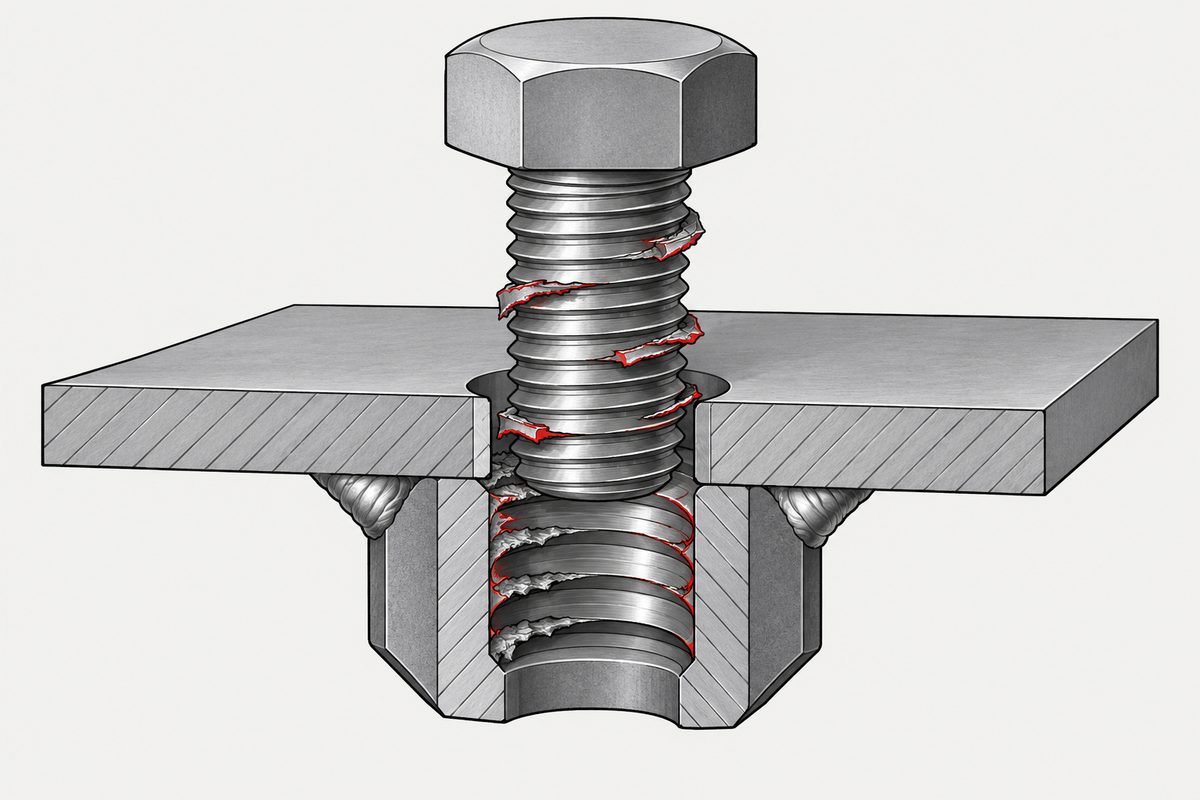
Somebody in heavy industry posted that class 9 weld nuts were stripping at 240 N·m, with the thread coming away on the bolt and half of each thread wall sheared and half burnished. Four of the twelve replies landed on the same explanation independently: the welding heat ruined the heat treatment. Go and check the standards and that answer has a problem in front of it.
Class 9 is not in the standard any more
ISO 898-2 lists the nut property classes, and the 2022 fourth edition lists 04, 05, 5, 6, 8, 10 and 12. The change list at the front of that edition says plainly that property class 9 has been deleted completely. The introduction gives the reason, missing or decreasing market need, and it also gives the replacement: class 5 and class 9 are substituted by class 6 and class 10 respectively.
So a nut marked 9 is not wrong, it is from the previous edition, and the class it maps to now is 10, not 8. That matters if anybody reaches for a substitute in the middle of an investigation. Which classes exist, what each number promises and when substitution is allowed is the nut has one number.
The second thing that standard says is more useful here. ISO 898-2 states in its scope that it does not specify weldability. It sits in a short list with prevailing torque, torque and clamp force, and corrosion resistance. So the moment a nut is meant to be welded, the document that defines property classes has stepped back from it, and something else has to specify the part.
What the weld nut standard specifies instead
ISO 21670 covers hexagon weld nuts with flange, M5 to M16. Read its technical delivery clause and you find a part specified along a completely different axis.
- Weldability first. The steel is capped at 0.25% carbon and a carbon equivalent of 0.53%, computed as C plus Mn/6 plus (Cr+Mo+V)/5 plus (Ni+Cu)/15. Free-cutting steel is not permitted.
- Quench and temper is optional, and capped. The standard's own designation example is Weld nut ISO 21670 - M10 - St, and it spells out what that means: made of steel, not quenched and tempered, suitable for use with a bolt or screw of property class 10.9. A quenched and tempered nut adds QT to the designation, and then the hardness shall not exceed 300 HV. Carbon that would take hardness higher is exactly the carbon the weldability limit has already spent.
- Strength appears as proof load, not as a class. Table 2 gives one number per size: 14 800 N at M5, 60 300 N at M10, 88 500 N at M12, 164 900 N at M16. The test method is borrowed from ISO 898-2. The class system is not.
- The thread is 6G. Not 6H. Product grade A, thread to ISO 724 with tolerance class 6G per ISO 965-3. What the letter and the number each control is thread tolerance classes.
- It ships uncoated, and any corrosion protection the manufacturer applies must not impair weldability. So the usual plating conversation does not happen here. What plating normally costs you in thread fit is plating and thread tolerance.
- The marking is the manufacturer's mark. That is the whole requirement, on the face opposite the flange, M5 and up. There is no class marking, because there is no class. What a class mark means when there is one is a mark is a claim, not a certificate.
The conformity test deletes the weld
One line in the mechanical properties clause is worth the price of the standard. The nut has to meet the Table 2 proof load, tested to ISO 898-2, and then: in case of dispute, welding projections shall be removed prior to testing.
Read that as a statement about what the number covers. The proof load is verified on a nut that is not attached to anything, with the projections that make it a weld nut machined off first. It characterises the threads and the body. It says nothing about the joint you actually built. The weld, the sheet, the hole and the heat are all outside the figure, and none of them appear anywhere in the mechanical properties clause.
That is not a defect in the standard. It is the only way to get a repeatable number. It does mean that a proof load quoted from a catalogue is not a promise about a nut on your part, in the same way that a nut's class is a statement about the nut rather than about how much thread your parent material actually holds, which is when the parent cannot be the nut.
So what about the heat treatment theory
It is the natural hypothesis and it deserves a straight answer, because the standards put two obstacles in front of it and neither is obvious.
The first is that the default part has no heat treatment to lose. ISO 21670's own designation example describes the plain steel weld nut as not quenched and tempered, with QT as the thing you have to ask for. If the nut on the line is the default, welding cannot have tempered a martensitic structure that was never there. And if it is the QT version, the ceiling is 300 HV, so the distance the hardness could fall is small to begin with.
The second obstacle is in the test everyone reaches for. ISO 898-2 explains that ISO 18265 offers no hardness to tensile strength correlation for steel in the work-hardened condition typical of cold-forged non-quenched-and-tempered nuts. For those nuts the minimum hardness is informative only and is not a criterion in case of dispute. The maximum, 334 HV, is the mandatory one, and it exists to catch unintended processing that would make the nut brittle. Sending failed parts for a hardness check can therefore come back with a number that settles nothing, and the useful version of that same test is the one looking for a value that is too high.
None of this proves the welding was innocent. It says the hypothesis has to be reframed before it can be tested, and that the obvious test may not be able to answer it. Reading a stripped thread for what actually failed is stripped threads, and the burnished half of a torn flank has its own reading in why stainless galls.
A graded bolt gives the opposite answer to the same suspicion, because there the quench and temper is exactly what the class number describes and the standard states a minimum tempering temperature for it. What decides the argument on either part is whether it was ever in the condition the argument assumes.
The table nobody opens
ISO 21670 ends with connecting dimensions, and this is the part that quietly decides whether a weld nut installation is inside the standard at all. Each thread size gets a minimum and maximum plate thickness and a hole diameter to H11.
| Thread | Plate thickness, min | Plate thickness, max | Hole diameter H11 |
|---|---|---|---|
| M6 | 0,88 mm | 1,8 mm | 8,0 mm |
| M8 | 1,0 mm | 2,0 mm | 10,5 mm |
| M10 | 1,25 mm | 2,5 mm | 12,5 mm |
| M12 | 1,5 mm | 3,0 mm | 14,8 mm |
| M16 | 2,0 mm | 4,0 mm | 18,8 mm |
The maximum is the one that surprises people. An M12 weld nut is specified against a plate between 1,5 and 3,0 mm. Put it on a 6 mm bracket because the bracket happens to be there and the welding parameters, the projection collapse and the heat path are all outside what the dimensions assume. The hole matters too: it is a clearance for the pilot, and an H11 hole is a specification rather than whatever the laser left.
What to settle before the weld nut goes on the drawing
- Name the standard, not the class. A weld nut called up by class is calling up something ISO 21670 does not issue. The designation the standard does issue looks like Weld nut ISO 21670 - M12 - St, and the QT suffix is a separate decision with a 300 HV ceiling attached.
- Check the plate against Table 3. Both ends of the range, not just the thin end.
- Ask what the torque figure is based on. ISO 21670 gives a proof load and no torque, and ISO 898-2 says in its scope that it does not specify torque or clamp force properties. Any tightening spec for a welded joint came from somewhere else, and that somewhere is worth naming.
- Ask whether the proof load was verified with the projections removed. The standard says that is what happens in a dispute, so it is the state the number describes.
This is not one of the six steps. It shows up across them, or after assembly. Where the decisions that lead here were made is in specifying a screw, which sets out the order and why doing it out of order is rework.
Common questions
Is there such a thing as a class 9 nut?
There was. ISO 898-2:2012 included property class 9 and the 2022 fourth edition deleted it completely, giving decreasing market need as the reason. The same introduction states the substitution: class 5 and class 9 are replaced by class 6 and class 10 respectively. So a nut marked 9 is an older-edition part rather than a nonconforming one, and the class it maps to now is 10.
Why does a weld nut have a proof load but no property class?
Because the two requirements pull against each other. A property class above the low classes is reached with carbon and heat treatment, and ISO 21670 caps carbon at 0.25% and the carbon equivalent at 0.53% so the nut can be welded at all. It then specifies the strength directly as a proof load per size, and allows an optional quenched and tempered version with hardness limited to 300 HV. Strength is stated as a load rather than inferred from a class.
Does welding destroy the heat treatment of a weld nut?
The question needs the designation first. ISO 21670 describes the plain steel weld nut as not quenched and tempered, so on a default part there is no martensitic structure for the weld heat to temper. If the part is the QT version, the standard caps hardness at 300 HV, so the range available to lose is narrow. That does not clear the welding process of causing a failure, but it does mean the loss-of-heat-treatment story cannot be assumed and has to be established for the specific part.
We sent failed nuts for hardness testing. Will that tell us anything?
It can, but read what ISO 898-2 says about the limits first. For non-quenched-and-tempered nuts, which is what cold-forged high-volume nuts usually are, the minimum hardness is informative only and is explicitly not a criterion in case of dispute, because ISO 18265 carries no hardness to tensile correlation for work-hardened steel. The maximum of 334 HV is the mandatory limit and it exists to catch processing that has made the nut brittle. So a low reading proves less than people expect and a high one proves more.
Can we put an M12 weld nut on a 6 mm plate?
Not within ISO 21670. Its connecting dimensions table specifies a plate thickness of 1,5 to 3,0 mm for M12 along with a 14,8 mm H11 hole. Thicker plate is not automatically a stronger joint here, because the projection collapse and heat path the design assumes have both changed. If the plate has to be thicker, that is a decision to take with the welding process rather than by reading the nut catalogue.
References
- ISO 21670:2014 — Fasteners, hexagon weld nuts with flange; 4.2 material and carbon equivalent, 4.3 tolerance class 6G, 4.4 proof load and removal of projections, 4.5 uncoated delivery, clause 5 designation, clause 6 marking, clause 7 and Table 3 connecting dimensions
- ISO 898-2:2022 — nuts with specified property classes; clause 1 scope, including the exclusion of weldability, and the introduction on the deletion of class 9 and on hardness for non-quenched-and-tempered nuts
- ISO 965-3 — ISO general purpose metric screw threads, deviations for constructional threads (the source of tolerance class 6G)
- ISO 18265 — metallic materials, conversion of hardness values (cited by ISO 898-2 for why the correlation does not hold in the work-hardened condition)
Both ISO documents were read from the publicly available preview PDFs, which for ISO 21670:2014 carry the complete technical delivery clauses and both tables, and for ISO 898-2:2022 carry the scope, foreword and introduction but not the property tables. Clause content quoted here comes from those pages; anything from the ISO 898-2 tables should be checked against a purchased copy. ISO 21670 covers hexagon weld nuts with flange only. Square weld nuts, weld nuts without flange, clinch nuts and rivet nuts are separate documents with their own material and dimensional rules, and none of the figures here transfer to them. The ISO 965-3 and ISO 18265 catalogue numbers were not cross-checked against a second source.
Enquiries
If the enquiry is for weld nuts, send the plate thickness and the hole diameter with the thread size. ISO 21670 specifies a range for both, and whether your sheet is inside it changes the answer before anything about the nut does.
Request a quotation
Tell us the part and the quantity. We will come back on feasibility, lead time and price.
Or email us directly sales@tigerfasteners.com