 TIGERFASTENERS
When the parent material cannot be the nut
The short version: an insert usually does raise what the joint can take, and it also moves where the joint fails. A tapped hole asks a small area of thread in the parent material to carry shear; an insert puts a harder thread in the middle and asks a much larger interface to resist being pulled out and spun round. The capacity is the reason to fit one. The relocated failure is the part people forget — pull-out and torque-out are not what you were testing for before.
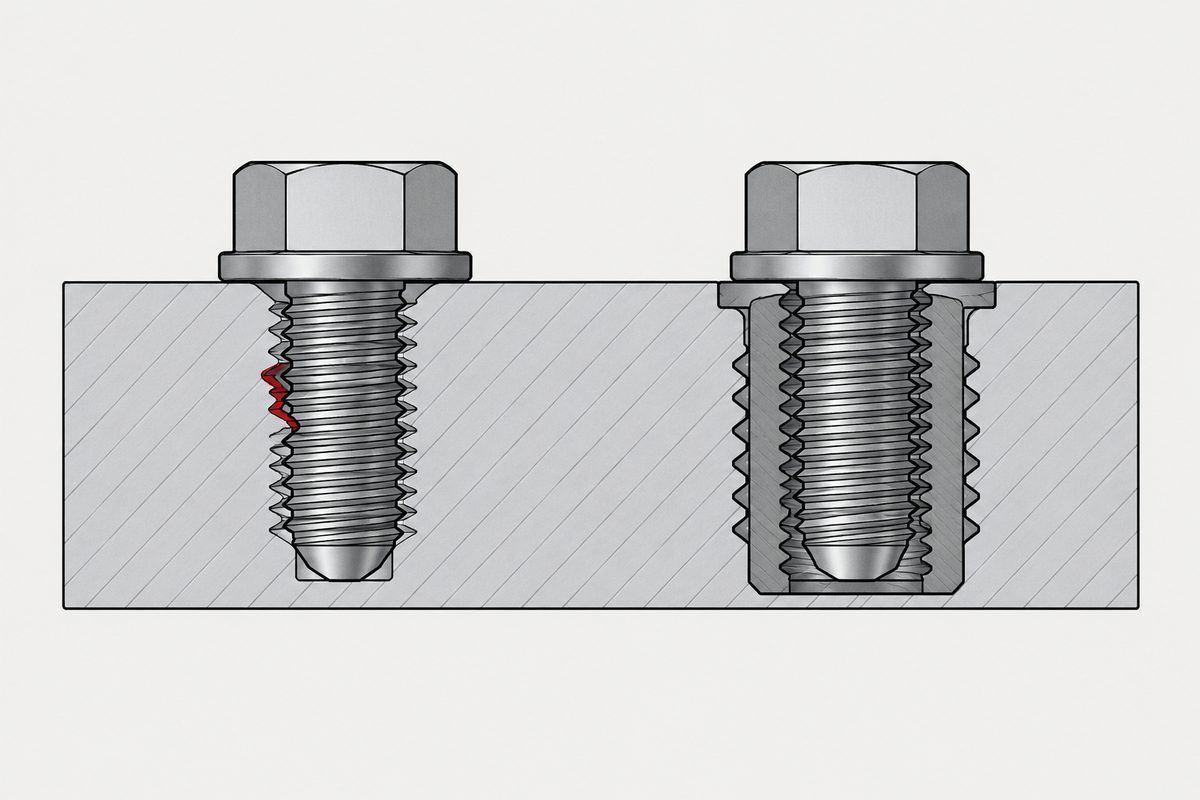
Three reasons the parent cannot be the nut
The decision order starts with the substrate because the substrate decides what a thread can be. Sometimes the answer is that it cannot be one:
- The thread would fail before the screw does. A joint is meant to break at the cheap part, and when the hole strips instead, the shear area ratio was never achieved. In a soft parent, getting there can need more engagement length than the part has depth for
- It will not survive being opened again. Every reassembly re-forms a plastic thread, and the material removed does not come back. If the answer to how many times does this open is more than once or twice, the thread is a candidate to live in something harder than the housing — where the line actually falls depends on the resin, the screw and the torque, and is worth establishing by test rather than by rule
- It would relax even unopened. Polymers creep, and preload leaks away through the thread flanks and the bearing face while nothing visibly breaks
What the insert actually changes
Capacity, usually upward — a metal thread in a plastic housing takes more torque and more load than a formed one. But the part that changes the engineering is where the load is carried and in what mode.
| Tapped into the parent | Through an insert | |
|---|---|---|
| Load path | Screw thread into parent thread | Screw thread into insert; insert into parent over its outer surface |
| Area carrying it | Small, concentrated at the first engaged threads | Large, spread over the knurled outside of the insert |
| How it fails | Thread strips | Pull-out or spin-out — the insert leaves the boss, or turns in it |
| What you test | Strip torque, thread engagement | Pull-out force axially, and rotation under torque — and you have to watch which one moved |
Which is why "we added an insert" is only half an answer to a strength question. It usually buys capacity and it relocates the weakest link to the insert-to-boss interface, and that interface has its own geometry to get right. Knurl form is part of it — coarser knurls resist turning better and load the plastic harder, straight and helical patterns favour torque-out and pull-out differently — but the boss around it matters at least as much.
What each type assumes
- Heat-set and ultrasonic. Assume a thermoplastic that can be locally melted or plasticised so it flows into the knurls and undercuts. Tip temperature is set relative to the resin, and overshooting degrades the material the insert is meant to anchor in — but controlled local melting is the mechanism, not a failure of it. Both assume a boss designed for the insert rather than one designed for a screw
- Moulded-in. Assumes you own the tool and can accept the cycle-time and handling cost, in exchange for the parent forming around the insert instead of being pushed aside
- Press-in. Assumes a hole held to a tolerance, because the grip is an interference fit and the interference is the dimension that matters
- Expansion. A different mechanism: the insert is set first and then expanded outward by the screw or by the installation tool, so the retention is created during assembly rather than during insertion
- Wire thread inserts. Assume a hole tapped to receive them — most often in metal, though there are plastics versions installed the same way. They put a harder thread into a softer material, or repair one that has already failed
- Blind rivet nuts. Assume sheet, where there was never enough depth for a thread and the fastener has to bring its own
The list is not a ranking. Each one is answering a different question about what the parent is and what tooling exists.
So fit an insert — and here is how that buys nothing
Adding an insert without changing the boss. I have no frequency data for this and will not pretend otherwise, but it is the one worth checking first because it is invisible on the drawing. A boss sized for a thread-forming screw is a different part from a boss sized for an insert — different hole, usually different wall. Drop an insert into the old geometry and the failure moves from the thread to the boss without getting any better.
An insert that pulls out often points at a boss that was too shallow, a hole too large, or too little material around it. One that spins often points at a thin wall, poor knurl engagement, or a tightening torque higher than the surrounding material can hold. Insert geometry does matter — length, knurl form and undercuts change both numbers — but if the boss is the binding constraint then a different insert moves it rather than removes it, and the boss is the part that needs designing either way.
What to settle before specifying one
- How many times does this joint open? That is the question the insert exists to answer, and if it is zero the insert may be solving nothing
- What is the parent, exactly? Thermoplastic, thermoset, filled, cast, sheet — each rules out different installation methods
- Is the boss being redesigned, or reused? Reusing it is the assumption worth making explicit, because nothing on the drawing flags it
- Who measures pull-out and torque-out, on moulded parts? Not calculated, and not on a test block — on the part
The same question — what will the parent do — also decides how the holes should be arranged: why fastener holes are staggered, and what the design codes actually pay you for it.
For sheet specifically, the thickness floor and what an extruded hole is really worth are in when the sheet is too thin to hold a thread.
Before deciding the parent cannot hold a thread, check what the parent actually is — a die casting is not one material.
When the parent is masonry rather than metal or plastic, the thread is abandoned altogether and the load goes into resin and interlock. What the European assessment document requires before a number may be published for that is in five pull-outs in your brick, minus 3,4 standard deviations.
This page covers step 1, the substrate. The whole order is substrate, thread, head, drive, finish, documentation, and why doing it out of order is rework rather than a tweak is in specifying a screw.
Common questions
Does a threaded insert make the joint stronger?
Usually yes, and it also changes where the joint is weakest, which is the part that catches people. A metal thread in a plastic housing takes more torque and more load than a thread formed in the plastic itself, and the load spreads over the knurled outside of the insert into a much larger area of the boss. But it introduces two failure modes a tapped hole does not have — the insert pulling out of the boss, and the insert spinning in it — so the capacity gain comes with a new weakest link that has to be designed and tested for.
What is the difference between pull-out and torque-out?
They are separate failures with separate tests. Pull-out is the insert leaving the boss along the screw axis, and it usually points at a boss that is too shallow, a hole that is too large, or too little material around the insert. Torque-out, or spin-out, is the insert rotating in the boss while the screw is tightened, and it usually points at a thin wall, poor knurl engagement, or a tightening torque higher than the surrounding material can hold. Neither is thread stripping, and neither is measured by a strip torque test.
Why did the insert not fix the problem?
Most often because the boss was not redesigned with it. A boss sized for a thread-forming screw has a different hole and usually a different wall thickness from one sized for an insert. Dropping an insert into the old geometry relocates the failure from the thread to the boss without improving it, which is why an insert is a change to the part rather than a change to the fastener.
When should a plastic part have an insert rather than a formed thread?
Repeated opening is the usual trigger, because reassembly re-forms the plastic thread and any material displaced or removed does not come back — where the practical limit falls depends on the resin, the screw and the torque, so it is worth establishing by test rather than by a number. Two other triggers do not involve opening at all: a parent that creeps enough for preload to leak away unopened, and an engagement length needed to make the thread stronger than the screw that is more depth than the part has.
What is the installation target for a heat-set insert?
Getting the boss to flow into the knurls and undercuts, which means locally melting or plasticising it in a controlled way rather than avoiding melting. Tip temperature is set relative to the host resin, and overshooting degrades the material the insert is supposed to anchor in. It assumes a thermoplastic — a thermoset will not reflow, so the method does not transfer. The other half of the setting is the hole, because the insert displaces a volume of polymer that has to go somewhere: the hole is where it goes.
References
Enquiries
Deciding between an insert and a bigger screw? Send the parent material, the boss dimensions, and how many times the joint is opened over its life. An insert changes which interface fails rather than removing the failure — and if the boss is not being redesigned with it, the change usually moves the problem rather than fixing it.
Request a quotation
Tell us the part and the quantity. We will come back on feasibility, lead time and price.
Or email us directly sales@tigerfasteners.com