 TIGERFASTENERS
When the sheet is too thin to hold a thread
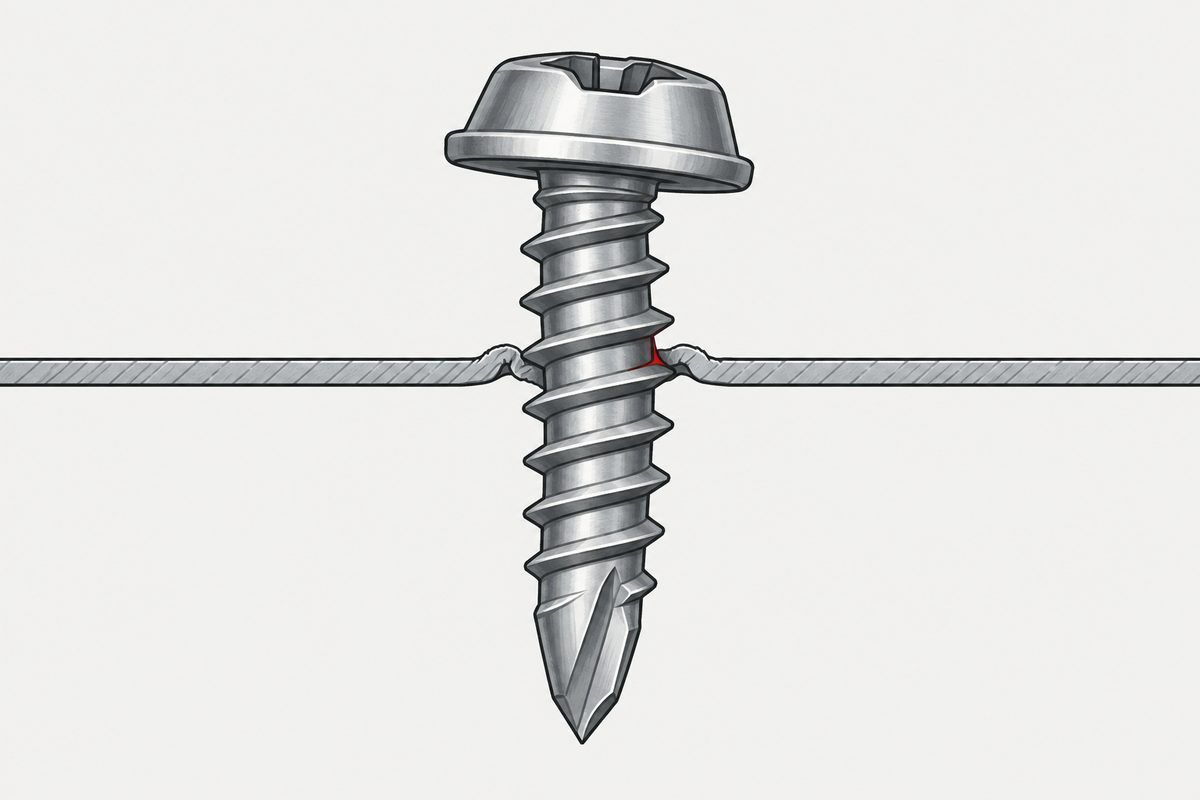
There is a thickness below which a tapping screw stops being a fastener and starts being a peg. The number most people quote for it — two threads of engagement — we could not find in any standard. The one that is in a standard is different, and simpler: the sheet has to be at least as thick as the thread pitch.
The floor that is actually written down
DIN 7975, which covers hole data for ISO 1478 ST tapping screws in metal, states it directly: the sheet thickness must be at least equal to the thread pitch. Below the engagement limit, the screw turns into the hole without developing driving torque at all — it does not thread, it wobbles in. The standard separately requires the total thickness of the joined sheets to exceed the pitch.
The rule you have heard is not a standard. “At least one and a half threads” and “at least two threads” are industry rules of thumb. We looked in DIN 7975, DIN 7500-2, ISO 1478, ISO 2702 and manufacturer engineering data and found no first-hand standard that sets them as a general requirement for sheet joints. The “1.5 threads” that turns up in NASA documents is about how far a locking insert protrudes, which is a different question entirely.
The thickness range each screw size is actually for
DIN 7975 tabulates the sheet thickness range for each ST size. This is the part worth having in front of you, because the lower limit moves with the screw size — it is not one number for the whole table.
| Size | From | To |
|---|---|---|
| ST2.2 | 0.8 | 1.8 |
| ST2.9 | 1.1 | 2.2 |
| ST3.5 | 1.3 | 2.8 |
| ST3.9 | 1.3 | 3.0 |
| ST4.2 | 1.4 | 3.5 |
| ST4.8 | 1.6 | 4.0 |
| ST5.5 | 1.8 | 4.5 |
| ST6.3 | 1.8 | 5.0 |
| ST8 | 2.1 | 6.5 |
| ST9.5 | 2.1 | 7.5 |
So the table as a whole runs about 0.8 to 7.5 mm. These are guideline values, not numbers that guarantee strength without testing, and the hole diameter itself depends on the sheet's tensile strength as well as its thickness.
Thread-forming screws do not have an equivalent floor. DIN 7500-2 gives hole diameters by material and engagement length, not a minimum thickness rule. Its 2016 edition removed the older short engagement steps and extends to 30 mm; public reproductions collapse the shortest into “2 mm and smaller”, and that 2 mm should not be read as a formal safety floor.
The remedy the standard names, and what it is actually worth
DIN 7975 explicitly lists flared or drawn pilot holes — extruded holes — as what you do when the sheet is not thick enough. It does not give dimensions for them.
Vendor engineering data does. And it is more modest than the figure that gets repeated.
- A worked TAPTITE II example puts 0.060 in sheet with at least 0.053 in of extrusion height, giving 0.113 in of total engagement — about 1.88 × the sheet thickness, which the manual describes as approaching twice.
- Mate gives a maximum forming height of 2.5 T from the underside of the sheet to the top of the extrusion. That is a limit against tearing, not a promise of 2.5 T of usable thread.
So “an extruded hole gives you two to three times the thickness” is not a citable rule. Something approaching 2 T under specific tooling and material is defensible. And whatever the formed height, you still have to subtract the entry radius, the wall thinning, the tapping chamfer and any incomplete threads before calling it engagement.
On strength: TAPTITE II claims nearly twice the failure torque and Mate claims up to twice the holding strength against a punched hole. Neither publishes the specimen material, sample size, scatter or raw pull-out data, and we found no independent dataset comparing flat and extruded holes at the same screw, material and thickness. Treat the multiple as a vendor engineering claim.
Countersinking thin sheet, where the geometry runs out first
If the countersink depth exceeds the sheet thickness, the cone breaks through the back face. That enlarges the bottom of the hole, removes the cylindrical wall and the remaining bearing section, and in the extreme leaves a knife edge. If the same sheet is also supposed to provide the thread, the engagement drops further.
No general standard rescues you here. ISO 7721 governs countersunk head form and its measurement; ISO 15065 and DIN 74 govern countersink dimensions and their designation. Those are geometric mating standards — none of them says a too-thin sheet still counts as a normal full countersink, and we could not find a general minimum-remaining-thickness rule in them, or in ASME B18.6.3.
Sheet work often uses a formed or dimpled countersink instead, but that is a different sheet-metal structure. A cut countersink that is too deep for the sheet is not the equivalent of it.
What actually changes as the sheet gets thinner
The direction is right and it is in the design codes. AISI S100 and EN 1993-1-3 already check screw tension and shear, pull-out, and pull-over or pull-through as separate limit states. Test work observes screw-hole extrusion, thread shear, pull-out and the sheet wrapping over the head as distinct modes.
It is tempting to put that more sharply — not a lower point on the same curve, but a different curve. That is a useful picture rather than a strict boundary. The modes compete continuously as thickness, hole diameter, pitch, head diameter, material strength and load direction change, and they can mix or hand over gradually. Thin-sheet pull-out still includes shear of the limited engaged thread, so it is not unrelated to stripping. And thick sections are not confined to stripping and screw fracture either — bearing, edge tearing and head-related failures exist there too.
So does a bigger screw fix it
We drafted a firm no. The evidence does not support a firm no.
- A larger thread outside diameter can raise some pull-out and bearing capacities.
- A larger head, or a washer, raises pull-over capacity directly. The AISI design equations list screw diameter and effective head diameter as favourable variables.
- But a larger size usually brings a larger hole and a coarser pitch. At a fixed sheet thickness that may not add any threads, and it can weaken the net section.
The honest version: going bigger is not a universal fix. It may raise some sheet-side capacities and it may not change the controlling failure mode, so it has to be checked mode by mode — pull-out, pull-over, and sheet deformation.
Where this connects
The type letter on the screw decides how the thread gets made in the first place: the letters on a tapping screw. The torque window in sheet is in tapping screw torque. When the parent genuinely cannot be the nut, the options are in when the parent cannot be the nut. And the countersink geometry itself is in countersunk hole dimensions.
References
- DIN 7975:2016 — §3.2 (sheet thickness at least equal to the pitch; flared or drawn pilot holes as the remedy), §3.4 (total joined thickness), Table 1 (thickness range by ST size), Table 2 (hole diameters by size, sheet tensile strength and thickness)
- DIN 7500-2:2016 — hole diameters by material and engagement length; no equivalent minimum thickness rule
- ISO 1478 — tapping screw thread; ISO 2702 — heat-treated tapping screws
- ISO 7721 (countersunk head form), ISO 15065 and DIN 74 (countersink dimensions), ASME B18.6.3 — searched for a minimum-remaining-thickness rule; none found
- AISI S100 and EN 1993-1-3 — screw tension and shear, pull-out, pull-over as separate limit states
- TAPTITE II technical manual; Mate Forming Solutions, tapping extrusion — extrusion heights and vendor strength claims
Guideline values are not a substitute for validation. Acceptance for any particular joint is governed by your drawing and your own testing.
The other way to put a thread in thin sheet is to press one in, and that has its own governing condition: a self-clinching fastener needs the panel to be softer than it is, which is a pairing the handbook rules out for all-stainless assemblies.
This page covers step 1, the substrate. The whole order is substrate, thread, head, drive, finish, documentation, and why doing it out of order is rework rather than a tweak is in specifying a screw.
Common questions
How thin can sheet be before a tapping screw stops working?
DIN 7975 states the sheet thickness must be at least equal to the thread pitch, and that the total thickness of the joined sheets must exceed the pitch. Below the engagement limit the screw turns into the hole without developing driving torque. The standard also tabulates a thickness range per ST size, from ST2.2 at 0.8 to 1.8 mm up to ST9.5 at 2.1 to 7.5 mm, so the floor moves with the screw size.
Is there a minimum number of threads of engagement?
Not one we could find in a standard. "At least one and a half threads" and "at least two threads" are industry rules of thumb; we looked in DIN 7975, DIN 7500-2, ISO 1478, ISO 2702 and manufacturer data without finding a first-hand standard that sets them as a general requirement for sheet joints. The 1.5 threads that appears in NASA documents refers to locking insert protrusion, which is a different question.
How much engagement does an extruded hole actually add?
Less than the figure usually quoted. A worked TAPTITE II example gives 0.060 in sheet plus at least 0.053 in of extrusion for 0.113 in total, about 1.88 times the sheet thickness, described as approaching twice. Mate specifies a maximum forming height of 2.5 T, but that is a limit against tearing rather than a promise of usable thread. Two to three times thickness is not a citable rule, and the entry radius, wall thinning, tapping chamfer and incomplete threads all have to come off before calling it engagement.
What happens if the countersink is deeper than the sheet?
The cone breaks through the back face, which enlarges the bottom of the hole, removes the cylindrical wall and the remaining bearing section, and in the extreme leaves a knife edge. ISO 7721, ISO 15065, DIN 74 and ASME B18.6.3 are geometric standards and none of them provides a remedy for this or a general minimum-remaining-thickness rule. Sheet work often uses a formed or dimpled countersink instead, which is a different structure, not an equivalent.
Will a bigger screw fix a thin-sheet joint?
Sometimes, and not as a rule. A larger thread outside diameter can raise some pull-out and bearing capacities, and a larger head or a washer raises pull-over capacity directly — AISI design equations treat screw diameter and effective head diameter as favourable. But a larger size usually means a larger hole and a coarser pitch, which at fixed sheet thickness may add no threads and can weaken the net section. It has to be checked mode by mode: pull-out, pull-over, and sheet deformation.
Enquiries
If you are working near the bottom of the thickness range, send the sheet material, thickness and how the hole is made. Whether it needs an extrusion, a different size, or something that is not a tapping screw at all is usually clear from those three.
Request a quotation
Tell us the part and the quantity. We will come back on feasibility, lead time and price.
Or email us directly sales@tigerfasteners.com