 TIGERFASTENERS
The letters on a tapping screw are not grades
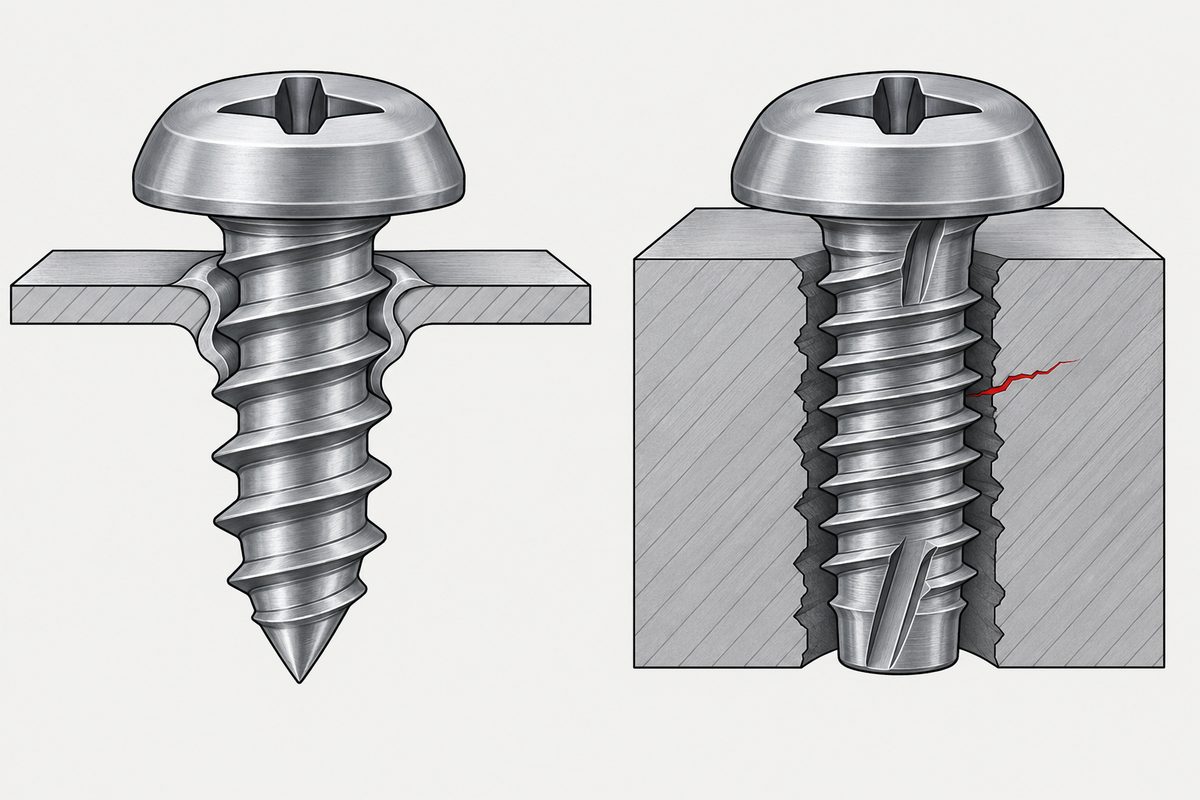
Type A, AB, B, BP, C, D, F, G, T. They look like a scale and they are not one. A Type F is not better than a Type B. Each letter fixes two independent things at once — which thread series the screw uses, and how that thread gets made in the parent — and it is the combination, not the letter's position in the alphabet, that has to match the job.
Where the letters live now
First a housekeeping point, because the obvious citation is out of date.
The type letters were in ASME B18.6.4, covering thread forming and thread cutting tapping screws in the inch series. That standard was merged into B18.6.3 in 2013 and is now a historical document. The current one is ASME B18.6.3-2024, Machine Screws, Tapping Screws, and Metallic Drive Screws (Inch Series).
On the history: the B18 committee was formed in 1922, jointly sponsored by SAE and ASME, with ASA B18.6 published in 1947, a dedicated tapping-screw standard in 1958, USA Standard status in 1966 and ANSI recognition in 1981. SAE J478 (2004) was superseded by B18.6.3-2013. We could not confirm the common claim that the letter system originated at SAE alone and then moved across, so we are not repeating it.
The two dimensions, which is the part worth learning
We drafted this article around a tidy split: coarse spaced threads that form, and machine-pitch threads that cut. That is wrong, and the exceptions are the interesting part. There are two independent axes.
| Forming | Cutting | Rolling | |
|---|---|---|---|
| Spaced thread | A, AB, B, BP | BF, BT | — |
| Machine-screw pitch | C | D, F, G, T | TRS |
The two cells in bold are the ones a neat dichotomy loses. Type C is a machine-screw pitch thread that forms, not cuts. And BF and BT are spaced threads that cut. If you carry “spaced means forming” around as a rule, those two will catch you out.
What each letter actually specifies
| Type | Thread | Point |
|---|---|---|
| A | Coarse spaced thread | Sharp gimlet point |
| AB | Same spaced thread as B | Gimlet point |
| B | Spaced thread | Blunt, with incomplete entering threads |
| BP | Same thread as B | A cone point extending beyond the incomplete entering threads |
| C | Machine-screw diameter-pitch, approximately Unified form | Blunt, tapered incomplete entering threads. Forming, not cutting |
| D | Machine-screw pitch | One flute |
| F | Machine-screw pitch | Multiple flutes; tapered entering threads complete or incomplete at the maker's option |
| G | Machine-screw pitch | Slotted point, incomplete entering threads |
| T | Machine-screw pitch | Wide milled cutting slot; flute included angle 90° to 95°, cutting edge above the screw axis |
So A against AB — the two that look most alike — differ mainly in the pitch series, not the point. Both have a gimlet point; AB uses B's spaced thread.
Two types the standard steers you away from, and not the ones you would guess
- Type A. ASME states that AB has the wider application range and recommends AB over A; A sizes are given for reference only. Machinery's Handbook puts it more directly: use AB for new design, and substitute AB for A in existing designs where you can. But the standard's own wording is recommended over, not superseded — Type A has not disappeared from the standard.
- Type C is the one explicitly marked not recommended for new design, on the grounds of declining usage and the generally higher driving torque it needs. That surprised us: C is a thread-forming type with a machine-screw pitch, which sounds like the modern choice.
D, F, G and T are not listed as obsolete, so do not carry over a general impression that the cutting types are legacy.
The metric side, and a letter collision that will bite you
ISO uses a different field entirely. ISO 1478 gives a metric tapping-screw thread size series — ST2.9, ST3.5, ST4.2 and so on — specifying pitch, diameter, the 60° thread form and the thread end. That is a size series, not a functional type. It does not map onto an ASME letter.
And the trap. ISO also uses the letters C and F, for cone end and flat end. Those are not ASME's Type C and Type F. A bare “Type C” on a metric drawing is genuinely ambiguous, and the two readings are a forming screw and an end shape.
There is also no official conversion table between ST sizes and the type letters. ISO 1478:1999 Table 1 does relate ST sizes to the older #0, #1, #2 thread numbers, but explicitly for information only. Any letter-to-ST chart you find online is a supplier comparison, not an equivalence.
On a metric drawing, call up the applicable ISO product standard, the ISO 1478 ST size, and the point type that product standard requires. The standard's own example is written ISO 1478 – ST3,5, with the point type specified in the product designation; a pan head, for instance, comes from ISO 7049.
What the letters do not tell you
We wanted to end on a line: the letters encode the material and the hole, so getting them wrong gives you exactly two failures — it will not bite, or it splits the part. Both halves of that turned out to be too strong.
The letters specify the thread, the point and how the thread is made. They do not encode a particular material with a particular hole condition. What actually happens also depends on hole diameter, the parent's hardness and ductility, thickness or boss geometry, engagement length, finish, and how it is assembled.
And the failure list is longer than two. Alongside failing to start and cracking the part, a mismatch can give you stripped internal threads, a broken screw, a collapsed boss, driving torque too high to seat the screw, insufficient clamp load, stress cracking or creep, and chip-related problems.
So the honest version is the one that is still useful: the letter is a description of the screw's geometry and method, not a grade. It has to be matched to the joint, and the matching is a separate job the letter does not do for you.
Where this connects
How the four routes into a parent differ, and why swarf is a reliability question, is in choosing a screw type. The forming route into metal, including the hole tolerance it needs, is in thread-forming screws into metal. For plastics, see screws for plastic, and for the torque window, tapping screw torque. Where this decision sits among the rest is in specifying a screw. The numbered types you also see in catalogues — 1, 23, 25 — are in the numbers are old names, which is also where type 17 turns out to belong to a different standards family.
References
- ASME B18.6.3-2024 — Machine Screws, Tapping Screws, and Metallic Drive Screws (Inch Series); current standard
- ASME B18.6.4-1998 (R2005) — merged into B18.6.3 in 2013; historical
- ASME B18.6.3-2013 §4.1, §4.1.1.1–4.1.1.5, Table 44 notes — type descriptions and the not-recommended notes
- ASME B18.12 — type definitions for the fluted and slotted points
- ISO 1478:1999 — tapping screws thread, ST size series, thread ends; Table 1 informational mapping to older thread numbers
- ISO 7049:2011 — example of a product standard carrying the point type
- Machinery's Handbook, 31st edition — AB for new design
- SAE J478 (2004), superseded by ASME B18.6.3-2013
Acceptance for any particular part is governed by your drawing and the standards it invokes.
This page covers step 2, the thread. The whole order is substrate, thread, head, drive, finish, documentation, and why doing it out of order is rework rather than a tweak is in specifying a screw.
Common questions
What do the type letters on a tapping screw mean?
They describe the screw, not its quality. Each letter fixes two independent things: whether the screw uses a spaced thread or a machine-screw pitch, and whether the mating thread is formed, cut or rolled. A, AB, B and BP are spaced threads that form; BF and BT are spaced threads that cut; C is a machine-screw pitch that forms; D, F, G and T are machine-screw pitches that cut. A Type F is not a better screw than a Type B.
Which standard defines Type A, AB, B, C and F?
They were in ASME B18.6.4, covering thread forming and thread cutting tapping screws in the inch series. That standard was merged into B18.6.3 in 2013 and is now historical. The current document is ASME B18.6.3-2024, Machine Screws, Tapping Screws, and Metallic Drive Screws (Inch Series).
Is Type A obsolete?
Not exactly. ASME notes that AB has the wider application range and recommends AB over A, giving A sizes for reference only, and Machinery’s Handbook advises AB for new design. But the standard’s wording is "recommended over", not superseded, and Type A has not been removed. The type actually marked not recommended for new design is Type C, because of declining usage and the generally higher driving torque it needs.
How do ASME type letters relate to ISO 1478 ST sizes?
They are different fields. ISO 1478 gives a metric thread size series — ST2.9, ST3.5, ST4.2 and so on — specifying pitch, diameter, the 60 degree form and the thread end. That is a size series, not a functional type, and there is no official conversion to the ASME letters. ISO 1478:1999 Table 1 relates ST sizes to older thread numbers for information only. Charts online that map letters to ST sizes are supplier comparisons.
Should a metric drawing name a type letter such as Type C?
Better not to. ISO also uses C and F, for cone end and flat end, which are not ASME Type C and Type F, so a bare letter is ambiguous. On a metric drawing call up the applicable ISO product standard, the ISO 1478 ST size, and the point type that product standard requires — the standard’s own example is written ISO 1478 – ST3,5, with a pan head coming from ISO 7049.
Enquiries
If a drawing you have been given specifies a type letter with no standard beside it, send it over. Which system it came from usually settles quickly, and it changes what you would quote.
Request a quotation
Tell us the part and the quantity. We will come back on feasibility, lead time and price.
Or email us directly sales@tigerfasteners.com