 TIGERFASTENERS
The all-stainless clinch assembly is the combination the handbook rules out
Read about seven minutes. A self-clinching nut is specified by a hardness difference rather than by a strength, because the sheet is what holds it. PennEngineering publishes two tables a page apart: the hardest sheet each fastener material can go into, and how hard common sheets actually are. Read them together and the all-stainless enclosure — the thing you would specify for corrosion — is the combination that does not work.
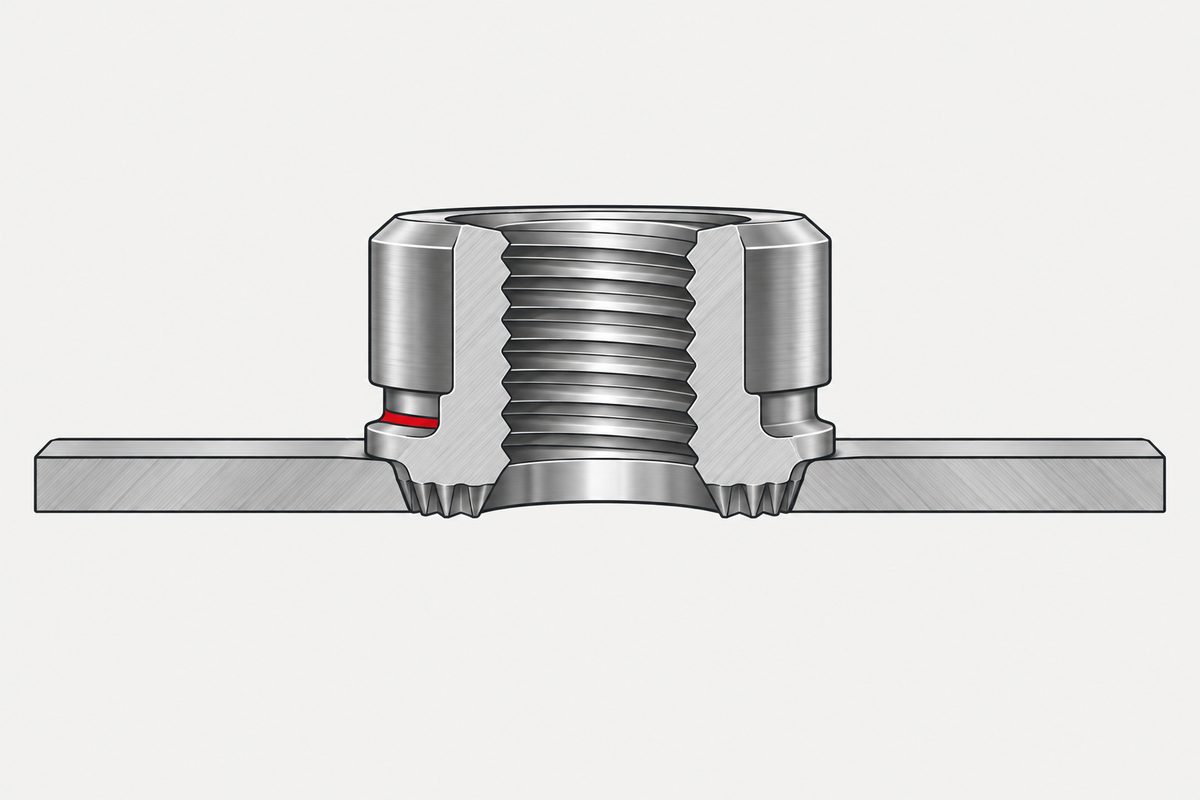
The sheet holds the fastener, not the other way round
A self-clinching nut has no thread in the panel and no weld. It is pressed into a plain round hole, and the panel material is displaced into an undercut around the fastener body. PennEngineering’s handbook labels the mechanism on its cutaway in four words: host metal flows into undercut.
That single sentence sets everything else. If the panel has to flow, the panel has to be the softer of the two. So the governing specification for this part is not a strength or a class. It is a difference in hardness between a component you buy and a sheet you already chose, and only one of those appears on the purchase order.
Two tables, printed a page apart
The handbook gives the ceiling first — the hardest sheet each fastener material is rated to go into:
| Fastener material | Maximum sheet hardness |
|---|---|
| Aluminum | < HRB 50 / HB 89 |
| Unhardened steel | < HRB 60 / HB 107 |
| 300 series stainless steel | < HRB 70 / HB 125 |
| Hardened steel | < HRB 80 / HB 150 |
| Hardened stainless steel | < HRB 88 (92) / HB 183 (202) |
Then it gives what common sheets actually measure:
| Sheet material | Typical hardness |
|---|---|
| 5052-H32/34 aluminium | HRB 15–30 / HB 30–65 |
| Cold-rolled steel | HRB 40–75 / HB 80–140 |
| 6061-T6 aluminium | HRB 50–55 / HB 89–96 |
| 304 stainless steel (annealed) | HRB 80+ / HB 150+ |
| HSLA steel | HRB 80–85 / HB 150–169 |
Two notes before using them. The handbook flags HSLA steel itself as a material that does not follow the typical rules, without saying why, so it sits in the table with a warning attached rather than as an ordinary row. And the second table’s column headers read “Fastener Material / Sheet Hardness” while its rows are plainly sheet materials — the label is wrong in the source. We are reproducing it as printed rather than quietly correcting it, because a reader checking our tables against the handbook should find what we found.
Read across, and one row cancels another
A 300 series stainless fastener is rated for sheet below HRB 70. Annealed 304 stainless sheet is HRB 80 and up. The ceiling is below the floor, so that pairing is outside the recommendation before any other question is asked.
That is worth sitting with, because it is the combination an engineer reaches for on purpose. A stainless enclosure gets stainless hardware so the assembly does not have two metals in it and does not rust at the fixings. The reasoning is sound and the corrosion outcome is real. The installation is the part that fails, and it fails on a number printed in the supplier’s own handbook.
We did not have to infer it. The same handbook states the conclusion directly in its list of practices:
Do use proper alloy (A286/400 Series) stainless fasteners in stainless steel sheets. 300 Series fasteners do not provide adequate differential hardness for best performance.
So there are two routes to the same place. A reader can derive it from the two tables, and the manufacturer writes it out on another page. When a document lets you reach its conclusion independently and then confirms it, that is a document worth reading properly rather than skimming for the dimension you came for.
The corrosion choice narrows the installation window
Line the two tables up by material and the shape of the trade appears. Going up the fastener list buys a harder sheet, and the materials chosen for corrosion resistance are not the ones at the top:
| If you pick this fastener | Sheets it covers |
|---|---|
| Aluminium, < HRB 50 | 5052 aluminium only |
| Unhardened steel, < HRB 60 | plus 6061-T6, part of cold-rolled range |
| 300 series stainless, < HRB 70 | most cold-rolled steel; not stainless sheet |
| Hardened steel, < HRB 80 | all of the cold-rolled range |
| Hardened stainless, < HRB 88 | reaches into stainless and HSLA |
The 300 series row is the one that catches people, because 300 series is what “stainless fastener” usually means when nobody specifies further. It buys the corrosion behaviour and it does not buy the hardness, and those two are not sold separately.
The fix is disqualified by the reason you wanted it
The obvious move is to take the handbook’s advice and order 400 series. PennEngineering has a dedicated note about exactly that, in its stainless steel product catalogue, and it is worth reading to the end:
In order for self-clinching fasteners to work properly, the fastener must be harder than the sheet into which it is being installed. In the case of stainless steel panels, fasteners made from 300 Series Stainless Steel do not meet this hardness criteria. It is for this reason that 400 series fasteners are offered… However, while these 400 Series fasteners install and perform well in 300 Series stainless sheets they should not be used if the end product: • Will be exposed to any appreciable corrosive presence. • Requires non-magnetic fasteners. • Will be exposed to any temperatures above 300°F (149°C)
Read the first bullet against the reason the enclosure was stainless. The 400 series part exists because 300 series cannot install into stainless sheet, and it must not be used where there is appreciable corrosion. So the fastener that goes into your stainless panel is ruled out by the thing that made you choose a stainless panel.
That is not a contradiction in the handbook. It is a genuinely constrained problem, stated honestly by the party selling the parts, and the honest ending is that there may not be a catalogue answer. The note closes by asking you to contact their technical support for other options, which is what a supplier writes when the table has run out. Two further disqualifiers sit alongside corrosion in that list, and both are easy to miss on an electronics enclosure: a 400 series part is magnetic, and it is out of scope above 149 °C.
Two ways a panel leaves the range after you specified it
Both are in the same list of practices, and both happen after the drawing is approved.
Beware of processes such as hard coat anodizing and nitriding that might increase panel hardness. This might make it more difficult to install self-clinching fasteners.
A panel that was inside the window when it was specified can be outside it by the time it reaches assembly, because a surface process was added for a reason that had nothing to do with the fasteners. The hardness that matters is the hardness at installation, not the hardness of the material as ordered.
The tabulated sheet figures carry the same caution from the other direction. HRB 80+ for annealed 304 is a typical value for the material, not a measurement of your panel, and forming the panel moves it: a cross-check pointed us to PennEngineering’s warning that punching, laser cutting, bends and cold working can harden the area around the hole — which is the area the fastener has to flow.
Plating has an ordering rule rather than a hardness one:
When using steel panels, install plated fasteners after panel is plated. Otherwise install unplated fasteners into panel if entire assembly is going to then be plated.
Either sequence works and the mixed one does not, which makes this a scheduling constraint between two suppliers rather than a property of either part. Our page on sheet too thin to hold a thread covers the other end of the same problem, where the panel cannot carry a thread at all.
What this page did not establish
- This is one manufacturer’s guidance, though not only one. Every number and quotation above is PennEngineering’s, published for its own products, and it is not a standard. A cross-check found two other makers publishing comparable ceilings — aluminium around 50, 300 series stainless 70, carbon steel 80 — with variation of a few points by product family, one listing 85 where PEM gives a generic 80 and another 90 where PEM writes 88 (92). We did not verify those ourselves. The agreement is close enough to suggest the shape is general and loose enough that the exact ceiling belongs to the part you are actually buying.
- No sheet thickness or edge distance appears here. The handbook says those live in the individual catalogue bulletins, which we did not read. Hardness is only one of the panel conditions and this page covers only that one.
- “Do use” is guidance, not a guarantee. The handbook recommends A286 or 400 series into stainless sheet. It does not promise a result, and nothing here says a particular combination will pass your own testing.
- Why HSLA is different is not explained. The handbook flags it as not following the typical rules and leaves it there. We are not filling that in.
- The header mismatch is reproduced, not diagnosed. We do not know whether the second table’s column label is a typesetting slip or something else, and we did not ask.
One thing does narrow that dead end: the hardness window belongs to self-clinching as a mounting method, and two other ways of retaining a captive screw deform the fastener instead of the panel.
This is not one of the six steps. It shows up across them, or after assembly. Where the decisions that lead here were made is in specifying a screw, which sets out the order and why doing it out of order is rework.
Common questions
Why does a self-clinching fastener need a soft sheet?
Because the sheet is what holds it. The fastener is pressed into a plain hole and the panel material is displaced into an undercut around the fastener body — PennEngineering’s handbook labels it "host metal flows into undercut". If the panel has to flow, the panel has to be softer than the fastener, so the governing specification is a hardness difference rather than a strength.
Can I use a stainless self-clinching nut in a stainless panel?
Not in 300 series. PennEngineering’s table caps 300 series stainless fasteners at sheet below HRB 70, and its own table of typical sheet hardness puts annealed 304 stainless at HRB 80 and up. The handbook also states it directly: use proper alloy A286 or 400 series stainless fasteners in stainless sheets, because 300 series fasteners do not provide adequate differential hardness for best performance.
What is the maximum sheet hardness for each fastener material?
PennEngineering’s handbook gives aluminium below HRB 50, unhardened steel below HRB 60, 300 series stainless below HRB 70, hardened steel below HRB 80, and hardened stainless below HRB 88 (92). Those are that manufacturer’s figures for its own products, not a standard, and hardness is only one of the panel conditions.
Does anodizing or nitriding the panel matter?
Yes, and it happens after the drawing is done. The handbook warns that processes such as hard coat anodizing and nitriding might increase panel hardness, which might make self-clinching fasteners more difficult to install. The hardness that decides the outcome is the hardness at installation, not the hardness of the material as ordered.
Should the fastener go in before or after plating?
Either order works so long as it is consistent. The handbook says that with steel panels you install plated fasteners after the panel is plated, or install unplated fasteners into the panel if the entire assembly is going to be plated afterwards. It is a sequencing constraint between two suppliers rather than a property of either part.
Is HSLA steel treated the same way?
The handbook lists HSLA steel at HRB 80 to 85 and marks it as a material that does not follow the typical rules, without giving a reason. We are reporting the flag rather than explaining it, because the source does not explain it either.
References
The handbook was downloaded from pemnet.com, converted with pdftotext and read directly; both tables and all four quotations above are taken from it. It is a manufacturer’s published guidance for its own products rather than a standard, and we have not checked whether other makers of self-clinching fasteners publish the same ceilings, so nothing here should be read as an industry-wide figure. The second table is reproduced as printed, including its column header reading "Fastener Material" above rows that are plainly sheet materials; we do not know why and did not correct it. The observation that a 300 series fastener capped at sheet below HRB 70 cannot take annealed 304 sheet at HRB 80 and up is a comparison of the handbook’s own two tables, and it agrees with the handbook’s separate instruction to use A286 or 400 series alloys in stainless sheet — the two routes are reported together rather than presented as an original finding. No minimum sheet thickness or edge distance appears on this page: the handbook places those in individual catalogue bulletins, which we did not read.
Enquiries
If an enclosure is stainless and the hardware has to be stainless too, the alloy is the question to settle first, before the thread size. It changes what you can order and when it arrives.
Request a quotation
Tell us the part and the quantity. We will come back on feasibility, lead time and price.
Or email us directly sales@tigerfasteners.com