 TIGERFASTENERS
The hardness limit belongs to the mounting method, not to the part
Read about six minutes. Our page on self-clinching fasteners ended on a real dead end: the panel has to be softer than the fastener, an all-stainless assembly fails that test, and the alloy that passes it is disqualified by the corrosion resistance you wanted stainless for. That conclusion is correct and it is narrower than it looks. The hardness window belongs to one way of mounting, and there are two others.
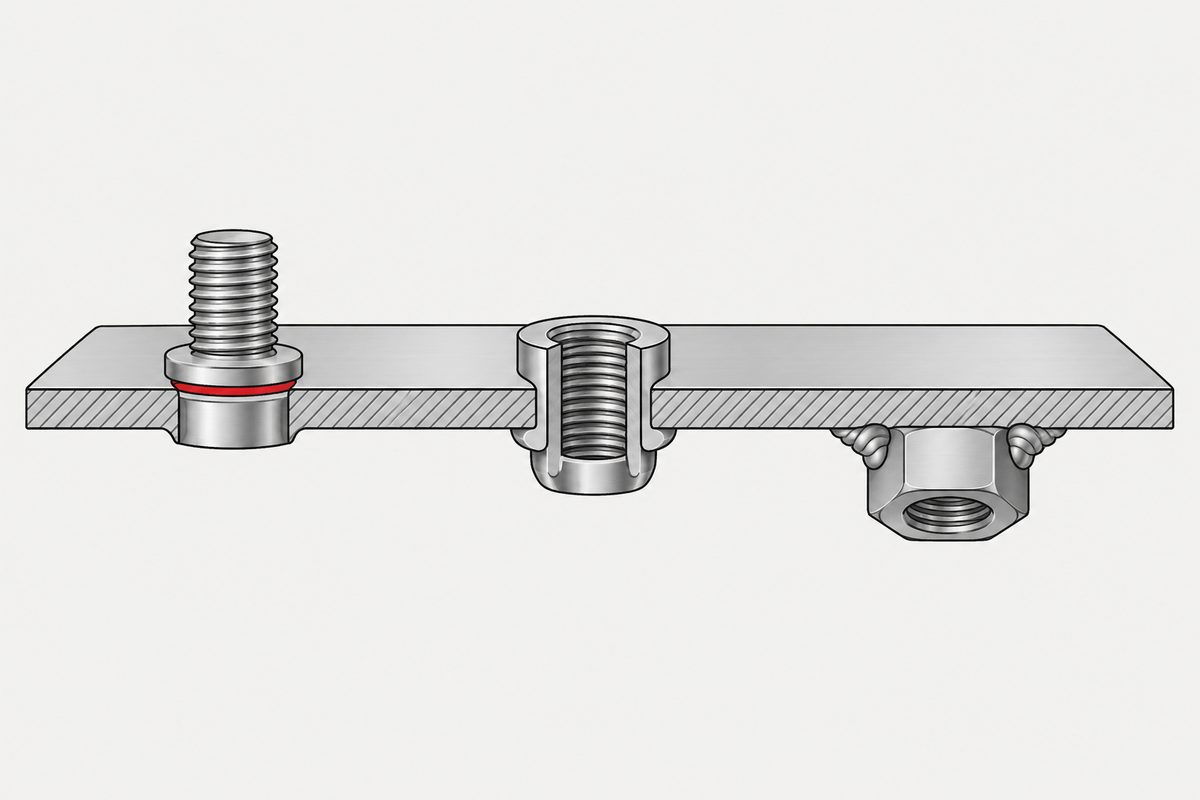
Where the previous page stopped
A self-clinching fastener is held by the panel: it is pressed into a plain hole and the panel material flows into an undercut. Everything follows from that, including the constraint we traced to its end — the panel has to be the softer of the two, so the fastener material sets a ceiling on the panel you may install into.
That page finished honestly and unhelpfully: for a stainless panel there may be no catalogue answer. What it did not ask is whether the constraint is a property of self-clinching or a property of captive fasteners in general. It is the first one.
Three mounting styles, and only one of them deforms the panel
A captive panel screw — a screw held permanently in the panel so it cannot be dropped into the equipment when the cover comes off — is retained by a component that has to be attached to the panel somehow. Trade coverage of the category describes three ways of doing that:
| Style | What deforms | Consequence |
|---|---|---|
| Self-clinching | the panel | panel must be softer than the fastener |
| Flare-mounted | the retainer | no hardness difference required |
| Float / flare-mounted | the retainer, over a washer | as above, plus float for misalignment |
The middle column is the whole article. Self-clinching asks the panel to flow, so the panel must be able to. Flaring squeezes the end of the retainer instead, and the retainer is a part the supplier controls. Nothing is being asked of the panel except that it have a hole.
Treat those three as the common grouping rather than an exhaustive taxonomy. They are how the category is usually described, not a list anyone has certified as complete.
Captive means it will not be lost, not that it will not loosen
The word does a lot of work and it is worth pinning down, because it names one property and people hear two. A captive screw is retained in the panel: back it out fully and it stays with the cover instead of falling into the equipment. That is the whole claim.
It says nothing about the screw staying tight. A cross-check pointed us to Howmet’s troubleshooting material for panel fasteners, which states that a captive screw assembly can still back out of the mating part under vibration and can fully disengage the mating thread, and that a locking washer or self-locking nutplate is the answer to that. We have not read that page ourselves and are reporting it as a lead, but the distinction it draws is the one the word invites people to miss: retention in the panel and resistance to loosening are two mechanisms, and buying the first does not buy the second.
The same cross-check found documented ways the retention itself fails — an oversized hole or a panel too hard or too thin leaving the clinch incomplete, over-pressing reducing retention rather than improving it, a flare that never forms because the countersink or tool alignment was wrong, and exposed split retainer rings being dislodged. So captive is a function of correct installation, not a property that arrives in the box.
What the sources actually claim
Two sentences carry the argument, and both are worth reading exactly rather than paraphrased:
Flare-mounted panel fasteners with captive screws can be specified for use in virtually any thin material of any hardness.
Float/flare-mounted style fasteners can install into any thin panel material (including printed circuit boards), regardless of panel hardness.
Note “virtually” in the first and the parenthesis in the second. Printed circuit board is a useful thing to name, because it is not a metal at all — a mounting method that works in laminate is clearly not relying on the substrate to flow into anything.
These are descriptions of what a product family is positioned to do, published as trade coverage rather than as a manufacturer’s data sheet or a standard. That is a weaker source than this site normally builds on, and it is the reason this page states a direction rather than a specification.
The thickness figure, and one that does not add up
Two numbers appear alongside those claims. One converts cleanly and one does not, and checking both takes a calculator:
| As printed | Inches × 25.4 | Result |
|---|---|---|
| 0.036 in. (0.92 mm) | 0.914 | agrees |
| 0.81 in. (2.06 mm) | 20.574 | does not agree |
| 0.081 in. (2.06 mm) | 2.057 | agrees |
The first is a minimum sheet thickness quoted for one basic type of self-clinching captive screw assembly: 0.036 in., 0.92 mm. The conversion holds, so both halves of that figure say the same thing.
The second is the float available in the mounting hole on the float/flare style, printed as 0.81 in. (2.06 mm). Those are not the same length. Eight tenths of an inch is over 20 mm, which would be a remarkable amount of float in a panel fastener. Move the decimal one place and 0.081 in. gives 2.057 mm, which matches the metric figure to the printed precision. We are not claiming to know what the source intended; we are saying the two halves disagree and only one reading makes them agree. Nor is 0.081 a category figure: a cross-check put the range across brands at roughly 0.060 to 0.090 in., with no single industry value.
It is worth doing that check on any figure that arrives in two units. A dual-unit number is its own verification, and it costs one multiplication to use.
What this changes about the earlier conclusion
The stainless problem does not go away; it moves. If the fastener has to be self-clinching — because the design wants nothing protruding on the back face, or because that is what the assembly line installs — the hardness ceiling is real and the previous page’s ending stands. What changes is that this is a consequence of choosing that mounting method, and the method is a decision rather than a given.
That reframing is the useful part when a specification runs out of options. The question to ask is not only which part meets the requirement, but which of the requirement’s constraints came from the part class and which came from a choice made earlier and quietly. The same move appears in the stud-versus-bolt argument, where two questions had been collapsed into one word.
What this page did not establish
- The main source is trade coverage. The three mounting styles, both quoted claims and both numbers come from an industry publication rather than a manufacturer’s technical document or a standard. Every previous page in this series rested on something stronger, and the difference is stated here rather than smoothed over.
- “Any hardness” is positioning, not a guarantee. The first quotation says virtually any thin material of any hardness. That is a description of what the family is for. It is not a promise about a particular panel, and no test data is offered with it.
- 0.92 mm is one type, not the category. The source attributes that minimum to one basic type of captive panel screw assembly. Nothing here says it applies to self-clinching captive screws generally, and we found no published minimum for the flare-mounted styles.
- We did not resolve the float discrepancy. We can show that 0.81 in. and 2.06 mm are different lengths and that 0.081 in. reconciles them. Which the source meant is a question for the source.
- Standards exist for part of this category, and we read none of them. A cross-check reports that military and aerospace captive screws are covered by NAS and MS specifications, while the panel thickness, retainer, float, installation tooling and performance of commercial spring-loaded assemblies are set by manufacturer catalogues. So “no standard” would be wrong and “a standard governs this” would be wrong; which of the two applies depends on which market the part is from.
This is not one of the six steps. It shows up across them, or after assembly. Where the decisions that lead here were made is in specifying a screw, which sets out the order and why doing it out of order is rework.
Common questions
Does a captive panel screw always need a soft panel?
No. That requirement belongs to the self-clinching mounting style, where the panel material is displaced into an undercut and therefore has to be softer than the fastener. Flare-mounted and float/flare-mounted styles deform the retainer instead of the panel, and trade coverage of the category describes them as usable in thin material of any hardness.
What is the difference between flare-mounted and float/flare-mounted?
Both deform the end of the retainer rather than the panel. The float version deforms it over a washer, which leaves the assembly free to move slightly in the mounting hole so it can take up misalignment with the mating thread. That float is quoted as up to 2.06 mm, though the inch figure printed alongside it does not convert to that.
What is the minimum panel thickness for a captive panel screw?
One published figure is 0.036 in., 0.92 mm, and the source attributes it to one basic type of self-clinching captive panel screw assembly rather than to the category. The conversion checks out. We found no published minimum for the flare-mounted styles.
Can a captive screw be installed into a printed circuit board?
The float/flare-mounted style is described as installing into any thin panel material including printed circuit boards, regardless of panel hardness. That is consistent with the mechanism: if the retainer is what deforms, the substrate is not being asked to flow, so it does not have to be metal.
Does this contradict the page on self-clinching hardness limits?
No, it narrows it. That page is about what happens when the panel is the thing being deformed, and its conclusion holds whenever self-clinching is the mounting method. This page adds that the mounting method is itself a choice, so a hardness ceiling reached that way is a consequence of the choice rather than a property of captive fasteners.
References
- Design World, Turning to captive panel screws — the three mounting styles, the statements that flare-mounted and float/flare-mounted styles suit thin material of any hardness, the 0.036 in. (0.92 mm) minimum sheet thickness, and the float figure whose two units do not agree
- Our earlier page on self-clinching fasteners — where the hardness ceiling comes from and why an all-stainless assembly runs out of options
This page rests on a single industry publication, which is a weaker foundation than the manufacturer handbooks and vendor technical guides the rest of this series used, and that is why it argues a direction rather than quoting a specification. The three mounting styles, both quoted sentences and both dimensional figures are from that one source. The arithmetic is ours and can be repeated: 0.036 × 25.4 = 0.914, so the 0.92 mm printed beside it agrees; 0.81 × 25.4 = 20.574, which is not the 2.06 mm printed beside it, while 0.081 × 25.4 = 2.057, which is. We report that the two halves of the float figure disagree and that one reading reconciles them, without claiming to know which the source intended. No manufacturer data sheet was read for this page and no standard was consulted, so whether captive panel screws are covered by any published standard is left open.
Enquiries
If a cover has to come off in service without anything falling into the equipment, the useful thing to tell us early is what the panel is made of and whether anything may protrude on the back face. Those two answers pick the mounting style, and the mounting style decides which constraints you inherit.
Request a quotation
Tell us the part and the quantity. We will come back on feasibility, lead time and price.
Or email us directly sales@tigerfasteners.com